

Behind the News
Iran Is Weak. The U.S. Is Ready. So Why No Strike?
Escalation risks and strategic leverage are driving U.S. restraint despite intelligence assessments that Iran’s regime is unusually vulnerable
- Brian Racer
- | Updated
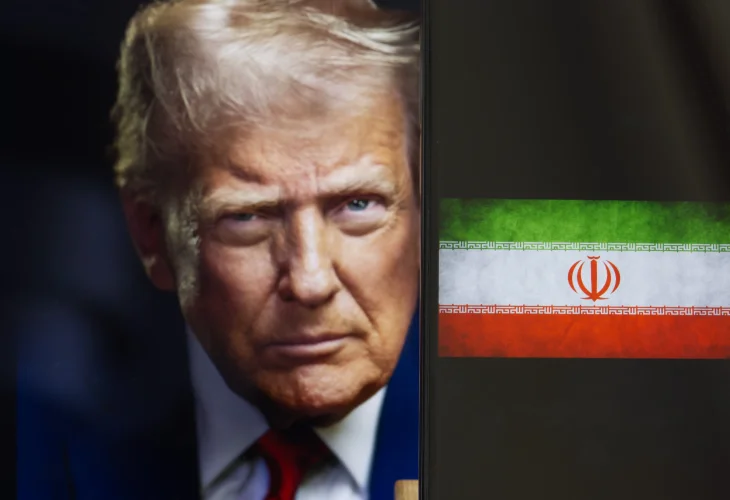 Trump and Iran (Shutterstock)
President Donald Trump said on Monday that the situation with Iran is “in flux,” even as the United States has moved what he described as a “big armada” into the region. U.S. officials say military options are real and increasingly immediate. Yet as of now, no strike has been ordered.
The hesitation is notable because U.S. intelligence assessments circulated over the past several days indicate that Iran’s leadership is at its weakest point since the 1979 Islamic Revolution. Protests that erupted late last year shook pillars of regime support, reached areas long viewed as loyal to Supreme Leader Ayatollah Ali Khamenei, and exposed deep economic and political strain. While the demonstrations have largely been suppressed in recent weeks, U.S. officials say the regime’s underlying fragility has not been resolved.
At the same time, the U.S. military has continued to expand its posture in the region. Earlier this week, the aircraft carrier USS Abraham Lincoln entered U.S. Central Command’s area of responsibility, accompanied by warships equipped with Tomahawk missiles. The Pentagon has also dispatched additional F-15 and F-35 fighter jets, refueling aircraft, and air defense systems, while placing long-range bombers on heightened alert. Senior U.S. commanders have stepped up coordination with Israel and other regional partners in recent days, including high-level consultations between U.S. Central Command chief Brad Cooper and Israeli defense officials.
Trump has signaled both pressure and restraint. In an interview published Monday by Axios, he highlighted the carrier deployment while declining to discuss which military options have been presented to him. At the same time, he said diplomacy remains possible,He also said diplomacy remains possible, insisting that Tehran wants to engage. “They want to make a deal. I know so. They called on numerous occasions,” Donald Trump said. Several hours later, a senior U.S. official told reporters that Washington remains “open for business” on negotiations, provided Iran accepts long-standing U.S. conditions, including removing enriched uranium, limiting missile capabilities, halting support for regional proxies, and ending independent uranium enrichment.
Humanitarian pressure has also intensified in recent days. The Iranian human rights organization HRANA reported this week that the death toll from clashes during the crackdown is likely greater than 23,000, including 6,126 confirmed deaths and 17,091 cases under review. HRANA said 11,009 people were seriously wounded and 41,880 were arrested. The figures have fueled renewed calls for U.S. action, particularly from hawkish lawmakers who argue that Washington has a moral obligation to respond.
Despite that mounting pressure, U.S. officials and analysts say the central reason for restraint is the risk of triggering a much wider war that Washington may not be able to contain. Iranian officials have warned in recent statements that any American strike, even a limited one, would be treated as an “all-out war,” with retaliation likely against Israel, U.S. forces across the region, and key shipping routes. U.S. officials say allies have urged caution, warning that once a strike begins, escalation could unfold rapidly and on multiple fronts, leaving little room to control the pace or scope of the conflict.
Domestic political considerations reinforce that calculation. Trump has consistently tried to avoid open-ended wars in the Middle East, particularly ones that could draw U.S. forces into prolonged fighting. Instead, the administration has leaned on sanctions, military pressure, and diplomacy to weaken adversaries without triggering full-scale war. The current carrier deployments and heightened readiness allow Washington to apply pressure immediately while stopping short of conflict, preserving leverage now while keeping military options available if conditions change.
For now, U.S. officials say the military is prepared to act if ordered, and additional consultations are expected this week. The pause appears deliberate. U.S. officials believe sustained pressure rather than an immediate strike, can force concessions from a weakened enemy, while still keeping the option of rapid escalation on the table if circumstances change.

