

Behind the News
Israel’s Largest Recovery Operation: How Ran Gvili Was Finally Located
Unrelated decisions made months earlier, followed by intelligence reversals and a massive recovery effort, enabled Israel’s largest operation in Gaza
- Brian Racer
- | Updated
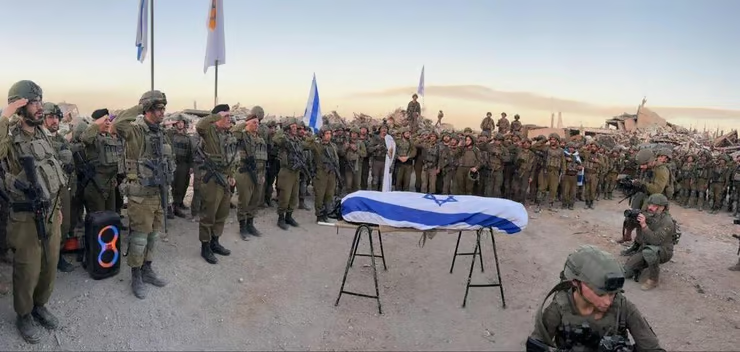 Gvili's body returned (Used in Accordance with 27a)
The return of Ran Gvili’s body was not the product of a last-minute raid or a single intelligence breakthrough. It followed months of one of the largest recovery operations Israel has carried out during the war, involving the removal of roughly 700 bodies and forensic examination of around 250 bodies under combat conditions in Gaza. The operation combined combat maneuvering, engineering work, intelligence collection, and industrial-scale forensic screening across a live combat zone, including inside an active cemetery. In scale and logistics, it resembled a disaster-response effort more than a conventional counterterrorism raid. Gvili’s identification has already been reported. This is how Israel reached the point where that recovery was possible.
The foundation for that effort was laid months earlier, long before any intelligence suggested that Gvili might be buried at the site. Fighters operating in northern Gaza approached the Southern Command with a request to expand the “yellow line,” the operational boundary defining areas under Israeli control. The request was not linked to hostages or missing soldiers but driven by force-protection concerns. The area included a Muslim cemetery, later identified as the Al-Bats cemetery in the Shuja’iya neighborhood of northern Gaza, which posed a risk to troops due to terrain, concealment, and suspected underground infrastructure.
The Southern Command chief approved the request, quietly shifting the yellow line. Israeli forces then began operating freely in the area, including inside the cemetery, where engineering units destroyed a tunnel for operational and force-protection reasons. At the time, none of these actions were connected to any assessment about Gvili’s burial location.
Only later did intelligence begin to catch up to the operational reality on the ground. Information pointing to the cemetery as a possible burial site initially carried a low probability assessment. Other hypotheses were considered more likely, including tunnels and hospital sites deeper inside Gaza. Over time, those alternatives were examined and ruled out.
As part of the intelligence effort, Shin Bet forces extracted several Gazans from the Strip for interrogation. Their questioning helped narrow the focus to a specific sector of the cemetery. Additional intelligence inputs reinforced the assessment. Gradually, the probability crossed the 50 percent threshold that decision-makers require to approve a major operation.
The intelligence shift did not immediately trigger action. In the months leading up to the operation, the political echelon hesitated to authorize a search at the cemetery. Officials hoped Hamas might eventually return the body and worried that acting too soon could close off other channels for securing his return.
Underlying the hesitation was a deeper national fear, the possibility that bodies of Israeli hostages could disappear permanently in Gaza, creating additional “Ron Arads.” That fear hovered over the process even as intelligence confidence increased.
Once intelligence and operational conditions aligned, the window opened. Forecasts of heavy rain added urgency, raising the risk that flooding could complicate or even prevent excavation. Operation “Lev Amitz” was approved and launched. Hundreds of troops were deployed to the cemetery area, which was already under Israeli control thanks to the earlier expansion of the yellow line.
The search quickly revealed what the forces were up against: intelligence indicated that Gvili had been buried in a mass grave containing approximately 170 bodies, requiring delicate engineering work. Elisaf Werman, commander of the Southern Scanning Unit of the Military Rabbinate, said the physical limits of the site forced a change in approach. Heavy machinery could be used only in limited ways, meaning teams were left no choice but to dig by hand for large portions of the search. Soldiers and specialists worked body by body, through the night, under strict discipline.
“We worked all night in freezing cold, we didn’t stop for a moment,” Werman said, describing the pace of the operation. The discipline was not optional. “I explained to the people that we cannot miss even one body, because if you miss one, this entire operation can collapse,” Werman said.
As bodies were recovered, they were transferred immediately to on-site forensic teams. More than 20 volunteer dentists were brought in to carry out dental identification, often the only viable method after months in the ground. Working alongside military and police forensic units, they examined roughly 250 bodies in just over 24 hours, moving methodically from one set of remains to the next. Because the remains had been deliberately concealed, there was no way to locate Gvili directly, forcing investigators to search body by body through the mass grave.
Gvili was ultimately found wrapped in a standard Shifa Hospital body bag, wearing his police uniform, police boots, and police belt. “Around the 251st body, as best as I remember, I received a photo, and indeed, this was a scientific identification of Ran,” said Dr. Esti Sharon, commander of the volunteer dental identification unit.
After the identification was confirmed, Israel Police Commissioner Danny Levy told Gvili’s father that his son had been found intact and in uniform. “You are receiving your son as he went out, even with a tear in his pants,” Levy said. “He was whole. He was a hero of the Israel Police.”
The moment of recognition did not end the work. “The moment I saw the dental images sent from the pit, my hands started to shake,” Sharon said. Even then, protocol took over. Teams continued working as usual to ensure that no information would be released before the family was formally notified. Only after scientific confirmation and notification did the operation pause.
For those involved, the recovery closed a loop that had begun on October 7, 2023. “From the first fallen on October 7 until the last one inside Gaza,” Werman said, summing up the arc of the effort.
The operation that enabled Ran Gvili’s return was not the product of luck or a single breakthrough. It rested on early force-protection decisions, sustained operational control, intelligence persistence, and a willingness to act independently of Hamas once conditions allowed. In doing so, it removed one of Israel’s deepest fears of the war, that someone would be left behind forever.

