

World News
Iran Moves to Emergency Governance as War Fears With US, Israel Grow
Tehran decentralizes power, warns of regional retaliation, and coordinates with allies as officials brace for possible military confrontation
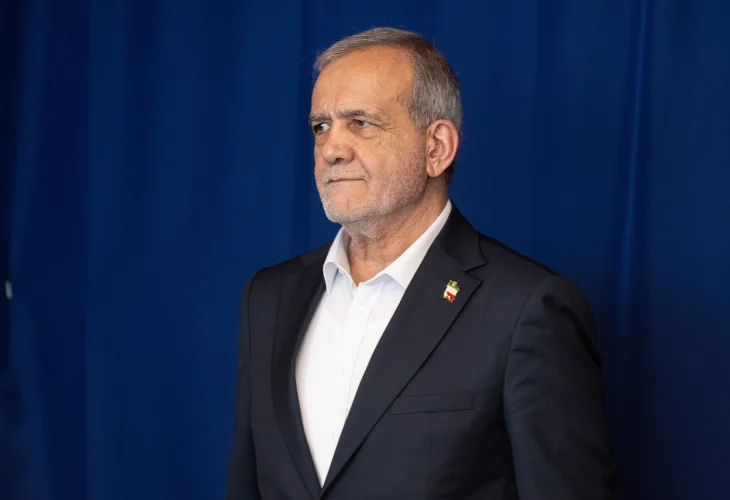 Masoud Pezeshkian (Shutterstock)
Iranian President Masoud Pezeshkian has begun implementing emergency measures aimed at ensuring the supply of essential goods and maintaining government operations in the event of new attacks by the United States or Israel, according to a report by the Financial Times.
The steps were announced during a meeting with governors from Iran’s border provinces. Pezeshkian said authority would be transferred from the central government to provincial officials to allow faster decision-making if national systems are disrupted. “We are transferring authority to the provinces so that governors can contact the judiciary and officials in other organisations and make decisions themselves,” he said.
According to the Financial Times, the measures are designed to reduce bureaucracy, accelerate the import of basic commodities, and allow local administrations to continue functioning under emergency conditions. Iranian officials told the paper the move reflects concern that a future conflict could include strikes on senior leadership or critical infrastructure. A government spokesperson described a “heavy shadow of war” hanging over the country, adding that Iran is preparing for worst-case scenarios.
Alongside these preparations, Iranian officials have pointed to ongoing diplomatic efforts. Ali Gholaki, a journalist with close ties to Iran’s security establishment, told the outlet Ensafnews that Iran and the United States are holding talks “directly or indirectly” in a “third country.” However, he expressed doubt that diplomacy would prevent a clash, describing a future war as “very likely.”
At the regional level, Pezeshkian has sought to reinforce Iran’s narrative. Iranian media reported that he held a phone call with Saudi Crown Prince Mohammed bin Salman, during which he accused Israel and the United States of directly supporting “instigators of unrest” inside Iran.
Iranian leaders have paired these messages with blunt warnings. Mohsen Rezaei, an adviser to Supreme Leader Ali Khamenei, said Iran would not restrain itself if attacked. “If you attack us, we will not stop even if you beg for a ceasefire,” he warned.
Regional media reports indicate that Tehran is also coordinating closely with its allies. The Emirati outlet Aram News, citing Lebanese and Iraqi sources, said intensive meetings have taken place in recent days involving leaders of the so-called “Axis of Resistance,” under the supervision of commanders from the Islamic Revolutionary Guard Corps’ Quds Force. The meetings reportedly focused on preparing a unified response to a potential American strike on Iran and planning for the period that would follow.
According to the sources, the discussions included detailed war scenarios, response mechanisms, and the division of roles among different fronts. The aim, they said, is to prevent any future conflict from remaining limited to Iran and instead turn it into a wider regional confrontation. Statements issued recently by Iranian allies were described as reflecting a shift from general warnings to clearly defined political and military positions.
The sources added that recent statements by militias in Iraq, the Houthis in Yemen, and Hezbollah in Lebanon align with these understandings. Each front is expected to respond differently in the event of war. Lebanese security sources said Hezbollah is not expected to intervene immediately following an initial strike on Iran, unless the attack is broad and aimed at significantly damaging Iran’s capabilities.
Iran has also intensified its warnings regarding the Strait of Hormuz. The deputy commander of the IRGC navy claimed Iran has “full control over the skies and waters” of the strait and monitors all maritime movement. He warned that neighboring countries would be considered hostile if their territory, airspace, or waters are used against Iran. Iranian media added that disrupting shipping through the narrow strait, a critical global energy route, is an operational option Iran could activate if tensions escalate further.

