

Behind the News
Dollar Nears 3 Shekels, Approaching Lows Not Seen in Three Decades
The dollar–shekel exchange rate is hovering around 3.10, its weakest level since 2021 and near mid-1990s levels, as global dollar weakness and growing confidence in Israel push the shekel higher
- Brian Racer
- | Updated
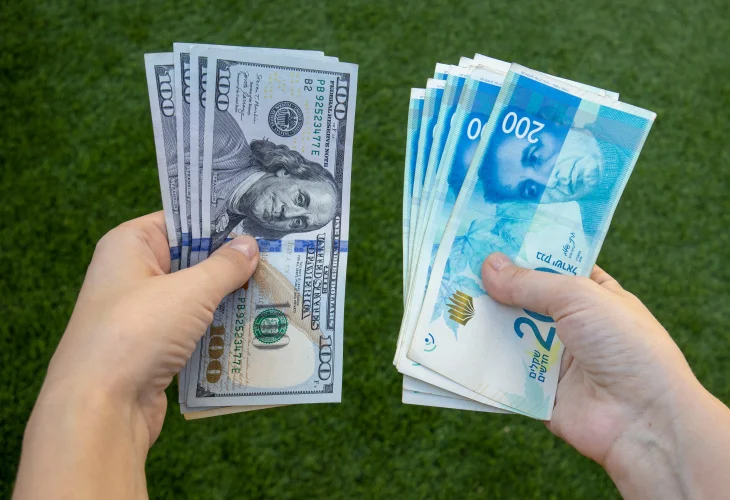 Dollars and Shekels (Shutterstock)
Israel’s shekel has strengthened to around 3.10 per dollar, marking its strongest point since the height of the COVID period and approaching levels last seen in the mid-1990s. The move brings the Israeli currency close to the psychological 3.00-shekel threshold, a level long viewed by markets as carrying both economic and symbolic weight.
For many Israelis, the shekel’s sharp strengthening is already raising concern, despite imported goods, overseas travel, and online purchases becoming cheaper. For exporters, high-tech companies paid in dollars, and people whose pensions and savings are invested in the U.S., and for Americans connected to Israel, the move carries clear economic consequences.
Economists say the move is being driven by a mix of forces inside Israel and abroad. In Israel, markets are increasingly treating the country as a safer place to put money, pushing more demand toward the shekel and pushing the dollar lower. Large Israeli investment funds are bringing money back home, exporters are selling their dollars and converting them into shekels, and foreign investors are slowly returning to Israeli assets.
Security developments are also strengthening the shekel, as investors increasingly see the war and the region as moving toward a more stable phase. Markets are reacting to sustained U.S. involvement, a lack of major escalation in recent weeks, and growing discussion about diplomatic and regional arrangements going forward. Even as tensions remain, investors tend to strengthen a country’s currency when they believe the security situation is no longer deteriorating and may be gradually improving.
Alongside local factors, the dollar’s weakness is part of a broader global trend. The U.S. currency has been losing ground against major currencies worldwide, due to uncertainty around American economic policy and expectations that central banks are moving toward interest-rate cuts, which reduce the dollar’s appeal. As interest rates in the U.S. are expected to fall, holding dollars becomes less attractive, pushing investors toward other currencies, including the shekel.
Israeli economist David A. Meyer noted that the dollar has weakened significantly in recent days and still remains overvalued, suggesting further declines are possible as interest-rate gaps continue to shrink. In this environment, the shekel’s strength is not occurring in isolation but as part of a wider reassessment of the dollar’s global position.
Some economists have outlined far more dramatic scenarios. Prof. Leo Leiderman has argued that a major regional shift, such as a fundamental change in Iran or a broad wave of normalization between Israel and Arab countries, would make Israel look far less risky to investors and could trigger a surge of investment into the country. “There is no red line in exchange rates,” he has said, adding that a financial boom would lift markets and significantly narrow Israel’s perceived risk. Other economists caution that while a dip below 3.00 shekels is possible, it is not the central scenario and would likely face strong resistance.
As the dollar approaches 3.00, attention is turning to the Bank of Israel. So far, the central bank has not intervened. In the past, intervention typically meant purchasing dollars in the market or signaling discomfort through official statements. A weaker dollar helps curb inflation, a key goal for the bank, but prolonged shekel strength can harm exporters and long-term growth. The bank faces a balancing act of tolerating strength that benefits consumers, or step in to protect the real economy.
The implications are uneven. Consumers enjoy greater purchasing power, while exporters and pension savers feel the squeeze. For American Jews and investors watching from abroad, donations to Israel buy less, travel becomes more expensive, and the currency move raises broader questions about regional stability and U.S. economic standing.
Looking ahead, markets are watching several signposts closely: whether the dollar tests 3.00 shekels, any signal or action from Bank of Israel, developments in U.S. monetary policy, and security headlines that could rapidly shift sentiment. For now, the shekel’s strength reflects confidence, but in foreign exchange markets, confidence can turn quickly.
