

Israel News
Netanyahu: “Heroes Fell” After Biden-Era Arms Embargo
Israeli leader says US weapons holds during Rafah fighting left troops exposed; Biden aides deny claim and call it “categorically false”
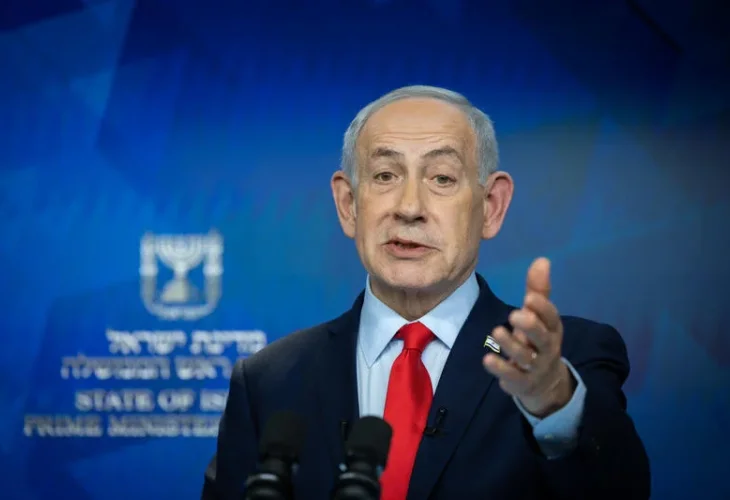 Prime Minister Benjamin Netanyahu (NOAM REVKIN FENTON/POOL/Flash90)
Prime Minister Benjamin Netanyahu said last night that Israeli soldiers were killed in Gaza because the IDF lacked sufficient ammunition due to what he described as a Biden-era American arms embargo.
Speaking at the close of a lengthy press conference, Netanyahu said the shortage occurred at a critical stage of the war against Hamas terrorists and ended only when US President Donald Trump took office.
“At a certain stage, we did not have enough ammunition, and because of that, heroes fell,” Netanyahu said. “Part of that shortage was due to the embargo imposed by the previous American administration.”
Netanyahu said Israeli forces were operating in areas where artillery and airstrikes had already been used, but Hamas terrorists remained inside booby-trapped buildings. According to the prime minister, the lack of appropriate munitions increased the danger to troops advancing on foot.
The remarks marked one of Netanyahu’s most explicit attempts to link battlefield losses to US policy decisions made during the Biden administration. He said the experience strengthened his determination to ensure Israel never again faces such shortages.
Netanyahu tied the issue directly to his broader goal of reducing Israel’s dependence on American military aid. He said Israel must develop a stronger domestic arms industry and shift its relationship with Washington “from aid to partnership,” including joint development and production with the United States and other allies such as India and Germany.
According to Netanyahu, the problem became prevalent after Israel entered Rafah in May 2024, despite US opposition. At that point, the Biden administration imposed a partial arms embargo, including restrictions on heavy MK-84 bombs weighing roughly one ton and on D-9 armored engineering bulldozers. Both systems are used to demolish structures, neutralize explosives, and clear booby-trapped buildings and routes.
Netanyahu and his supporters argue that the absence of sufficient heavy munitions and engineering equipment limited the IDF’s ability to safely deal with Hamas’s extensive use of explosives and mined structures during the ground maneuver. Netanyahu said that “Gaza was booby-trapped” and that “at a certain stage, we simply did not have enough ammunition, and people fell, heroes fell.”
Data compiled during the war highlights the scale of the threat posed by enemy explosives. From the renewal of fighting in March 2025 until the ceasefire in October 2025, 61 Israeli soldiers were killed during ground operations in Gaza. Of those, 38, more than 60 percent, were killed by enemy explosive devices, including booby traps and planted charges.
US officials who served under Biden responded angrily to Netanyahu’s claims, accusing him of spreading falsehoods and disregarding American support for Israel during the war.
Brett McGurk, one of Biden’s senior Middle East advisers, rejected the accusation outright. “That statement by Netanyahu is categorically false,” McGurk said, adding that Biden left office with a ceasefire in Gaza, hostages returning home, a ceasefire in Lebanon with Hezbollah defeated, and Iran in what he described as its weakest position since 1979 following two failed missile attacks. He said Biden’s commitment to Israel’s security, including US military assistance, “was unwavering throughout the war.”
Amos Hochstein, another top Biden aide, was even harsher. “Netanyahu is both not telling the truth and ungrateful to a president that literally saved Israel at its most vulnerable moment,” Hochstein said.
The dispute echoes earlier clashes between Netanyahu and the Biden administration over arms deliveries during the war. US officials previously denied withholding weapons, while Israeli leaders repeatedly warned that pauses and restrictions endangered troops in combat.
Netanyahu said he has already drawn his conclusion from the war. “I have resolved that we will not reach such a situation again,” he said. “We must have a robust and as independent as possible arms industry, so that we don’t lack weapons and don’t lack ammunition.” He added that Israel should move its relationship with the United States “from aid to partnership,” with joint development and production of advanced weapons systems.

