

Israel News
First Daytime Jewish Prayer Held at Joseph’s Tomb in 25 Years
Move follows defense approval and marks first daylight access to the Kever Yosef in Shechem since its abandonment during the Second Intifada
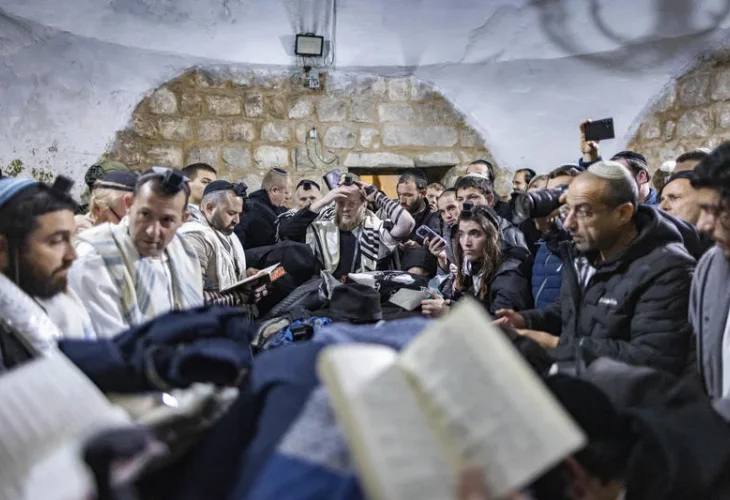 Shacharit this morning at Joseph's Tomb (Kever Yosef)
Hundreds of Jews held a Shacharit prayer service Thursday morning at Joseph’s Tomb (Kever Yosef) in Shechem, marking the first time in 25 years that Jews prayed at the site during daylight hours. The prayer followed an overnight entry that extended into the morning under a new security arrangement approved this week. Until now, Jewish access to the tomb had been limited almost exclusively to nighttime visits, with worshippers required to leave before dawn due to security concerns.
Joseph’s Tomb is located inside a densely populated Palestinian city and has long been considered a highly sensitive flashpoint. Any Jewish entry requires advance approval, extensive coordination, and a significant military presence. According to organizers, Thursday’s visit was carried out with authorization from Central Command and included the deployment of Israeli forces to secure access routes, establish perimeter control around the compound, and oversee the operation with senior officers on site.
The expanded access follows a decision by Defense Minister Israel Katz, reached after months of discussions between political leaders and the military. Under the new arrangement, worshippers may now remain at the site into the morning hours to allow for Shacharit prayers, with tightly defined entry and exit windows set by the IDF based on real-time security assessments.
The move was pushed by Samaria Regional Council head Yossi Dagan and Knesset member Zvi Sukkot, who described the development as a turning point after decades of restrictions. Sukkot said the site had been abandoned following a government decision taken during the outbreak of the Second Intifada under then-prime minister Ehud Barak.
“First, I would like to thank Defense Minister Israel Katz for the dramatic decision and the first step toward a full return to Joseph’s Tomb,” Sukkot said. “We have achieved an important step by holding a Shacharit prayer and entering the site in daylight. This is the beginning of an important and historic correction, and we will continue working until full Jewish presence is restored at Joseph’s Tomb.”
Dagan framed the morning prayer as a symbolic reversal of longstanding practice. “This morning is a morning of historical correction,” he said. “After years of entering in the dead of night, we are returning home with our heads held high and in full daylight. Joseph’s Tomb is an important symbol, and the move to daytime entry is a significant step in our work plan to establish a permanent and full presence at the site.”
Joseph’s Tomb is traditionally identified as the burial place of the biblical Joseph, son of Jacob. A yeshiva operated at the compound until it was abandoned in 2000 due to escalating violence. Since then, Jewish access has been sporadic, highly regulated, and frequently disrupted by security incidents over the years.
Rabbi Yosef Elitzur, head of the Od Yosef Chai Yeshiva that once operated at the site, said the prayer carried deep personal meaning. “We are happy and excited to be here, in the yeshiva’s beit midrash, praying Shacharit here,” he said. “We hope to quickly reach a stage of permanence.”
The Yesha Council welcomed the development, calling the daylight prayer “a clear declaration of sovereignty” and thanking the defense minister and security forces for enabling the visit. Israeli security officials, meanwhile, stressed that any further expansion of access would continue to depend on ongoing risk assessments.

