

Israel News
Tucker Carlson Reframes Pro-Israel Support as Moral Liability for American Christians
The segment links U.S. funding and evangelical backing to alleged Christian mistreatment, challenging a core pillar of Israel’s American support
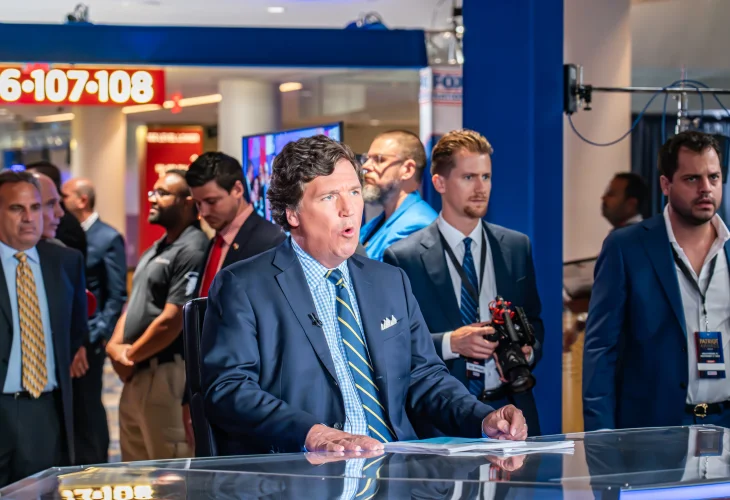 Tucker Carlson (Shutterstock)
Tucker Carlson released a new video last night arguing that American political and evangelical support for Israel is morally compromised by what he describes as the mistreatment of Christians in the Holy Land. Titled “The Shocking Reality of the Treatment of Christians in the Holy Land by US-Funded Israel,” the segment claims that American Christians are implicated in this so-called treatment because, Carlson argues, U.S. taxpayers and Western churches help finance Israel and shape its policies. The video drew more than 200,000 views within its first five hours of release.
Carlson opens the segment by calling the treatment of Christians in the Holy Land what he describes as “a political question,” citing U.S. taxpayer funding and donations from American Christian churches as the reason Americans should pay attention.
The core of Carlson’s case rests on interviews with two Christians from the region. The first is introduced as the Anglican Archbishop, who lives in Jerusalem. The archbishop claims that Christians are in long-term decline, saying, “I think now we are on the declining end of our Christian presence in the holy land.” He attributes this trend to events since Israel’s founding, stating that “the Christian population dwindled to half in 1948,” and describing further pressure in the decades since.
Carlson amplifies anecdotes of harassment, highlighting allegations that Christian clergy face abuse from Jewish extremists. The archbishop says that when he wears clerical clothing, he is sometimes harassed in public, including being spat at, and confirms that this has happened to him personally. Carlson then emphasizes that the alleged incidents involve “not Muslim religious extremists, but Jewish religious extremists.”
One of the most consequential segments of the video concerns Gaza. Carlson highlights an Anglican-run hospital, which the archbishop says “was hit at least eight times during the war” When asked who was responsible for the strike on the hospital, the archbishop says he does not know, acknowledging that responsibility for the incident remains unclear. Despite acknowledging the uncertainty, Carlson continues the segment by presenting the hospital strikes as part of a broader pattern of alleged mistreatment of Christians.
Carlson then introduces a second interviewee, a Jordanian Christian businessman. He describes Jordan as a country where Christians live securely despite being a small minority, saying, “Christians here in Jordan have always felt one and the same with the Muslims in Jordan,” and adding that he has “never felt discriminated against as a Christian.” He also notes that Christians are represented “in the Senate, in parliament, government, and in the military.”
Jordan is presented in the video as a point of contrast. Carlson highlights the country as stable and tolerant toward Christians, using it to compare conditions there with those he describes in Israel.
Carlson repeatedly directs his criticism toward American Christian political figures known for strong pro-Israel positions, including Mike Huckabee and Ted Cruz. He accuses them of failing to defend Christian communities in the Holy Land, at one point saying of Huckabee, “I’m sorry. I just want to be very clear about his shameful anti-Christian behavior.” Carlson frames the criticism not as a lack of awareness, but as a choice, arguing that political loyalty to Israel has been placed above solidarity with local Christians.
The video ends by broadening the indictment. Carlson claims, “there’s clearly a theme,” and concludes, “And it’s it’s an anti-Christian theme.” Carlson does not call for specific policy changes, but throughout the segment he raises questions about U.S. aid, evangelical political alignment with Israel, and how Israel is viewed by American Christians.
For Israel and American Jews, the significance of the segment lies less in the accuracy of each individual allegation than in the argument Carlson is advancing. He is explicitly reframing support for Israel as a moral failing for American Christians, arguing that U.S. funding and evangelical political backing make them complicit in what he describes as the mistreatment of Christians. If this framing takes hold, it challenges one of Israel’s most dependable sources of political and cultural support in the United States.

