

Magazine
Motherhood From Eye Level: Raising a Family in a Wheelchair
After a life-changing accident left her confined to a wheelchair, Bat Chen Elishavitz raises seven children with faith, humor, and heart, redefining motherhood when life looks different than planned.
- Moriah Luz
- | Updated
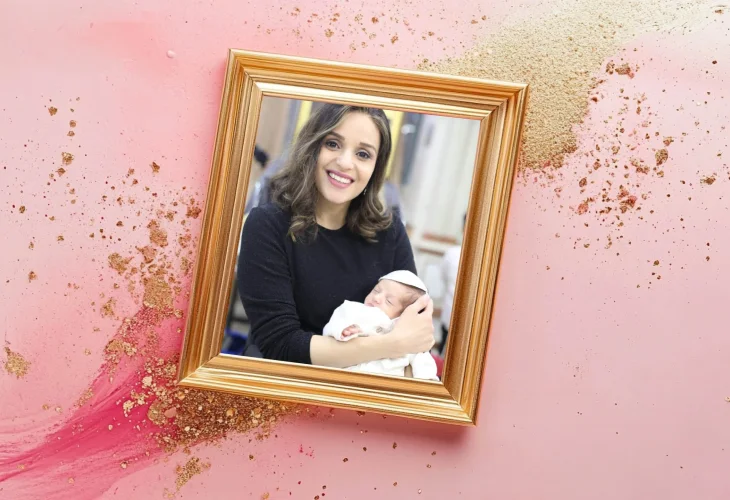 Bat Chen Elishavitz at her son's Brit Milah (Photo: Avi Katanov)
Bat Chen Elishavitz’s schedule is filled to the brim. Emotional therapy sessions at the clinic and via Zoom, bridal coaching, lectures, and above all, raising seven sweet children. Leading this nonstop rhythm is a young woman confined to a wheelchair. Sixteen years ago, her life’s dream shattered. From that breaking point, she chose life anew.
“Everything Is a Matter of Split Seconds”
Today, at thirty five, Elishavitz lives in Or Yehuda with her husband and their seven children as part of the Chabad Hasidic community. “We work under the city’s main emissaries and help wherever we’re needed,” she says. She now holds a master’s degree in social work and works as an emotional therapist, but as a teenager, her dreams looked very different.
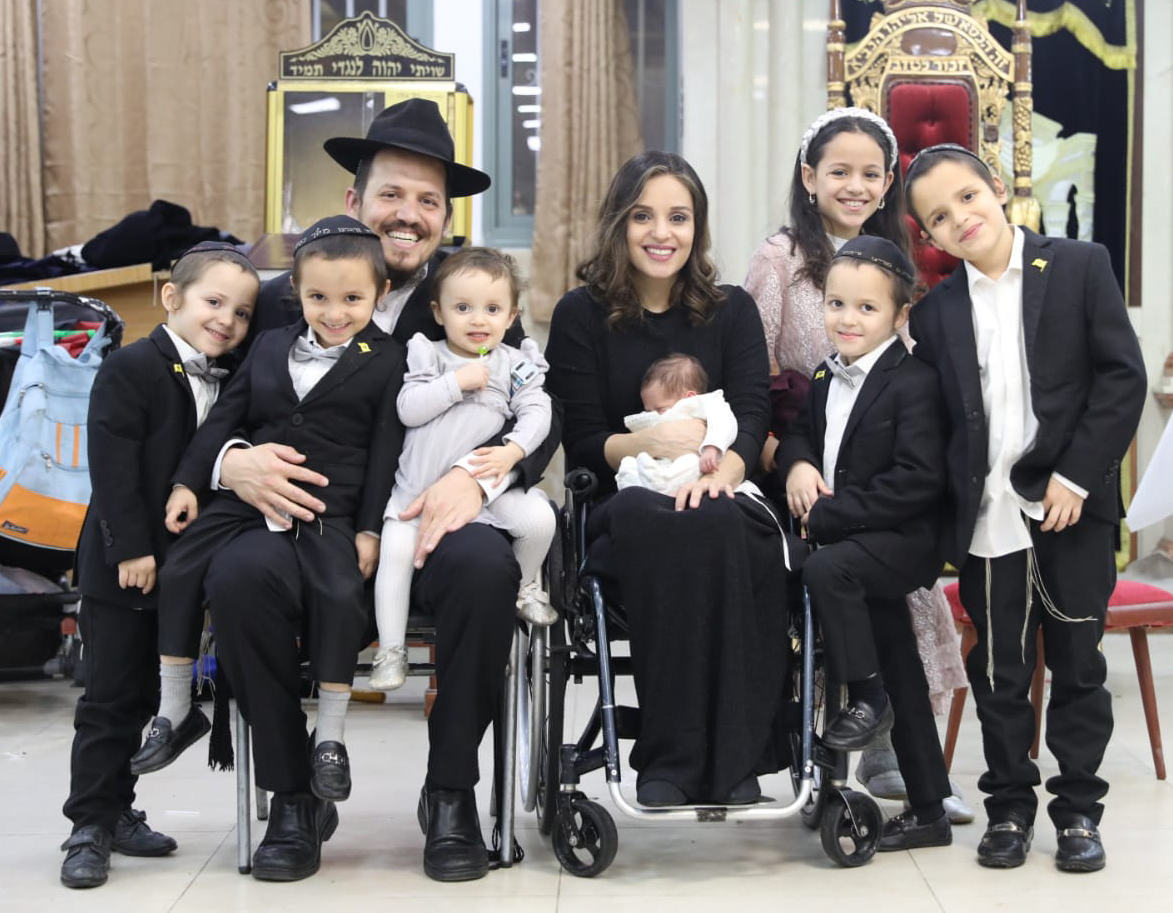 The Elishavitz Family (Photo: Avi Katanov)
“From a young age, I was involved in gymnastics and sports. I was always strong physically, and already in high school I knew I would pursue something in that field.” She grew up in a religious Zionist home but studied at a Chabad high school. While her friends discussed future plans, she was certain she would study sports.
After graduating, Elishavitz enrolled in physical education studies at Givat Washington College. Her dream was taking shape. During final exams of her first year, she went out with friends to study, only a short drive from campus. On the way back, her friend was driving. Elishavitz leaned back in her seat to rest.
She awoke to a blinding white light.
“Everything happened in split seconds,” she recalls. “I saw a car racing toward us, and then it crashed into us with tremendous force. My head was thrown back and forth. Because I had reclined the seat, the airbag didn’t deploy. My spine was shattered, and I became paralyzed from the waist down.”
The car filled with smoke. Her consciousness began slipping away. “I focused on breathing and kept telling myself, ‘Help is coming. Just hold on.’ In those moments, my entire life flashed before me. I understood that my life wasn’t ending. There were too many things I still had to do.”
Minutes later, she heard sirens. At the hospital, doctors discovered internal bleeding and placed her on life support. “My parents were told they didn’t know if I would survive the next three days.” When her condition stabilized, doctors slowly reduced the sedation and woke her.
Facing a New Reality
When did you understand the implications of the injury?
“It took a long time. At first, I didn’t understand anything. I was still under heavy medication.” A doctor explained she had undergone spinal surgery, but he did not tell her she would remain paralyzed. That information was given only to her parents. “He spoke calmly and reassuringly. ‘You’ll go through rehabilitation. Everything will be fine. You’re young and strong.’ I understood that to mean leading my old life again.”
Weeks passed, and her lower body remained motionless. She still believed she would return to who she had been. “I was transferred to rehabilitation at Tel Hashomer. I arrived convinced I would walk out on two legs. I believed Hashem would perform a miracle for me.”
Did anyone try to prepare you for reality?
“They tried.” On her first day, a doctor explained to her parents that the house would need to be renovated for wheelchair accessibility. She was told she would learn to function lying down and using her hands, that some things would be possible and others not, and that she would need assistance. “She wished me success in learning how to sit in a wheelchair.”
Elishavitz felt anger rise. “I decided I didn’t care about statistics or medical predictions. I was going to fight.” She refused psychological support and immersed herself in intensive therapy. Physical therapy, hydrotherapy, occupational therapy, gyms, alternative treatments. “It was a full-scale war against reality.”
Learning to Rise Again and Again
Did you experience moments of crisis?
“Every day. Every morning.” For six months, she relearned basic actions. Sitting, dressing, showering, transferring from bed to chair. “A short time earlier, I was an athlete doing flips in the air. Suddenly, everything took endless effort. It was emotionally and mentally exhausting.”
Her family and friends became her anchors. They refused to let her sink into despair. They got her out of bed, took her outside, and insisted on small pleasures. “They saved me.”
True Goodness Does Not Break
A week before the accident, Elishavitz met a young man for a potential match. They met only once. “It was wonderful. Perfect.” After the accident, she assumed that connection was gone.
To her surprise, her family told her that he kept asking about her, visited her, prayed for her recovery, and brought her a dollar he had received as a child from the Lubavitcher Rebbe. “I saw it as kindness, nothing more.”
But he did not give up. After her rehabilitation, she learned that he had been waiting. “He read my medical file and knew exactly what he was choosing. I couldn’t understand why.” He explained that although life would be harder than planned, her essence had not changed. “He said my personality was the same, and his heart wouldn’t let him walk away.”
“Even when a person breaks, their essence doesn’t change,” she reflects. “Through him, I learned that my value isn’t defined by what I can do. I have an inner value, a divine soul that remains whole.”
Two years after the accident, they stood beneath the chuppah.
Motherhood From Eye Level
Today, Elishavitz is the mother of seven. How does she manage?
“Our home is fully accessible. The counters, sinks, stove, washing machine, everything is adjusted. I cook and manage the household with my hands. Today there are many solutions.”
Are there unique challenges?
“Every mother questions herself. For a mother in a wheelchair, those questions intensify.” She recalls thoughts of fear and guilt. “What kind of home will they have? What will this do to them?”
Over time, she learned acceptance. “Every mother has limitations. There is no perfect mother. Children mainly need a mother’s heart, attention, and love. They feel it when you look at them at eye level. In our case, that’s literal,” she smiles.
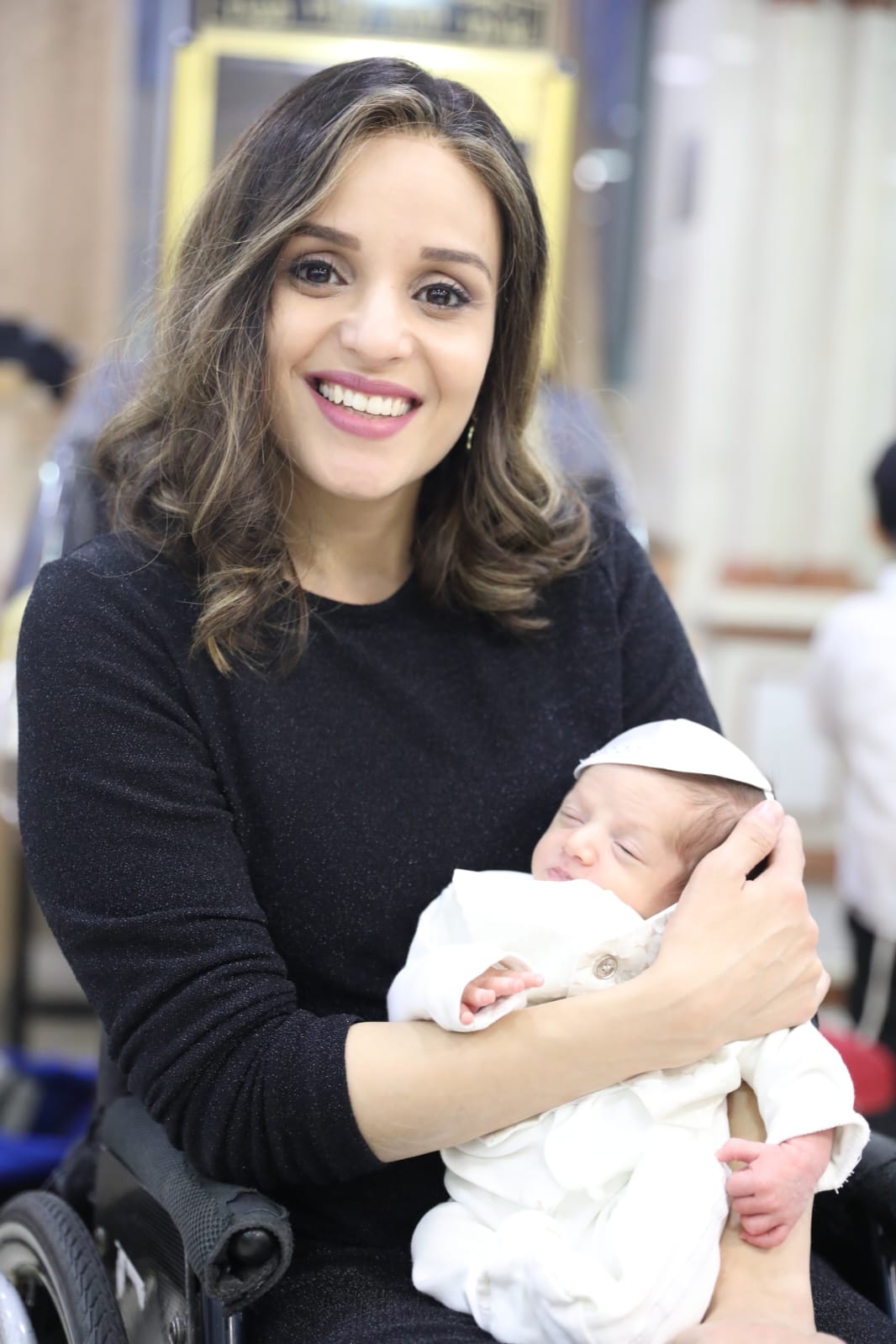 Bat Chen Elishavitz at her son's Brit Milah (Photo: Avi Katanov)
She shares moments of pain and humor. A daughter once asked her not to leave the car out of embarrassment. Another child once said, “It’s fun that Mom is in a wheelchair. We can sit on her all the time.”
Strength Through Faith and Giving
Despite her optimism, crises still arise. “My strength comes from Torah, Chassidut, and faith. Without them, I don’t know where I’d be.”
Giving is her second anchor. “On hard days, I want to cancel everything. But I go anyway. I give, and I come back filled with light.”
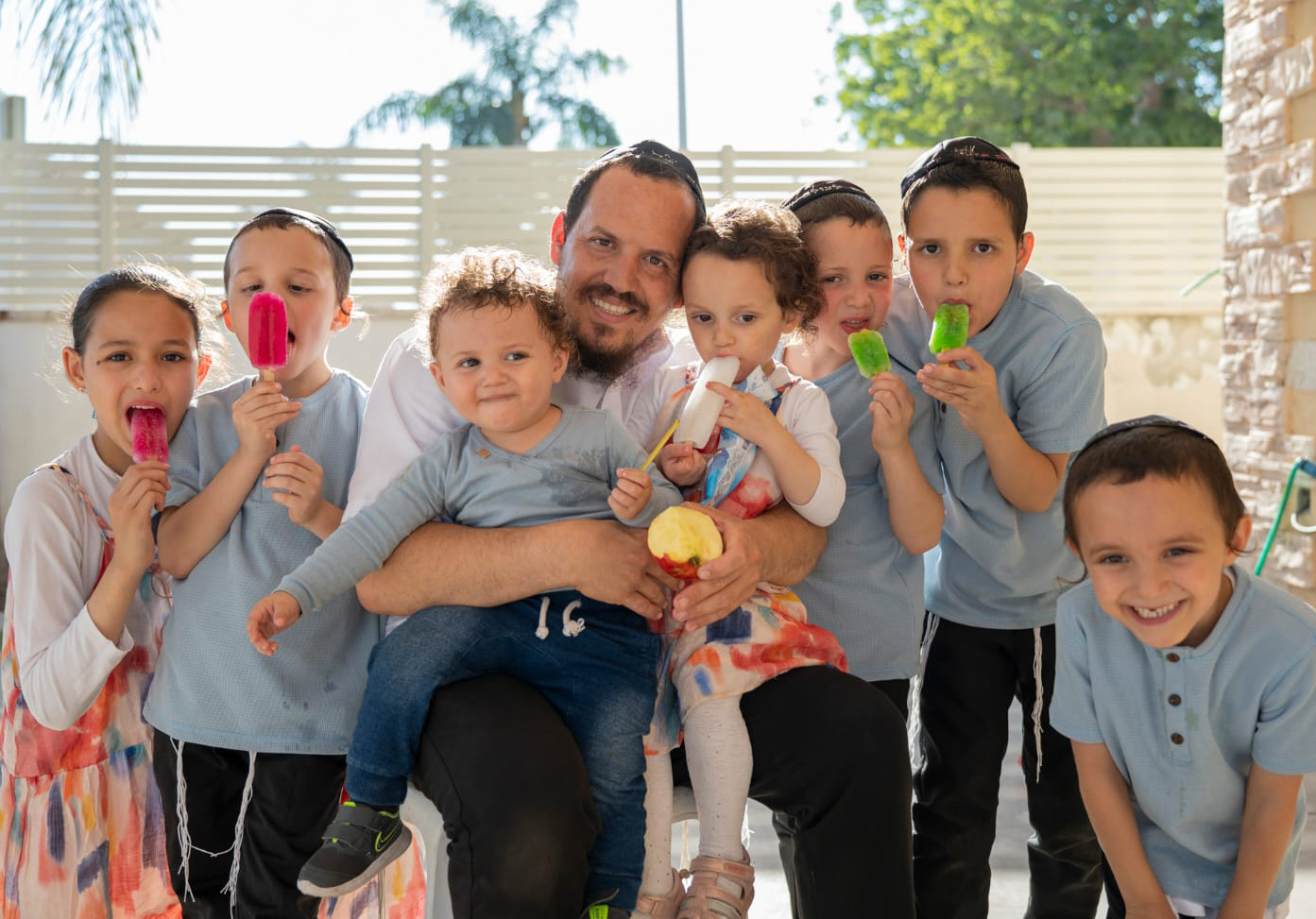 Bat Chen’s husband and children (Photo: Chana Elishavitz)
Years ago, she learned of a surgery that might restore movement. “I wanted it immediately.” The procedure cost half a million shekels and was privately funded through crowdfunding.
The surgery failed.
“This is still something I don’t understand,” she admits. “I understand the accident. I discovered strengths I never knew I had. But the surgery, the hope, and the crash afterward, that still hurts deeply.”
Would you give up the accident?
“I wouldn’t want even one more day in a wheelchair,” she says quietly. “I yearn for healing. I believe Hashem can do anything. But I also know that everything I’ve lived through revealed parts of myself I would never have discovered otherwise.”
She pauses. “Today, I am certain Hashem is with me. I have felt Him even in the darkest moments. I am grateful for the challenges, and at the same time, I wait with full faith for the redemption to come.”

