

Wonders of Creation
Nature’s Built-In GPS: How Sea Turtles Always Find Their Way
New research shows that sea turtles navigate with an internal GPS more advanced than our own, revealing the extraordinary wisdom embedded in nature.
- Yosef Yabece
- | Updated
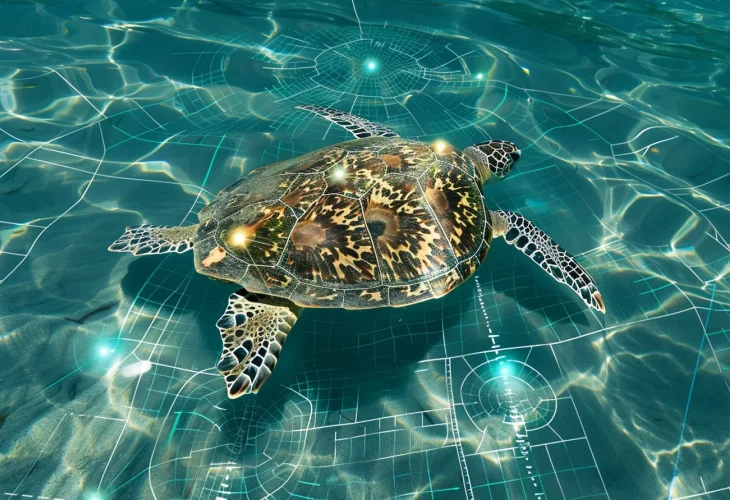
Meet Eric Cassel, a navigation engineer with an impressive track record. Over the years, he has served as a consultant for NASA on spacecraft navigation systems and has developed specialized navigation algorithms for aircraft. But Cassel’s interests extend far beyond engineering alone. He has also studied biology and philosophy, driven by the realization that many animals possess navigation mechanisms more advanced than even the most sophisticated systems currently in use at NASA.
Cassel believes that studying these biological systems not only has the potential to improve human technology, but also points to a deeper truth: such mechanisms are not random. They reflect the work of an extraordinary Designer. He explores this idea in his 2021 book Animal Algorithms, as well as in a recent article in which he focuses on one particularly remarkable navigator: the sea turtle.
Nature’s Master Navigators
Across the natural world, many creatures travel vast distances with astonishing precision. Migratory birds, salmon, and numerous other species navigate routes that stretch far beyond anything humans could manage unaided. Each species is equipped with a navigation system perfectly suited to its needs.
Yet a recent study published in Nature revealed something even more extraordinary. Sea turtles do not rely on a single navigation system, but on two.
Imagine a driver holding a smartphone GPS in one hand while simultaneously consulting a satellite phone that uses a completely different positioning method. Why would a turtle need such redundancy? After all, it is not piloting a spacecraft.
And yet, it appears that the turtle’s navigation abilities surpass those of any human pilot and even outperform those of migratory birds.
Beyond the Magnetic Compass
Bird migration, wondrous as it is, remains only partially understood. The prevailing theory suggests that birds sense Earth’s magnetic field and navigate much like a living compass needle, detecting north and orienting themselves accordingly. From the air, birds can combine this internal compass with visual cues and weather patterns to maintain continuity along their route.
But continuity is essential for compass-based navigation. Even a trained researcher, dropped into an unfamiliar location with a compass, would be lost. Knowing where north is does not tell you whether north leads to Lebanon if you are in Israel, or to the Arctic if you are in Sweden.
Sea turtles face an even greater challenge. Moving through underwater currents and island chains, they lack visual landmarks and continuity altogether. Over months of wandering, no simple compass would allow them to retrace their path or determine their precise location. Without external reference points, even a human wandering an open field for weeks would be unable to reorient themselves accurately.
Reading Earth’s Magnetic Signature
This difficulty led researchers to a remarkable discovery. Sea turtles do not merely sense Earth’s magnetic field. They also recognize magnetic signatures.
Every location on Earth possesses a unique magnetic fingerprint, a specific combination of magnetic properties. Today, scientists speak of magnetic latitude and magnetic longitude. Sea turtles have been using this system since creation.
In effect, the turtle can identify exactly where it is on the planet. One might imagine an internal map with a marker that reads, “You are here.” Emerging from an underwater cave, the turtle does not rely on memory alone. It determines its precise position and then swims toward its destination with astonishing accuracy.
Humans, without GPS or cellular signals, would be completely disoriented in such conditions. The turtle, however, knows exactly where it is and where it is going.
How Does the Turtle Do It?
Of course, turtles have no screens, antennas, or satellites. So how do they read magnetic signatures?
This is where the recent research becomes especially intriguing. Scientists hypothesize that a special protein called cryptochrome plays a key role. Cryptochrome releases tiny electrons that are sensitive to magnetic states, allowing the animal to detect subtle variations in Earth’s magnetic field.
But sensing magnetic information alone is not enough. To determine location, that information must be cross referenced. Researchers suggest that turtles possess an additional system capable of detecting radio frequency fields influenced by the magnetic field itself. By integrating these two streams of data, the turtle constructs an accurate internal picture of its location.
All of this occurs without GPS signals, without external devices, without surveillance, and without human engineering.
A navigation system embedded directly into life itself.
A system that, as Cassel points out, reflects not randomness, but design. A gift of navigation written into creation by Hashem Himself.

