

Wonders of Creation
Incredible Creatures: How Sea Cucumbers, Worms, and Beavers Shape Our World
An exploration of the unseen animals that quietly shape ecosystems and reveal the intricate design of the natural world.
- Yosef Yabece
- | Updated
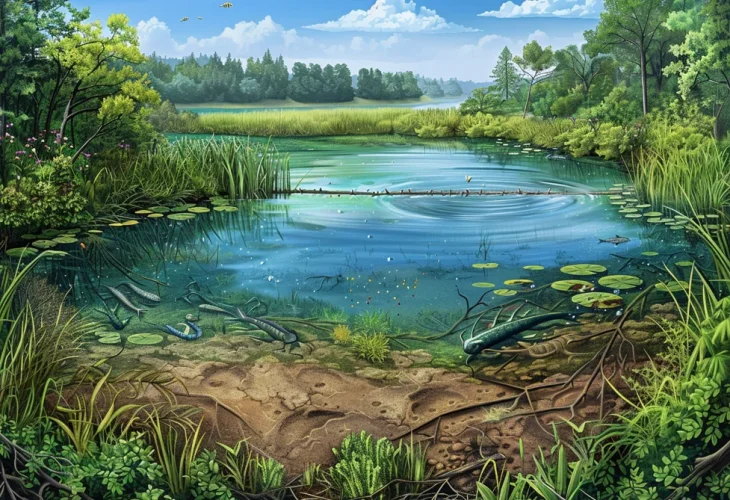 A beaver diligently building its dam, a reminder of nature's engineering marvels.
Animals are well known for their remarkable abilities to survive, hunt, and reproduce. Yet beyond these traits, many animals play roles in the world that far exceed what simple evolutionary explanations would suggest. These roles are essential to the balance of the ecosystem, and in many cases, the world quite literally depends on them.
Jewish sources already point in this direction. Our sages relate that King David once questioned why spiders were created. The answer came later, when a spider’s web concealed him from King Saul and saved his life. This story reflects a broader truth: every creature has purpose, value, and a role to fulfill in the world.
Animals as Engineers
Today, this idea is echoed in scientific research. Writer Gur Ziv explores this theme in the podcast Connecting the Ends, describing animals as natural engineers. Nature is filled with intelligent design, with creatures shaping their environments in ways that go far beyond what we initially see.
Some of these effects are dramatic. Termite mounds are so large they can be seen from space. Others are subtle, carried out quietly beneath the ocean surface. Researchers estimate that around 600 known species act as “landscape architects,” reshaping land and sea in ways critical to the planet’s stability.
Small Creatures, Vast Impact
To understand how even tiny animals can influence enormous areas, consider the pufferfish. To attract a mate, it carves intricate circular nests on the seafloor, sometimes up to sixteen times its own size. Over time, these structures accumulate and significantly alter the marine landscape.
On land, grazing cattle compact soil as they move, influencing plant growth and water absorption. These actions may seem incidental, yet together they shape entire ecosystems.
Scientists estimate that animals contribute roughly 76,000 gigajoules of energy each year through geomorphological activity, processes that physically shape Earth’s surface.
The Beavers’ Gift to the World
One of the most striking examples is the beaver. By damming streams to build its home, the beaver creates wetlands. These wetlands allow certain fish species to thrive, regulate water flow, reduce downstream flooding, and even contribute carbon essential to the atmosphere.
Without understanding this broader system, one might view the beaver as a nuisance. In reality, it is a central pillar in maintaining ecological balance.
Professor Gemma Harvey, who studies how species affect Earth’s physical systems, emphasizes that such processes are not marginal but vital to the planet’s condition.
Architects of the Ocean Floor
The ocean floor, too, is shaped by its inhabitants. Sea cucumbers are among its most important engineers. Some species produce annual sediment output equivalent to five Eiffel Towers per coral reef. Through feeding and burrowing, they oxygenate seabed layers, support bottom-dwelling organisms, and draw essential minerals upward for plankton communities.
Another remarkable creature is the ragworm, which lives at depths of over seven kilometers. By creating tunnels in the seabed, it allows oxygen and nutrients to seep downward, sustaining organisms below and enabling a continuous cycle of life. What one species releases becomes essential nourishment for another.
Everything Has a Place
When we encounter a living creature, even one that seems insignificant or unpleasant, it is worth remembering that it likely plays a role that indirectly affects our health and quality of life. Small fish feed larger ones, which sustain other animals, forming interconnected chains that support the world as a whole.
The world was created in such a way that nothing is unnecessary. Scientific research has only begun to uncover the depth of wisdom embedded in creation. The more we learn, the clearer it becomes that every creature, great or small, fulfills a mission woven into the fabric of the world itself.

