

Wonders of Creation
The Long Way Home: The Salmon’s Remarkable Journey
From fragile beginnings in icy rivers to a relentless return against powerful currents, the salmon’s life cycle reveals an extraordinary journey guided by an inner call woven into creation.
- Yosef Yabece
- | Updated
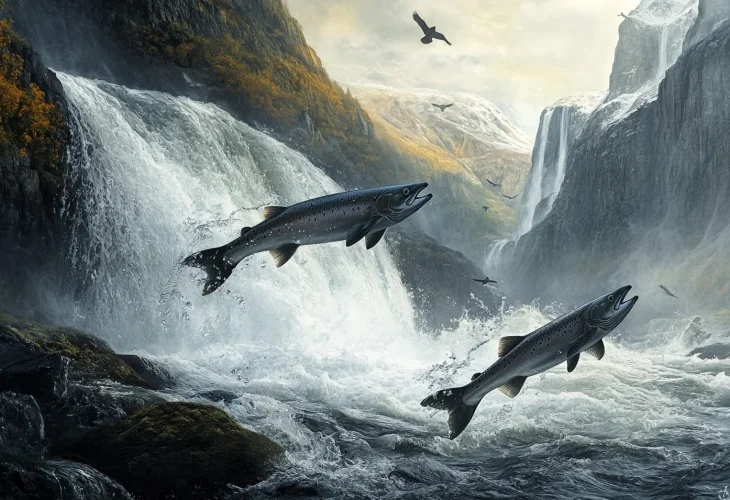 A salmon leaping upstream, symbolizing the epic struggle of its life cycle.
Born in the icy rivers of Norway and Canada, amid powerful currents and crystal-clear waters, the salmon begins its life in the most fragile of forms. From a tiny egg emerges a creature weak and small, yet destined for one of nature’s most extraordinary journeys.
In its earliest days, the young salmon lives in the narrow streams and rivers of its birthplace. Eventually, it finds its way to the vast expanse of the ocean, where it will grow stronger. Then, at precisely the right moment, an inexplicable inner call awakens. Drawn by a force beyond sight or sound, the salmon begin their arduous return, swimming in great numbers toward the exact place where their lives began.
Preparing for the Open Sea
Salmon start life as tiny fry in freshwater rivers. After hatching, they remain there for weeks or even up to two years, depending on the species. During this stage, they feed on the remaining yolk from their eggs and hide among rocks to avoid predators such as birds and larger fish.
As they mature, the fry undergo a remarkable transformation into the smolt stage. Their bodies adapt for life in saltwater through dramatic changes in their gills, kidneys, and overall osmoregulatory system. These adaptations allow them to regulate salt levels and gradually migrate from freshwater into the ocean. This transition typically occurs between one and two years of age.
Life in the Vast Ocean
Once in the ocean, both male and female salmon spend between two and five years there, depending on the species. During this time, they grow rapidly, feeding on small fish, crustaceans, and plankton. What began as a creature only a few centimeters long develops into a powerful fish that can reach a meter in length and weigh between ten and twenty kilograms.
They travel in massive schools, crossing thousands of kilometers of open water while evading predators such as seals and sharks.
The Return Journey
When the salmon reach maturity, usually between three and five years of age, the call to return becomes irresistible. Both males and females respond. The journey home can last weeks or even months and is among the most demanding migrations in the natural world.
They battle fierce currents, leap over waterfalls several meters high, and face predators including bears, eagles, and fishermen. At the same time, their bodies undergo yet another transformation, readjusting from saltwater back to freshwater as their kidneys and gills recalibrate salt regulation within the body.
Completing the Cycle
Throughout this journey, the salmon eat little or nothing, relying on the energy reserves accumulated during their years in the ocean. When they finally reach their natal river, the females dig nests in the gravel and lay thousands of eggs, which the males then fertilize.
For most Pacific salmon species, this moment marks the end of life. Shortly after spawning, they die, enriching the river with vital nutrients that support the next generation. Some species, such as Atlantic salmon, survive the spawning process, return to the ocean, and may spawn again in later years.
And so the pattern continues. Eggs hatch, tiny salmon emerge, and a new journey begins. Years later, when the time is right, they will return once more to that exact location, responding to the ancient call etched into their being by Hashem, sustaining the salmon’s life cycle from the dawn of creation until today.

