

Wonders of Creation
Why Bees Are Essential for Humanity's Survival
Beyond honey and hives, bees sustain the delicate balance of creation. A look at how these tiny creatures support life on Earth.
- Yosef Yabece
- | Updated
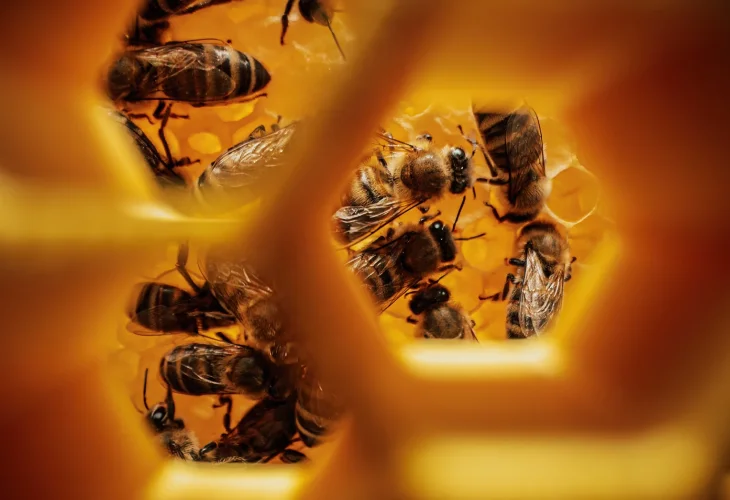 (Photo: shutterstock)
There is a well-known quote attributed to Albert Einstein, suggesting that if bees were to disappear, humanity would have only four years left. At first glance, this statement sounds puzzling. After all, humans do not live off bees. Honey may be sweet and enjoyable, but it is hardly essential for survival.
So why would the fate of humanity depend on such a small insect?
More Than Honey and Hives
We are all familiar with bees. Small flying insects buzzing from flower to flower in search of nectar, building honeycombs with their precise hexagonal cells where honey is stored and the queen lays her eggs. Yet most of us are unaware of the immense benefit bees provide to the world and their critical role in maintaining ecological balance.
Their true importance lies not in honey production, but in something far more fundamental.
The Secret of Reproduction
All living creatures reproduce, and one of the most widespread methods in nature is sexual reproduction. This process involves a male and a female, each contributing genetic information to create offspring that carry traits from both parents. This genetic diversity is essential. It strengthens species, increases resilience, and allows populations to survive diseases and environmental changes.
Without sexual reproduction, offspring would be exact copies of their source. If a disease targeted a specific weakness, entire species could be wiped out.
Plants, too, rely on sexual reproduction. And for most plants, the most efficient way to reproduce is through flowers.
A Challenge for Plants
In animals, reproduction is relatively straightforward. A male finds a female, and the process continues. Plants, however, are rooted in place. They cannot move, search, or choose partners. For them, sexual reproduction presents a serious challenge.
This is where one of nature’s most sophisticated systems comes into play.
The Flower and the Bee
The flower is the reproductive organ of the plant. Its pollen contains tiny sperm cells, each carrying genetic information. When a bee lands on a flower to collect nectar, pollen sticks to its hairy legs and body. As the bee moves on to the next flower, some of that pollen is transferred.
The receiving flower absorbs the pollen into its female reproductive structure. Genetic material from two different plants combines, allowing seeds to form with new and diverse traits.
In this way, bees act as living messengers, enabling plants to reproduce.
A Delicate Balance
Nearly all plants that reproduce through pollination depend on bees. Without them, these plants would fail to reproduce. Agricultural production would collapse. Food supplies for animals would shrink. Human food sources would be severely affected.
The result would be a cascading chain reaction that would disrupt ecosystems across the planet.

