

Wonders of Creation
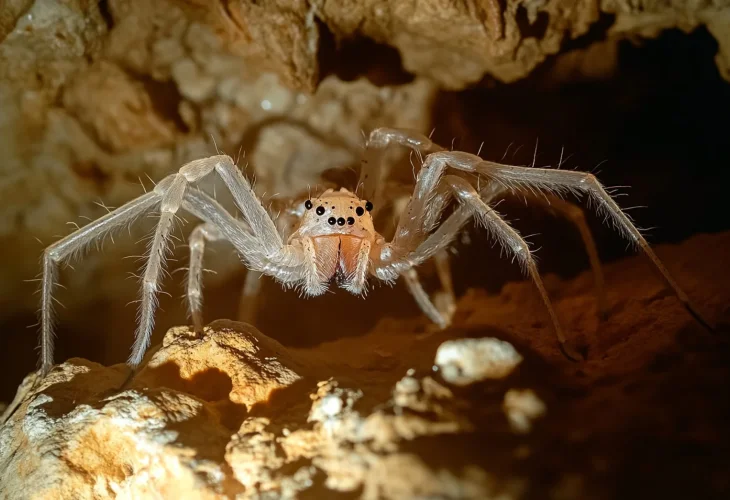
Cave Spiders: Masters of Survival in Total Darkness
Spiders boast highly developed eyes, perfect for the light. But in pitch-black caves, how do they spot their prey?
- Yosef Yabece
- | Updated
The natural world is filled with wonder. Yet in much of contemporary Western literature, every description of nature’s marvels is quickly followed by forced explanations about how they supposedly came into being “by chance” or through blind evolutionary processes. These explanations often distract from a deeper understanding of what we are truly witnessing.
Caves offer a striking example.
A cave is a world unto itself. Life inside it is fundamentally different from life above ground. Most creatures cannot survive there. Food is scarce, light is absent, and familiar survival strategies simply do not work. Rodents that feed on seeds must forage outdoors. They may dig shallow burrows, but they cannot live permanently in vast underground cave systems stretching for kilometers.
Why Caves Need Spiders
One of the most important inhabitants of caves is the spider. Spiders hunt insects, keeping their populations under control. Without spiders, insects would multiply rapidly, exhaust the limited food supply, and die in massive numbers. The cave would become a dangerous and unstable environment, filled with decay and imbalance.
In other words, spiders are essential to the cave ecosystem.
But the cave environment itself is not static.
A Sudden Change in Reality
Imagine a dramatic environmental shift. Forests are destroyed by logging or fire. Temperatures rise. Spiders that once lived above ground migrate into caves in search of survival.
Can a land spider suddenly become a cave spider?
At first glance, the answer should be no. Spiders possess sophisticated eyes designed for environments with light. Caves are completely dark. How can a spider hunt when it cannot see?
The answer is astonishing.
Adapting Without Waiting
Research shows that spiders can rapidly adapt to cave life by shutting down their visual system and developing an alternative sensory mechanism that does not rely on sight. Instead of vision, they “see” through heightened sensory perception, detecting vibrations, air movement, and subtle environmental cues.
This transformation does not take thousands of years. It does not wait for slow evolutionary processes. The spider does not have the luxury of time. It is in the cave now, and it must eat now.
The change happens quickly.
Recent studies have mapped the stages of this transformation and revealed that the adaptation is genetic. The spider’s DNA already contains the potential for this shift. When environmental conditions change, specific genetic pathways are activated, redirecting development toward a cave-adapted form.
Design, Not Randomness
This process is not random, and it is not an improvement generated by chance. It is part of the spider’s original design. The spider was created with built-in options, different modes of existence suited to different realities.
The same principle applies to many animals. When species move into snowy regions, they rapidly express traits suited for cold environments. These changes occur swiftly, not over millions of years. They do not transform one species into another. Rather, they reveal pre-existing possibilities embedded within the creature.
This exposes a fundamental weakness in the evolutionary narrative that assumes random mutations slowly generate new species over vast stretches of time. What we actually observe is something very different. Living beings express different, pre-planned adaptations in response to changing conditions.
For the Sake of the Environment
Importantly, the spider’s refinement is not “for itself” alone. It is for the environment.
Caves require spiders to remain stable ecosystems. Therefore, spiders are equipped with the ability to become cave spiders when needed. The design serves the system as a whole.
Israeli Research at the Front Line
This remarkable insight comes from the work of Efrat Gavish, an Israeli biologist who studied the cave orb-weaver spider, a species also found in Israel. By tracking its development from the embryonic stage, she identified the genetic mechanisms that redirect eye development and enable the spider to adapt to life in darkness.
Similar adaptive processes have been identified in cave-dwelling fish and crabs, further reinforcing the pattern.
A Field Just Beginning
This research opens the door to an entirely new way of understanding life. It suggests that many species are designed with layered potentials, activated as reality demands. We are only beginning to uncover this wisdom.
Re-examining how creatures are built to respond to changing environments may teach us not only about nature’s depth, but also about how to harness these mechanisms. In time, such insights may even help us develop new approaches to healing, both for animals and for humans.
The deeper we look, the clearer it becomes that creation is not random. It is precise, purposeful, and far wiser than we once imagined.

