

Wonders of Creation
Unveiling the Northern Lights: A Spectacle You Don’t Want to Miss
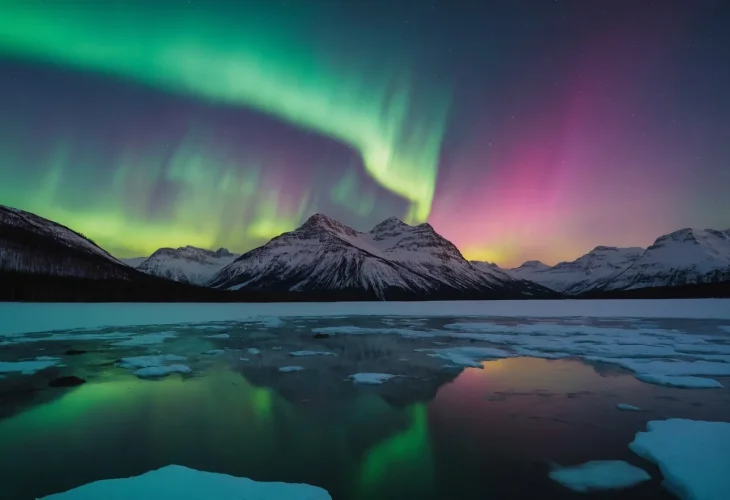
The Northern Lights are considered one of nature's most stunning displays. Every year, droves of tourists flock to Arctic countries like Norway and Sweden to witness this breathtaking natural phenomenon, and for good reason.
- Yosef Yabece
- | Updated
 (Photo: shutterstock)
Tourism remains one of the world’s most dynamic and influential industries, serving as a major economic pillar for many countries. Each year, millions of travelers pack their bags and board flights in search of memorable experiences and meaningful escapes. By 2026, the global tourism industry is estimated to exceed $11 trillion, accounting for roughly 10 percent of the world’s GDP, reaffirming its central role in the global economy.
Among the destinations considered essential for devoted travelers are iconic landmarks such as the Eiffel Tower, Big Ben, and the Statue of Liberty. Alongside these human achievements stands one of nature’s most breathtaking spectacles: the Northern Lights.
Each year, countless visitors travel to Arctic regions such as Norway and Sweden to witness this extraordinary phenomenon. The frozen northern skies come alive with flowing curtains of light, shimmering in shades of green, blue, and sometimes red. Seeing the Northern Lights is an unforgettable experience, one that leaves a deep and lasting impression.
Where the Northern Lights Begin
As wondrous as the Northern Lights appear, they are guided by a precise and fascinating process that begins far from Earth.
The source of the phenomenon is the Sun. The sun functions as a vast power station, producing immense energy through nuclear reactions at its core. This energy is released as light and heat, but the sun also emits streams of charged particles, primarily electrons and protons, into space. These particles form what is known as the solar wind, traveling at incredible speeds of millions of kilometers per hour.
Earth’s Protective Shield
The Earth is surrounded by a powerful magnetic field, functioning like a giant invisible magnet. This magnetic field acts as a protective shield, deflecting much of the solar wind and guiding charged particles toward the planet’s magnetic poles in the north and south.
This is why the Northern Lights are visible primarily near the polar regions.
When solar particles are drawn toward the poles and enter Earth’s upper atmosphere, they collide with atoms and molecules, mainly oxygen and nitrogen. Because the incoming particles carry tremendous kinetic energy, they transfer that energy to the electrons within these atoms.
Electrons naturally seek to return to their original energy state. As they do so, they release the excess energy in the form of light. This glowing release is what we see as the Northern Lights.
Why the Sky Changes Color
The colors of the aurora depend on which atmospheric gases the solar particles collide with and at what altitude.
When particles strike oxygen atoms at higher altitudes, the result is a yellow green glow, the most common color seen in the Northern Lights. Collisions with oxygen at lower altitudes can produce red hues. When nitrogen atoms are involved, blue or purple tones appear, adding depth and variation to the celestial display.
A Side Effect of Protection
Remarkably, the Northern Lights are not a phenomenon created for beauty alone. They are a visible byproduct of Earth’s atmospheric defense system. If the composition or density of the atmosphere were different, the intense radiation from the sun would make life on Earth impossible.
Earth’s atmosphere is one miracle among many, each finely balanced and precisely calibrated. Together, they create the conditions that allow life to exist on this delicate planet. The Northern Lights offer us a rare glimpse into that protective system, transforming a shield of survival into one of the most breathtaking sights in all of creation.

