

Torah Personalities
The Holy Ari: Life, Teachings, and Spiritual Legacy of Rabbi Yitzchak Luria
A comprehensive look at the Ari of Safed, his revolutionary Kabbalistic teachings, disciples, devotion to joy and Shabbat, and enduring influence on Jewish mysticism
- Rebbetzin Chedva Levi
- | Updated
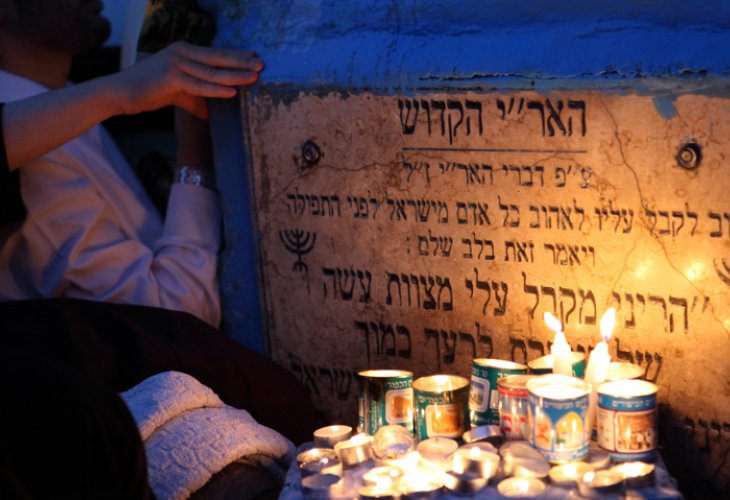 (Photo: Flash 90)
Rabbi Yitzchak Luria, known as the Holy Ari, was the greatest of the kabbalists of Safed during its Zohar era, more than 450 years ago. He was born in Jerusalem in the year 1534 to a Sephardic mother and to a father from the Luria family, a lineage renowned in Ashkenaz and traditionally traced back to Rashi and, through him, to King David.
When he was eight years old, his father, Rabbi Solomon, passed away. His mother then went down with him to Egypt, where they lived in the home of his wealthy uncle, who loved him dearly and later gave him his daughter in marriage. In Egypt, Rabbi Yitzchak studied Torah under David ben Zimra, a master of both revealed and hidden Torah, and under Bezalel Ashkenazi, author of the work Shitah Mekubetzet on the Talmud. The Ari himself participated in the composition of parts of the Shitah Mekubetzet.
Indeed, his strength in the revealed Torah was immense, marked by mastery and sharpness in the study of the Talmud and the halachic authorities.
During those years, the Ari would seclude himself for entire days along the banks of the Nile, returning home only toward Shabbat. There he merited revelations of the secrets of the Torah.
At the age of twenty one, he was first exposed to the Zohar, and from that point on he immersed himself deeply in it through solitude and contemplation.
When he was about thirty six, the prophet Eliyahu commanded him to return to the Land of Israel and transmit the secrets of Kabbalah to a select group of students, foremost among them Chaim Vital. The Ari taught only a small number of disciples, explaining that for this purpose he had come into the world and that this was the entire mission of his life.
He introduced a new path in the hidden Torah and a new understanding of the holy Zohar. He also engaged in the rectification of souls, reincarnations of souls, intentions in prayer, and more.
Before his passing, Moses Cordovero revealed to his students that his successor would be the man who, during his funeral procession, would see a pillar of fire walking behind his bier. He added that this man would illuminate the eyes of the generation with the wisdom of Kabbalah and described him as “a great man, a spark of Shimon bar Yochai.” Only the Ari saw that wondrous pillar, and from then on his place at the head of the kabbalists of Safed was recognized.
His disciples were known as the “Lions of the Ari.” Among his students in Kabbalah were Rabbi Chaim Vital, the greatest of his disciples, Rabbi Moses Alshich, Rabbi Solomon Alkabetz, Rabbi Joseph Chagiz, Joseph Karo, Rabbi Elijah de Vidas, Rabbi Elisha Naldo, Rabbi Moses Basola, and others. Together they went to Meron, to the burial place of Rashbi and his son Elazar. They sat in the very places where Rashbi’s disciples had sat and heard the Idra Rabba. The Ari prostrated himself on Rashbi’s grave, united his soul with that of the Tanna, and Rashbi revealed to him the secrets he had learned in the heavenly academy.
His close disciple Rabbi Chaim Vital relates that the Ari could sit with a single passage of the Zohar for many long weeks. There is a tradition that Heaven wished to assist him in interpreting the Zohar, but he refused, desiring to attain its levels through his own personal labor. Most of the Ari’s innovations concern the study of intentions in the performance of mitzvot and prayers, and unifications based on gematria and combinations of sacred names.
His Teachings and Works Recorded by His Disciples
The Ari’s disciples testify that he was fluent in Scripture, Mishnah, Talmud, Midrash, the account of Creation, the account of the Divine Chariot, the language of trees, the language of birds, the language of angels, the secrets told by inanimate objects and fire, the wisdom of the face and the hand, and the interpretation of dreams. He knew future events, recognized a person’s deeds from the scent of his garments, saw on a person’s forehead all that he had done, and knew a person’s thoughts and dreams, the sins of a previous incarnation, and the specific task for which a soul came into the world. He saw the souls of the righteous and learned with them the secrets of the Torah. At the closing prayer of Yom Kippur he knew who would live and who would die that year, and he saw souls leaving the body and ascending to the Garden of Eden on the eve of Shabbat.
Although the Ari left no written works of his own, his disciples, led by Rabbi Chaim Vital, carefully recorded his teachings. These writings are known as the Writings of the Ari. They are compiled in eighteen volumes and form an immense foundation for the study of Kabbalah and the understanding of the Zohar. Among them are Shaar HaHakdamot, Shaar Maamarei Rashbi, Shaar Maamarei Chazal, Shaar HaPesukim, Shaar HaMitzvot, Shaar HaKavanot, Shaar Ruach HaKodesh, Shaar HaGilgulim, tables of acronyms and abbreviations, glosses, and cross references.
The Ari also introduced and organized a new approach to prayer based on the intentions known by his name as “the intentions of the Ari.” Even today, many kabbalists regularly pray from a “Siddur of the Ari” and according to his intentions, in various versions.
Through divine inspiration, the Ari revealed the locations of many graves of Tannaim and Amoraim that had been lost over time. Many of the holy burial sites known today were identified through him.
On one occasion, sages of Spain said to him, “Our master, the lamp of Israel, God has placed so much wisdom in your hands. Why does the master not compose a single beautiful work so that Torah not be forgotten from Israel?” He replied, “If all the days were ink, all the reeds pens, and all the heavens parchment, they would not suffice to write all my wisdom. When I begin to reveal even one secret of the Torah, such an abundance flows upon me like a rushing river that I must seek ways to open a narrow channel through which to reveal a single secret of the Torah according to your capacity to bear it.”
His Character and Attainments Through Joy
The Ari possessed noble and elevated traits. He testified about himself that everything he merited was due to joy in the performance of a mitzvah. It is not enough to perform a mitzvah merely out of habit, for without joy the mitzvah does not shine. One who senses the infinite light hidden within every mitzvah and the bond with God cannot help but rejoice.
In the same measure, the Ari warned strongly against sadness, saying that it is akin to denial of God, for “whoever truly believes rejoices.”
Another reprehensible trait that poses a great obstacle is anger. He said that if we had illuminated eyes to see what the soul of an angry person looks like, we would be terrified. His soul is darkened, as if dead, and he loses the flow of blessing prepared for him.
Shabbat
Everything connected with Shabbat was of special significance to him. His disciples describe how already on Friday he would prepare for the arrival of Shabbat, going out with them into the fields to welcome it and singing Lecha Dodi dressed in four white garments. He would then arrange his table with profound mystical intentions and great precision, conducting himself in this way until the conclusion of Shabbat, with meticulous attention to every detail, immense reverence for the sanctity of the day, and great joy in every moment of Shabbat.
Out of his great love for Shabbat, he composed the hymns Asader LeSeudata and Azamer Bishvachin, recited on Friday night and Shabbat day. In these hymns, his name is hinted at in the initial letters of the stanzas, signing “I am Isaac son of Solomon Luria.” Some hold that the hymn Yom Zeh LeYisrael was also composed by him.
He conducted himself similarly on all festivals, giving elevated meaning to every detail, every action, and every word.
A segulah for success in the name of the Ari states that when the father enters the home from synagogue on Friday night, he should emphasize entering with the right foot, say “Shabbat shalom” aloud, look at the candles, and immediately begin the song Shalom Aleichem. The initial letters of the verse “On My holy day you shall call the Shabbat a delight” spell the word “bekol,” aloud.
His Passing
The Ari passed away on the fifth of Menachem Av in the year 1572, at about thirty eight years of age. His grave is a place of prayer and supplication for tens of thousands who come from afar.
A few days before his passing, a plague broke out in Safed and the Ari fell ill. After his death he was buried in the center of the ancient cemetery of Safed, near the grave of his teacher the Ramak, his son Rabbi Moses, Rabbi Moses of Trani, the Radbaz, Rabbi Solomon Alkabetz, Rabbi Elazar Azikri, and others.
At the bottom of the steps leading into the cemetery, a path branches left toward the “Mikveh of the Ari,” whose waters are constantly renewed from a spring that has flowed from deep within the earth for centuries. It is accepted that the Ari’s body was immersed in this mikveh before burial, and some maintain that even during his lifetime he immersed there. There is a tradition that one who immerses in this mikveh is assured not to depart from the world without repentance.

