

Israel News
Netanyahu Rushes to Washington as U.S.–Iran Talks Narrow to Nuclear-Only Deal
Israel presses Trump to expand negotiations to missiles and regional proxies as Iran rejects any discussion beyond enrichment
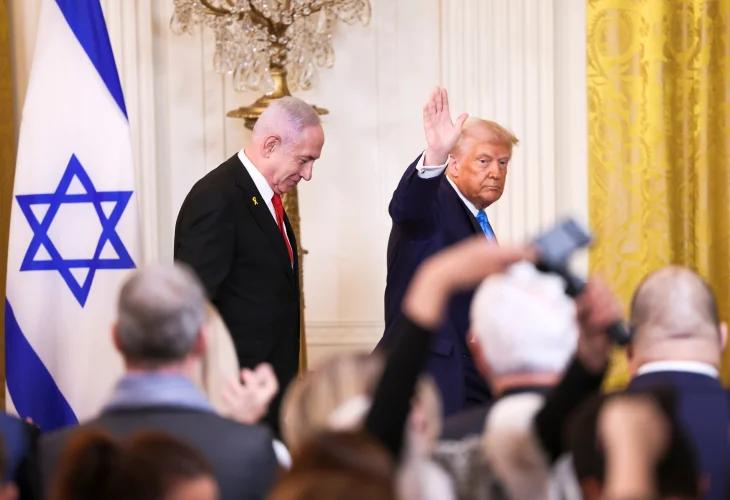 President Donald Trump and Prime Minister Benjamin Netanyahu (Shutterstock)
Prime Minister Benjamin Netanyahu is expected to meet U.S. President Donald Trump in Washington on Wednesday to discuss ongoing American negotiations with Iran, the Prime Minister’s Office announced Saturday evening. The pair’s seventh meeting since Trump returned to office was originally expected to take place later this month but was moved up as indirect U.S.–Iran talks resumed in Oman, with Israel seeking to quickly assert its red lines over the scope of any potential agreement.
According to the Prime Minister’s Office, Netanyahu believes any negotiations with Tehran must include limits on Iran’s ballistic missile program and an end to its support for regional proxy forces operating across the Middle East. Ahead of the visit, Netanyahu is also expected to convene coalition leaders and the political and security cabinets.
The first round of indirect U.S.–Iran discussions held Friday in Muscat lasted nearly eight hours. The talks were mediated by Oman’s foreign minister and included U.S. Middle East envoy Steve Witkoff and Trump adviser Jared Kushner, alongside Iranian Foreign Minister Abbas Araghchi. Trump described the discussions as “very good,” telling reporters aboard Air Force One that Iran appeared eager to reach an agreement. “They know that if they don’t make a deal, the consequences will be very severe,” he said, while stressing that Washington prefers a diplomatic solution.
Israel’s response followed quickly. The Prime Minister’s Office said Netanyahu believes any agreement with Iran must go beyond the nuclear file and include binding limits on Tehran’s ballistic missile program, as well as an end to its support for regional proxy forces operating across the Middle East. Israeli officials have repeatedly warned that a narrow nuclear-only framework would leave Iran’s broader military capabilities intact.
Israeli media have reported that officials are concerned negotiations could advance without incorporating those demands, raising the prospect of an agreement that Israel views as strategically insufficient. Those reports said the concern contributed to Netanyahu’s decision to move up his Washington visit in order to present Israel’s position directly to Trump before talks progress further.
Iranian officials, however, have drawn firm boundaries. In an interview with Al Jazeera on Saturday, Araghchi said the talks were indirect and focused exclusively on the nuclear issue. “Zero enrichment is outside the framework of the negotiations,” he said, adding that enrichment was a right Iran intended to preserve. He rejected any discussion of Iran’s ballistic missile program, saying it was “not negotiable now or at any time in the future,” and insisted talks must proceed without threats or pressure.
Araghchi also warned that any U.S. military strike on Iran would trigger retaliation against American bases in the region, though he said Tehran would not target neighboring countries hosting those forces. He added that while no date had been set for another round of talks, both Tehran and Washington believed discussions should resume soon.
Iran’s military leadership echoed the confrontational tone. Armed Forces Chief of Staff Mohammad Bagheri Mousavi said Iran’s air force was at its highest level of readiness and capable of delivering a “decisive, rapid and devastating response” to any attack. He warned that any attempt to impose war on Iran would expand the conflict across the region.
Alongside America’s diplomatic posture, Witkoff and Kushner visited the U.S. aircraft carrier Abraham Lincoln in the Arabian Sea on Saturday, together with Adm. Brad Cooper, the commander of U.S. Central Command. American officials have described the carrier as the spearhead of the U.S. regional strike group. British media separately reported that the United Kingdom reinforced its air presence in Cyprus overnight, deploying additional fighter jets amid concern over potential regional escalation.
With negotiations continuing and positions sharply divided, the Netanyahu–Trump meeting is shaping up as a near-term inflection point. Israel is expected to press its case that any agreement must go beyond the nuclear file, even as Washington and Tehran prepare for further talks in the days ahead.

