

World News
Thousands of Female Chabad Emissaries Convene for Largest Jewish Women’s Leadership Gathering
The five-day Kinus brings women representing 600 Jewish communities across 111 countries together for education, strategy, and renewal
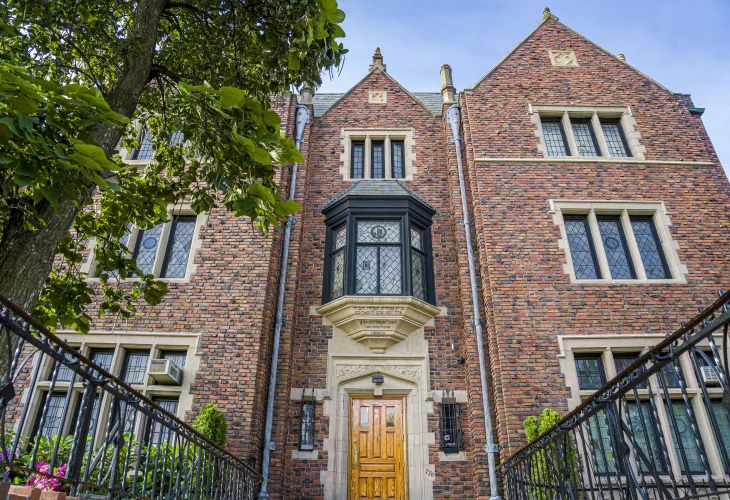 Chabad 770 (Shutterstock)
Thousands of female Chabad-Lubavitch emissaries from around the world gathered this week in Crown Heights, Brooklyn, for the 36th annual International Conference of Shluchos, the largest gathering of Jewish female leadership globally. The women represent roughly 600 Jewish communities across 111 countries and convened for five days of programming, reflection, and renewal.
The annual conference, centered around Chabad-Lubavitch world headquarters at 770 Eastern Parkway, comes at a moment of heightened danger for Jewish communities and Chabad institutions worldwide. Just weeks earlier, a deadly attack at a Chabad Chanukah event in Bondi, Sydney left 15 people dead, including a Chabad emissary. The gathering also followed a recent vehicle-ramming attack targeting Chabad’s headquarters in Brooklyn.
Female Chabad emissaries serve on the front lines of Jewish communal life, often as the primary Jewish presence in remote or isolated locations. While their husbands carry out rabbinic duties, the women manage educational programming, provide crisis support, oversee communal infrastructure, and ensure Jewish life continues uninterrupted, all while raising families far from extended support networks.
“We give the entire year. Our lives are all about giving, and today it’s about filling up our cup to make sure that we are receiving,” said Dinie Rapoport, a member of the conference’s executive committee. She described the gathering as a moment of renewal that enables participants to return home strengthened and recommitted to their mission.
Security considerations were a central feature of this year’s Kinus. Organizers coordinated closely with the New York Police Department and counterterrorism officials, while monitoring social media for potential threats. Rabbi Mendy Kotlarsky, director of the International Conference of Shluchos, said security has become a constant reality for Chabad events worldwide, but emphasized that the response is not retreat. “It’s a new reality that we live in,” he said, adding that the challenges only deepen the resolve to continue public Jewish life.
For many attendees, the conference also offered a rare chance to step away from isolated posts. Chani Aziza, an emissary in Dar es Salaam, Tanzania, where her and her husband are Chabad’s first emissaries in Tanzania. No kosher prepared food is available and everything must be cooked from scratch. Standing among thousands of fellow shluchos, she described the gathering as a source of strength. “It’s fun also to come here to take power, see all this amount of shluchos, everyone in different places and different challenges,” she said.
Education and youth engagement were a major focus of the conference. Devorah Leah Kalmenson, who moved to Leeds, England three years ago to help lead youth programming, spoke about managing multiple day camps each year while balancing family life. She credited training programs within the Chabad movement for helping her navigate the demands of running large-scale educational initiatives. Chabad currently operates 500 Jewish day camps and six overnight camps worldwide, reflecting a growing emphasis on reaching young families.
Veteran emissaries offered perspective on how the experience of shlichut has evolved. Perel Krasnjansky, who moved to Honolulu in 1987 to help establish Hawaii’s Chabad center, recalled the profound isolation of those early years. “It was like landing on the moon,” she said, noting that today’s emissaries benefit from global networks and constant connectivity that did not exist decades ago.
The shadow of the Sydney attack was felt throughout the conference. Laya Slavin, a Sydney-based community leader, said many local emissaries remained home to support their community. She debated attending herself before deciding to come, inspired by the message of Rabbi Eli Schlanger, the emissary killed in the attack. “There is so much to do in Sydney,” she said, describing volunteers baking hundreds of challahs for distribution, “but then again, you have that message from Rabbi Eli.”
The conference will culminate with a visit to the Ohel, the resting place of Rabbi Menachem M. Schneerson and Rebbetzin Chaya Mushka Schneerson, followed by a gala banquet honoring Australian shluchos and survivors.

