

Wonders of Creation
The Zombie Fungus: A Mind-Control Marvel of the Ant World
A fascinating look at the zombie fungus, a microscopic parasite that takes control of ants’ behavior, revealing one of nature’s most intricate and unsettling survival strategies.
- Yosef Yabece
- | Updated
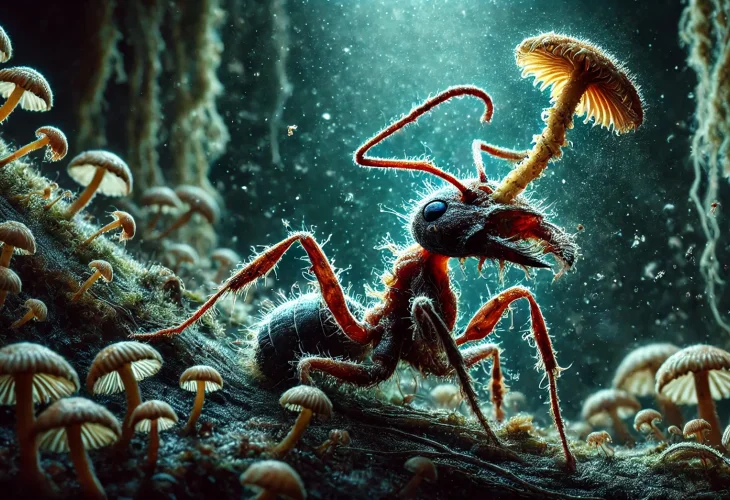
The kingdom of fungi is one of the most diverse and fascinating realms in nature. Fungi exist almost everywhere, from dry land to the depths of the ocean, and even inside living organisms. Some have evolved extraordinary survival strategies, but among the most astonishing is what is commonly known as the zombie fungus.
A parasite that takes control
The zombie fungus, scientifically called Ophiocordyceps unilateralis, is a remarkable parasite that infects ants and gradually takes over their bodies, turning them into what appears to be mindless “zombies.” Once inside the ant, the fungus releases chemical compounds that interfere with the ant’s nervous system, stripping it of control over its own behavior and redirecting it to serve the fungus’s needs.
After infection, the ant is compelled to leave its usual path and climb up a nearby plant. At a precise height, it clamps its jaws tightly around a stem or leaf in what researchers call the “death grip.” From there, the fungus begins to grow outward from the ant’s body, eventually producing spores that disperse into the environment and infect new hosts, completing its life cycle with chilling precision.
The sophistication of this process is breathtaking. It is difficult to comprehend how a microscopic spore can execute such a complex sequence of actions, something that would require advanced technology and entire research facilities if attempted by humans. To appreciate this marvel, it helps to look at the process step by step.
Step by step takeover
The process begins when a single fungal spore lands on an ant. The spore releases enzymes that dissolve the ant’s outer skeleton, allowing the fungus to penetrate the body. Once inside, it multiplies rapidly within the ant’s system, carefully avoiding killing its host too soon. At this stage, the fungus targets the central nervous system and eventually reaches the brain, setting the stage for full behavioral control.
When the fungus reaches the brain, it releases chemical compounds that closely resemble neurotransmitters. These substances alter brain function, effectively hijacking the ant’s behavior and turning it into a living tool that follows the fungus’s commands.
In the final stage, the ant is guided to climb approximately ten inches up a plant, where humidity and temperature are ideal for fungal growth. The ant bites down on the underside of a leaf, the most sheltered location for the fungus. Once anchored, the fungus enters its mycelium phase, spreading a network of fine threads throughout the ant’s body. These threads break down the ant’s tissues and convert them into energy. Days or weeks later, a fruiting body emerges, usually from the head or thorax, releasing new spores that fall or drift away in search of another ant.
How the colony responds
One of the most fascinating aspects of this phenomenon is the response of other ants. Early in the infection, the fungus disguises its presence. The infected ant continues to behave normally, foraging and interacting with its nest mates. The fungus even mimics the ant’s natural scent, preventing detection.
As the infection progresses, however, subtle changes appear. When the ant begins to move oddly or weaken, other ants may sense that something is wrong and start to distance themselves. If the infected ant does not leave the nest in time, some species take drastic action. Studies have shown that carpenter ants and others may capture the infected individual and remove it from the colony. In extreme cases, they dismember or kill the ant entirely to prevent the spread of spores and protect the rest of the nest.
A lesson hidden in the smallest details
All of this complexity is contained within a single microscopic spore. Within that tiny structure exists both the “software” of an intricate biological program and the chemical machinery needed to carry it out with precision and flexibility. Something so small contains an astonishing depth of wisdom.
The natural world continually reveals layers of intelligence and design that inspire awe. From the vastness of ecosystems to the smallest organisms, creation operates with remarkable order and purpose. The story of the zombie fungus is yet another reminder that even in the most unsettling corners of nature, there is profound wisdom at work. All that is left for us is to observe, reflect, and acknowledge the extraordinary depth of the world around us.

