

Wonders of Creation
Connecting the Cosmos and the Mind: Surprising Parallels in Nature
Two Italian astrophysicists noticed a striking resemblance between the network of galaxies in the universe and the human brain, sparking intriguing theories about the interconnectedness of all things.
- Yosef Yabece
- | Updated
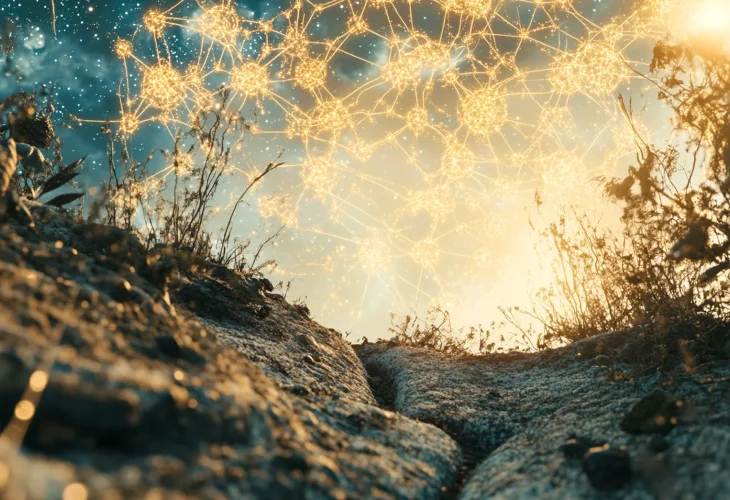
Five years ago, Italian astrophysicists Professor Franco Vazza and Professor Alberto Feletti of the University of Bologna were examining a section of the sky. As they analyzed computer simulations of the universe filled with stars and galaxies, they noticed something unexpected. The mapped structure of the heavens bore a striking resemblance to another image they knew well: the human brain.
The universe, it turns out, is not randomly scattered. Stars and galaxies form vast networks, connected by long filament-like structures. These cosmic “threads” closely resemble the neural networks found in the brain.
In an interview with Maya Mizrahi, the researchers explained that they compared the two systems on several fundamental levels. First, they examined how matter is distributed in each network. They analyzed digital slices of the human brain’s cortex and cerebellum and compared them with slices from simulations of the cosmic web. In both cases, the patterns of distribution followed remarkably similar rules.
Shared structure, shared proportions
The similarity does not stop at appearance. Both the brain and the universe function within a background of passive matter, and in nearly identical proportions. In the human brain, networks of billions of neurons are suspended in fluid, which makes up about 75 percent of the brain’s mass. Likewise, the universe consists of networks of billions of stars and galaxies embedded within dark matter, which also accounts for roughly 75 percent of the universe’s mass.
While the true nature of dark matter remains unknown, its presence is clearly inferred from measurements of the universe’s total mass. In light of these parallels, the ancient saying “Man is a small universe” suddenly feels less poetic and more literal.
Stars, societies, and shared laws
A related and equally intriguing idea was developed by Israeli physicist Alon Retter, who proposed what he calls the “Set Theory of Stars,” also known as the Astrosociology Model. According to Retter, the segmentation, distribution, and movement of stars across the universe mirror similar patterns found in human societies. Stars appear to form families, communities, and even larger groupings that resemble nations, with numerical proportions strikingly similar to how humans organize themselves.
Some researchers have extended this analogy even further, applying it to matter itself. Contemporary Russian physicists, for example, compared military maneuver tactics such as blitzkrieg warfare to the behavior of gases in nature. In the kinetic theory of gases, particles move, collide, and spread in ways that resemble masses of soldiers advancing from a central location. Both systems seek the most efficient way to channel energy through dense matter.
Other studies have drawn parallels between insect swarms and star clusters. One such study concluded simply that “clusters of midges behave like star clusters.” Similar research has shown that ants, too, follow physical laws that also govern inanimate matter.
Ants and the mathematics of light
One particularly elegant example involves Fermat’s Principle, formulated by Pierre de Fermat. This principle states that a beam of light traveling between two points will take the path that requires the least time, even if it is not the shortest distance.
Ants are well known for finding the shortest path to food. But what happens when the shortest path is not the fastest?
To illustrate this, consider a human example. A lifeguard must rescue someone drowning at sea. The swimmer is 45 meters away diagonally from the lifeguard’s booth but only 35 meters straight out from the shore at a point 30 meters down the beach. Since running is faster than swimming, the lifeguard’s quickest route is to run along the shore first and then enter the water, covering a total of 65 meters. The longer path, in this case, is the faster one.
Do ants reason the same way?
How ants choose the fastest path
Research described by Yehuda Blew examined this very question. Israeli scientists relocated three fire ant colonies into plastic boxes, each colony originating from a different location and containing thousands of workers and several queens. The researchers first measured how fast ants moved across different surfaces. On rough polyester, ants traveled at an average speed of 1.73 millimeters per second. On polished polyester, they moved at 2.97 millimeters per second. On acrylic glass, they reached 4.89 millimeters per second.
Each colony was then connected to a food arena containing cockroaches placed in one corner. The arena floor was divided into two types of surfaces: acrylic glass and polished polyester, acrylic glass and rough polyester, or polished polyester and rough polyester. Using the measured speeds and distances, researchers calculated which route would be shortest and which would be fastest.
The ants consistently chose the path that minimized travel time, even when it meant covering a longer distance. In other words, they behaved exactly as Fermat’s Principle predicts.
One design, many expressions
How do ants perform the calculations required to follow Fermat’s Principle? The answer is that they do not calculate in the human sense at all. Instead, they are guided by rules embedded deep within the natural world.
The same principles appear again and again across reality: in light, in gases, in insects, in stars, and even within the human brain. The inanimate, the living, and the conscious all operate according to shared laws.
The natural world is woven together with extraordinary wisdom. Hashem embedded the same principles throughout creation, from the smallest creature to the largest cosmic structure. By observing even a small fragment of this harmony, we gain a glimpse into the depth of the Creator’s design and are reminded that all of existence moves according to His will.

