

Purim
The Quiet Hero of Purim: Mordechai Behind the Scenes
He enters the Megillah as merely “a Jewish man in Shushan,” yet quietly becomes the figure who shapes everything.
- Y. Aviv
- | Updated
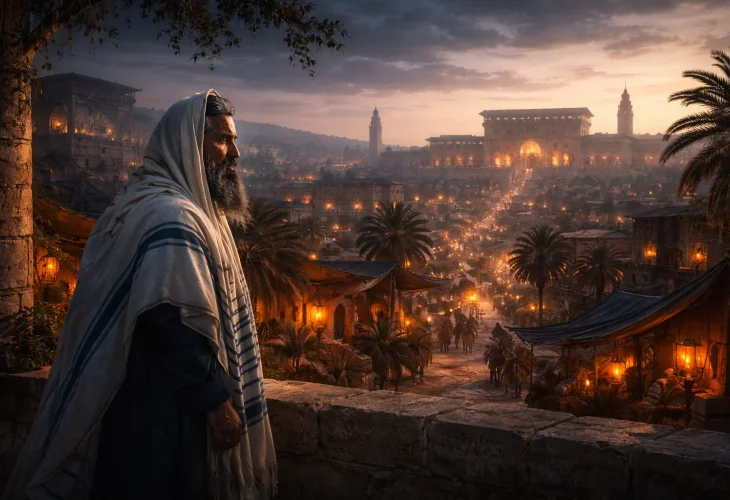
“A Jewish man lived in Shushan the capital, and his name was Mordechai, a Benjaminite who had been exiled from Jerusalem with the exile of King Jeconiah of Judah” (Esther 2:5).
In other words, Mordechai is introduced in the Megillah in the simplest possible terms. He is a Jewish man, descended from the tribe of Benjamin, living in exile as a result of the earlier deportation from Jerusalem that took place eleven years before the city’s final destruction. No title, no position of power, no public status. Just a Jew in exile, far from the center of events.
Yet as the story unfolds, Mordechai’s stature becomes increasingly clear. Quietly and without fanfare, he steers events from behind the curtain, shaping history without seeking recognition.
An Educator Who Builds the Future
The first thing Scripture tells us about Mordechai is not his political influence or public standing, but his role as an educator. “And he raised Hadassah, that is Esther, his uncle’s daughter; and when her father and mother died, Mordechai took her as a daughter.” He invests years in guiding and shaping her character.
That investment later bears fruit. Even when she ascends to the royal throne, Esther continues to follow his counsel. “And Esther did Mordechai’s bidding as she had done when raised by him” (Esther 2:20). His guidance is conveyed discreetly, without public display. Even when Mordechai uncovers the plot to assassinate the king, the information reaches Ahasuerus through Esther, with Mordechai making no effort to claim credit.
“All the days Mordechai would walk before the court of the women’s house, to know Esther’s welfare and what would be done with her” (Esther 2:11). For years, day after day, he strengthens her spirit so that her faith will not falter and her separation from home will not alter her way of life. The Midrash explains that Mordechai already sensed a deeper purpose at work. He said, “Why was this righteous woman taken to the king? Only so that salvation would come through her.”
In Mordechai’s eyes, Esther’s selection as queen was not a cause for celebration. She was, against her will, married to a non-Jewish king. Yet he understood that a hidden process was unfolding, one that required her presence in a position of influence. This understanding is what drove his persistent concern, his walking before the palace day after day.
Awakening a Nation
When the decree is issued and Mordechai’s fears are confirmed, he takes an extraordinary step to awaken the Jewish people. Shushan the capital was the seat of imperial power, distinct from the general city of Shushan. The Jewish population there was large and well integrated. The Sages teach that eighteen thousand five hundred Jews attended the king’s banquet alone, suggesting a vast community closely connected to the ruling circles.
Could such a horrific decree truly be imagined? A command to destroy, kill, and annihilate an entire people, without cause or provocation, born purely of hatred. The parallels to later chapters of Jewish history are chilling.
And once again, the surrounding world remains silent. Indifference prevails as disaster looms over their Jewish neighbors. Scripture records one exception, Charvona, whose words expose the gallows prepared for Mordechai. His memory is preserved for generations, even in the piyyut “Shoshanat Yaakov,” teaching that sometimes a single voice of support carries eternal weight.
Mordechai understands that silence is no longer an option. He goes out into the city square with torn garments and a bitter cry. The message is unmistakable. Throughout the Jewish community there is great mourning, fasting, weeping, and lamentation. Sackcloth and ashes spread among many. A wave of spiritual awakening sweeps the people, and public gatherings of repentance are organized.
The Sages describe how Mordechai gathered the children of Shushan while they fasted, sitting with them to study Torah. When Haman arrives, expecting to see despair, he instead finds learning. Mordechai tells him they are studying the laws of the korban ha-omer, appropriate for the days of Pesach, which they could no longer bring in exile. Haman responds with a startling admission: the small handful, the kometz, has overcome his ten thousand talents of silver.
Leadership Without Illusion
Even after the dramatic reversal, when Haman is forced to lead Mordechai through the city in royal procession, Mordechai does not succumb to triumph. “And Mordechai returned to the king’s gate.” He does not go home. The decree still stands, threatening the entire nation. This is not a personal struggle between him and Haman, but a national crisis. Therefore, the momentary honor does not intoxicate him, and he continues fasting and self-denial.
After Haman’s downfall, Mordechai remains restless. Time continues to pass, and the danger has not fully dissipated. Even when the king claims that a sealed decree cannot be revoked, Mordechai finds a creative and faithful solution. The Jews are granted permission to defend themselves against those who seek their harm. They do not initiate violence, but they are empowered to protect their lives. In this way, the royal decree is preserved, and the Jewish people are saved.
Finally, Mordechai and Esther ensure that this salvation will never fade from memory. “And these days of Purim shall not pass from among the Jews, and their memory shall not perish from their descendants.” Even in a future when other commandments may cease, the remembrance of Purim endures.
This is the legacy of Mordechai. A single individual, acting quietly, faithfully, and persistently, who fulfills the will of his Creator and succeeds in bringing salvation to an entire nation.

