

Purim
Why God’s Name Is Hidden in the Book of Esther: The Timeless Message of Purim
How hidden Divine Providence in the Megillah speaks powerfully to life in the 21st century
- Daniel Blass
- | Updated
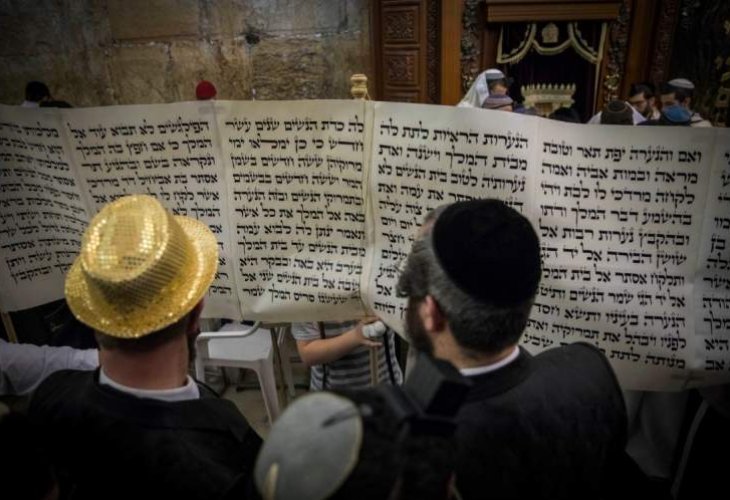 (Illustrative photo: Flash 90)
Lior asks: “Hello. I wanted to know why God’s Name is not mentioned in the Book of Esther, and how a holiday commemorating a salvation that occurred thousands of years ago is relevant to our lives today in the twenty-first century.”
***
Hello Lior. Both of your questions are answered by a single idea. The very fact that God’s Name is hidden in the Megillah teaches us the central lesson of the holiday, a lesson that was just as relevant in ancient Persia as it is in our own generation.
Divine Providence Behind Concealment
The Megillah expresses a form of divine providence that guides every step from behind a veil of concealment. As the Sages say: “Where is Esther hinted at in the Torah? In the verse, ‘And I will surely hide My face’” (Chullin 139b).
This can be compared to a father who covers his face with his hands in front of his young child. His face has not disappeared; it is hidden. The face is still there. This is the idea of a mask. It creates the illusion of absence, but it is not true disappearance.
The festival of Purim reminds us that God acts behind the scenes of the stage of history, behind events that are mistakenly perceived as “natural” or “coincidental.” With deeper reflection, however, one sees that these are in fact full miracles guided from Heaven.
This is the deeper reason God’s Name is hidden in the Megillah: to teach an enduring lesson in faith and divine providence for all generations.
A Historical Explanation
On the simple, contextual level, there may also be an external reason for this style of writing. Rabbi Abraham Ibn Ezra writes in his introduction to his commentary on the Megillah that God’s Name was omitted because the Megillah was written by Mordechai under the authority of the Persian Empire.
Since the Persians were idol worshippers, there was concern that when the Megillah would be translated into other languages, they would replace God’s Name with the names of Persian idols. Ibn Ezra notes that similar distortions occurred elsewhere, where idol names were substituted for the Divine Name. Out of respect for God’s honor, Mordechai therefore refrained from mentioning His Name explicitly in the Megillah.
In other words, God orchestrated events so that Mordechai could not write His Name openly, and was compelled to conceal it. Through this concealment, God taught us about His providence operating behind the scenes.
The commentators also explain that God’s Name is hidden in the Megillah through the repeated reference to King Achashverosh. The word “king” appears in the Megillah roughly two hundred times. Sometimes it appears as “King Achashverosh,” and sometimes simply as “the king.”
This repetition hints to the true King who stands behind all the events, directing them silently and invisibly.
How Purim Speaks to the Twenty-First Century
You ask how Purim relates to our lives today. The answer lies within the Megillah itself. All the miracles of Purim occurred in what appeared to be a completely natural way, without God revealing Himself to a prophet or speaking openly.
The miracles unfolded behind the scenes of history. Yet anyone who carefully observes the sequence of events in the Megillah is immediately struck by the precision of the divine providence guiding every detail.
The Reversal of Haman’s Plans
To this very day, adults and children alike smile with delight during the reading of the Megillah when they see how Haman’s evil plans are overturned against him, measure for measure.
Haman comes to request Mordechai’s execution, and to his astonishment Achashverosh asks him: “What shall be done for the man whom the king desires to honor?” Haman is certain the king means him, but in truth Achashverosh intends to honor Mordechai, who saved his life.
How did Achashverosh suddenly remember Mordechai? Because that very night his sleep was disturbed, and he asked that the royal chronicles be read to him.
Now Haman is forced to dress Mordechai in royal garments, place him on the king’s horse, and lead him through the city, proclaiming aloud about the very Jew who refused to bow to him: “Thus shall be done to the man whom the king desires to honor.”
Who, then, is the true King who desired to honor Mordechai, if not God Himself?
From Gallows to Judgment
Haman prepared a gallows fifty cubits high, about twenty-five meters, to hang Mordechai. But once he learned that the king favored Mordechai, he had no time to dismantle it, for he was immediately summoned to the queen’s banquet.
When Esther reveals Haman’s wicked plot to Achashverosh, Haman panics and falls at Esther’s couch, begging for his life. At that exact moment, Achashverosh returns to the room, and Haman’s face is covered in shame.
What is the fitting punishment for this villain? As the verse states: “Then Charvonah, one of the eunuchs before the king, said: ‘Behold, the gallows that Haman made for Mordechai, who spoke good for the king, stands in Haman’s house, fifty cubits high.’ And the king said: ‘Hang him on it’” (Esther 7:9).
A Perfectly Woven Design
All of Israel’s enemies were ready to destroy the Jewish people in a single day, but everything was reversed. The Jews struck down their enemies in Shushan, killing five hundred foes, the ten sons of Haman, and many others.
Anyone who studies the Megillah carefully will find a wealth of intricate details woven together like a masterful work of art. Each detail connects to another, all leading to the precise outcome intended by divine providence.
“Relief and Deliverance Will Come from Another Place”
God hid Himself behind every event in the Megillah, from beginning to end, and even hid His Name within it, in order to teach in every generation the essential lesson of searching for faith even within concealment.
This message is stated explicitly in the Megillah itself. Before Queen Esther acted to save the Jewish people, Mordechai said to her: “For if you remain silent at this time, relief and deliverance will arise for the Jews from another place” (Esther 4:14).
Mordechai was teaching Esther a fundamental principle: God has a plan, and He will fulfill His will in any case. He has many agents. Esther merited becoming the righteous agent through whom God chose to save Israel.
Purim as an Eternal Holiday
Purim is an eternal holiday because it teaches the most important lesson of all: faith and divine providence within a reality of concealment. This is precisely the condition of our era in the twenty-first century, before the coming of redemption.
Through humor, costumes, wine, and reversals, which are all symbols of the holiday, we are reminded that behind all the masks we see in the world, there exists a hidden divine reality directing everything.
A Lesson for the End of Days
This lesson also relates to the end of days. The Sages taught regarding the final redemption: “If Israel repents, they are redeemed; and if not, God appoints for them a king whose decrees are as harsh as Haman’s, and Israel repents and returns to the right path” (Sanhedrin 97b).
God will bring redemption in any case. But we can choose to be worthy agents who bring it swiftly and gently. If, Heaven forbid, we remain silent at such a moment, relief and salvation will come to the Jews from another place.
Reading the Megillah of Our Time
We must remember that God is the One who turns all events, what appears to us as “nature,” and the wheels of history leading to redemption.
One who observes carefully the “Megillah” of the twenty-first century will once again see the brilliant designs of the One who declares the end from the beginning. In an instant, everything will be overturned, the masks will be removed, and the Creator will be revealed in all His glory from within the greatest concealment.
Then it will become clear that the concealment itself was only a stage for revealed providence, and we will once again merit light, joy, gladness, and honor.

