

Purim
Megillat Esther in Light of Archaeological Evidence
An exploration of the historical and archaeological background of Megillat Esther, revealing how the physical remains of ancient Shushan illuminate key details of the Purim story.
- Hidabroot
- | Updated
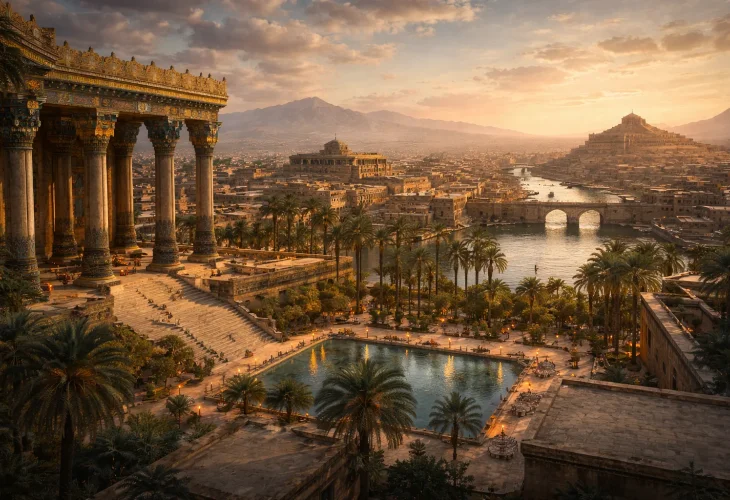
The events described in Megillat Esther took place a little more than 2,400 years ago. The story itself is familiar and well known, so there is no need to recount it here. Instead, we will take a closer look at the historical setting of these events and highlight several details in the Megillah that align strikingly with archaeological findings.
During that period, in the days of Darius I, roughly 2,500 years ago, the Achaemenid Persian Empire stretched across an enormous territory, from India in the east to Kush in the west. Because of its vast size, the empire maintained four principal capitals: Babylon, Ecbatana, Persepolis, and Shushan, the capital of Elam.
Why Shushan Was the Empire’s Center
Among these capitals, Shushan held a particularly important status. It served as the political and administrative center of the empire and functioned as the king’s winter residence. Situated in a hot climate, Shushan housed the royal court during the colder months. The city was fortified by a strong wall and lay along the banks of the Ulai River.
Within the city walls stood magnificent palaces and residential quarters. Shushan’s long history included eras of great prosperity and legendary wealth, alongside periods of conquest and destruction. Among its conquerors were Nebuchadnezzar of Babylon, Ashurbanipal of Assyria, Alexander the Great, and eventually the Arab armies. About seven hundred years ago, Shushan was abandoned entirely and has remained in ruins ever since.
Archaeological Discoveries at Shushan
The remains of ancient Shushan are located in today’s southwestern Iran, roughly one hundred kilometers north of the Persian Gulf. The archaeological site covers approximately four square kilometers and includes four distinct tells upon which the city was built.
Excavations began in the mid-nineteenth century and were expanded significantly by a French expedition at the end of that century. Despite interruptions caused by wars and political upheaval, archaeological work continued into modern times. Researchers date the earliest settlement at the site to nearly five thousand years ago.
“Shushan the Capital” and “the City of Shushan”
In the text of the Megillah, the city appears under two distinct names: “Shushan the capital” and “the city of Shushan.” Scholars generally understand this distinction to reflect two separate areas. “Shushan the capital” refers specifically to the royal and administrative precinct, while “the city of Shushan” denotes the broader urban area where the general population lived.
Support for this interpretation appears at the beginning of the Megillah, where the king hosts a feast “for all the people who were in Shushan the capital,” held in the courtyard of the palace garden. Such a setting could realistically accommodate the empire’s dignitaries only within the royal quarter itself.
Archaeological findings reinforce this understanding. Shushan was composed of four main complexes: the acropolis, the royal palace area, the governmental quarter, and a commercial district.
Mordechai’s Urgent Mission
When Haman’s decree was sealed with the king’s signet and issued, Mordechai went to the gate of the king’s palace and sent urgent messages to Queen Esther, urging her to intervene. Esther initially hesitated, fearing for her life, but after Mordechai’s rebuke, she accepted her role and asked that all the Jews “who are in Shushan” fast on her behalf for three days.
The verse then states: “And Mordechai passed and did according to all that Esther had commanded him.” This wording raises an important question. What does it mean that Mordechai “passed”?
Crossing the Water Channel
The Sages offered two explanations. One opinion understands this as a halachic decision to override the first day of Pesach with a communal fast, invoking the principle that in a moment of existential danger, certain commandments may be temporarily set aside to preserve the Torah as a whole.
Another explanation, supported by archaeological evidence, understands the verse literally. Excavations revealed that a broad, deep moat filled with water from the Ulai River surrounded the royal precinct. This moat separated the palace and government complex from the rest of the city, with access controlled by guarded bridges.
Mordechai, a known Jewish figure, could not openly cross these bridges without arousing suspicion. Yet he urgently needed to reach the Jewish population living in the city proper. The decree had been formally issued only in “Shushan the capital,” while the broader city was confused and alarmed, as the verse states: “And the city of Shushan was perplexed.”
Mordechai, who alone fully understood the scope of the decree due to his position at the king’s gate, therefore crossed the water channel itself rather than using the guarded bridge. In this way, he was able to reach the people and awaken them to fasting, prayer, and repentance.
Text, Tradition, and Archaeology
Here, the Megillah’s language, the teachings of Chazal, and the archaeological record converge. Each illuminates the other, revealing how deeply the biblical narrative is grounded in the historical and geographical reality of ancient Shushan.

