

World News
Mass Protests and Arrests Disrupt Isaac Herzog’s Visit to Australia
Police deploy emergency powers as Israel’s president presses for renewed ties and addresses Jewish communities despite unrest
- Brian Racer
- | Updated
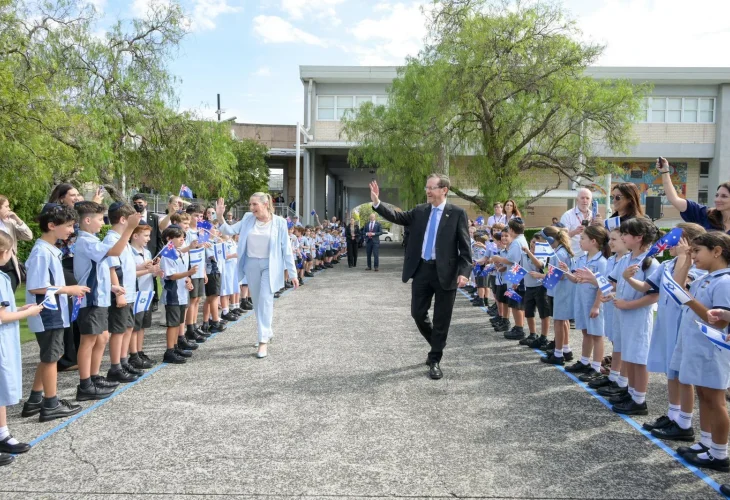 Isaac Herzog at Moriah College (Maayan Tof/GPO)
Mass protests and police clashes overshadowed President Isaac Herzog’s state visit to Australia this week, as thousands demonstrated against his arrival and authorities made dozens of arrests in Sydney and other major cities.
In Sydney, a rally at Town Hall against Herzog’s visit devolved into chaos on Monday night after police ordered protesters to disperse and deployed pepper spray to clear the area. Authorities said 27 people were arrested, with nine charged as of Tuesday on offences including offensive behaviour and resisting police. Five members of the public were hospitalized.
Herzog is visiting Australia at the invitation of Prime Minister Anthony Albanese following the December 14 terror attack at a Chanukah event at Bondi Beach that killed 15 people. The visit was intended as a gesture of solidarity with Australia’s Jewish community, but has instead become a flashpoint for public unrest and political debate.
New South Wales Premier Chris Minns defended the police response, saying officers were dealing with an increasingly volatile situation. “Context is important and the circumstances facing police were incredibly difficult,” Minns said, describing the scenes as effectively “the middle of a riot.”
Protesters and some public figures, however, accused police of excessive force. Australia’s special envoy to combat Islamophobia, Aftab Malik, described the response as involving “unprovoked violence and aggression,” while several protesters reported being assaulted during the dispersal.
Addressing the controversy on Tuesday, Herzog rejected the notion that the demonstrators reflected broader Australian sentiment toward Israel. Speaking to Jewish students at Moriah War Memorial College, he said the protesters “are a minority” and do not represent what he called the “silent majority of Australians” who wish to see relations with Israel restored to earlier levels.
Herzog recalled a 2008 visit to Australia, when he said Israel enjoyed strong bipartisan support across the political spectrum. “Something has happened in the last generation,” he said, referring to Israel’s current standing in the country, adding that the shift must be confronted through engagement rather than withdrawal.
During a brief question-and-answer session, Herzog told students they were facing a “huge wave of antisemitism,” something he said few expected to see in Australia, long viewed as a safe haven for Jews. He urged them to remain visible and confident, advising: “Stand up, look them in the eye, don’t be afraid,” and to take pride in their Jewish and Zionist identity.
Later on Monday evening, Herzog addressed a packed memorial-style gathering at the ICC Sydney Theatre, where community members marked the trauma of the Bondi Beach attack. Family members of victims, students, rabbis, and musicians took part in a program of readings, music, and tributes, emphasising shared grief and resilience across communities.
Herzog told the audience that the emotional scars of December 14 would endure long after the immediate shock faded, linking the attack to what he described as an age-old pattern of antisemitism. He said his decision to travel to Sydney was driven by action rather than symbolism, stressing the importance of physically showing up in moments of crisis.
Alongside the communal focus, Herzog also addressed the diplomatic dimension of his visit. He acknowledged “ups and downs” in Israel’s relationship with the current Australian government but said a central goal of the trip was to put ties “back on track,” upgrade cooperation, and improve understanding. He is scheduled to meet Albanese in Canberra as part of those efforts.

