

Israel News
Netanyahu Takes Off to Washington as U.S. Iran Talks Move Ahead Without Red Lines
Israeli officials say the prime minister aims to harden deal terms before negotiations narrow to enrichment alone
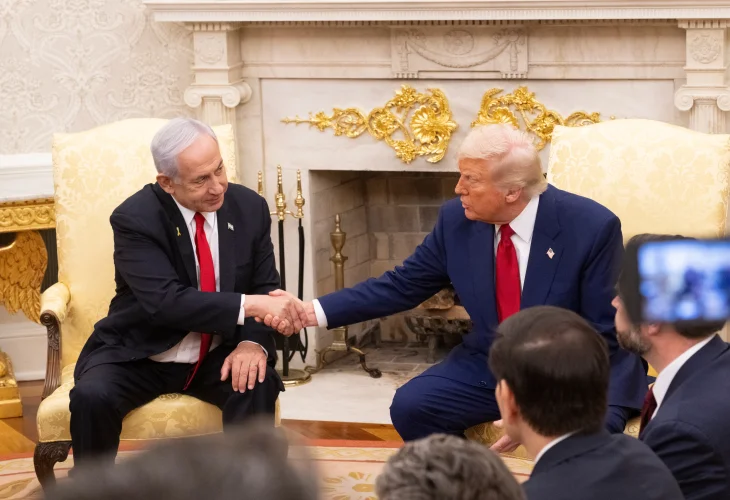 PM Benjamin Netanyahu and President Donald Trump (Shutterstock)
Prime Minister Benjamin Netanyahu departed Tuesday at midday for a short visit to Washington, where he is expected to meet Donald Trump on Wednesday, as talks between the United States and Iran move toward another round.
Israeli officials describe the visit as a strategy-shaping session rather than a crisis response, aimed at influencing the scope and limits of any potential agreement with Tehran before negotiations advance further.
At the center of the talks is Washington’s decision to keep its red lines deliberately undefined. Trump has publicly emphasized a single condition for an agreement. “The most important thing, the first condition: no nuclear weapons,” the president said. US officials have avoided spelling out enrichment thresholds or other concrete limits, signaling flexibility at the negotiating table while keeping options open.
Speaking ahead of his departure, Prime Minister Benjamin Netanyahu said he would speak with Donald Trump about Gaza, “and mainly about Iran and what must be included in any agreement.”
Israel’s concern is that such ambiguity could allow an agreement that prevents an Iranian bomb but leaves Tehran with capabilities Israel considers unacceptable. Israeli officials say Netanyahu intends to press for a broader framework that goes beyond enrichment alone and addresses missiles and regional activity.
According to sources close to the prime minister, Netanyahu is expected to present Trump with information indicating renewed Iranian activity in its ballistic missile program. Israeli officials insist that any agreement must include zero enrichment or enrichment capability, removal of enriched material from Iran, limits on ballistic missile ranges, and an end to Iranian support for regional terror organizations.
Netanyahu’s office has stated that missiles and Iran’s regional activity cannot be separated from the nuclear issue. “The prime minister believes that all negotiations must include limiting the ballistic missiles, and ending support for the Iranian axis,” the statement said.
Tehran, however, has publicly rejected that approach. Iranian officials say they are prepared to discuss guarantees against nuclear weapons but insist that enrichment and missile capabilities are non-negotiable. Iran’s foreign minister has warned that any attack on the country would be met with retaliation against US assets in the region.
Alongside the diplomatic track, Washington has continued to reinforce its military posture in the Middle East, deploying additional naval and air assets to the region. US officials have described the buildup as support for diplomacy rather than a signal of imminent action, but they have not ruled out the use of force if talks fail.
Vice President JD Vance said this week that the administration is keeping its options open. “The president is going to keep his options open,” he said, adding that Trump would choose a military option if he concluded it was the only viable path.
Israeli officials view the military posture as both leverage on Tehran and preparation for the possibility that negotiations collapse without a meaningful agreement. US sources cited in Israeli media have said Netanyahu favors a military option should diplomacy fail, though Israeli officials frame the visit primarily as an effort to clarify consequences before talks move forward.
Ahead of Netanyahu’s visit, Iran’s Foreign Ministry signaled resistance to Israeli involvement in the talks. A spokesman said Tehran was negotiating directly with Washington and that it was “the responsibility of the American envoys to act independently, without yielding to foreign pressure, and to decide what is best for U.S. foreign policy.”
As of now, the Netanyahu–Trump meeting is the sole event on the prime minister’s schedule in Washington. Israeli officials expect the next round of US–Iran talks to be set only after the meeting concludes.

