

World News
AJC Survey: American Jews Now Alter Daily Life After Violent Antisemitic Attacks
Majority report reduced personal safety, rising online threats, and widening gaps with the broader public after a year of deadly antisemitic incidents
- Brian Racer
- | Updated
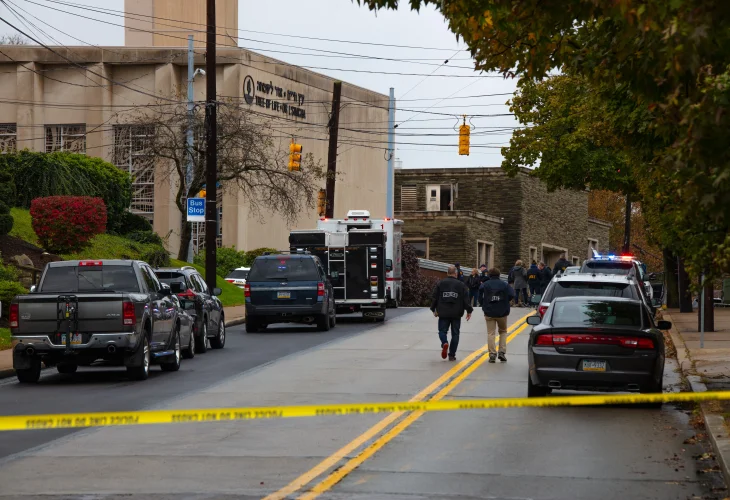 Security outside synagogue (Shutterstock)
The vast majority of American Jews say violent antisemitic attacks over the past year have forced them to live differently in the United States, according to a new survey released by the American Jewish Committee.
The survey found that 91% of American Jews say they feel less safe as a Jewish person in the U.S. following the arson attack on Pennsylvania Gov. Josh Shapiro’s residence, the Capital Jewish Museum murders, and the Boulder hostage-march firebombing.
Taken together, the data shows that Jewish insecurity is no longer episodic but structural, shaping how Jews assess risk in everyday public life. The report comes more than two years after October 7, which 78% of American Jews say also made them feel less safe in the United States.
“The fortress walls of metal detectors and bullet proof glass we build around the Jewish community today signal additional cracks in the foundation of our society,” said AJC CEO Ted Deutch.
That insecurity is translating into concrete changes in daily behavior. More than half of American Jews, 55%, report changing their behavior in the past year out of fear of antisemitism. Among the 31% who say they were personally targeted by antisemitism, either in person or online, the impact is even sharper, with 80% saying they altered their behavior.
“We need Americans to wake up to the reality of what their Jewish neighbors are experiencing,” Deutch said. “Right now, in America, when Jews gather, whether at synagogue or a community event, it’s routinely behind metal detectors and armed guards. No one in America should have to change their behavior because of what they believe, but that’s how most Jews are living their lives. What we’re asking for is what every other minority group expects in America: the freedom to be who we are without fearing for our safety.”
Young American Jews are experiencing antisemitism at particularly high levels. Nearly half, 47%, of Jews ages 18 to 29 report being personally targeted in the past year, compared to 28% of those aged 30 and over. Seven percent of young Jews report being the target of a physical antisemitic attack, more than triple the rate among older respondents.
Concerns are especially acute on college campuses. Forty-two percent of American Jewish college students say they experienced antisemitism during their time in school, while one in four report feeling excluded from a group or event because they are Jewish. A similar share say they were excluded due to their actual or assumed connection to Israel.
Much of the antisemitism reported in the survey is occurring online. For the first time in the history of AJC’s tracking, more than seven in ten American Jews, 73%, say they experienced antisemitism online, either by seeing or hearing it or by being personally targeted. Nineteen percent say they were directly targeted by antisemitic remarks or posts online, and 21% of those who encountered online antisemitism say they felt physically threatened as a result.
The rise of generative AI is adding to those concerns. Sixty-five percent of American Jews say they are concerned that AI chatbots will spread antisemitism, and 69% worry that misinformation generated by these tools will lead to antisemitic incidents.
The survey also highlights a gap between how Jews and the broader public view antisemitism. While 93% of American Jews say antisemitism is a problem in the U.S. today, only 70% of U.S. adults agree. A majority of American Jews, 86%, say antisemitism has increased since the October 7 attacks, compared to 63% of the general public.
The sense of exposure documented in the survey is also reflected in how American Jews view political leadership’s response to antisemitism. For the first time, the survey asked American Jews about their views on President Donald Trump’s response to antisemitism. Roughly two-thirds of respondents said they disapproved, with 84% of Jewish Democrats disapproving of Trump’s response “at least somewhat” compared to 9% of Jewish Republicans.
Deutch warned that the survey’s findings point to a broader societal breakdown, not an isolated communal problem. “This is about more than just what’s happening to Jews,” Deutch said. “We’ve always been first, the Jews have always been a canary in the coal mine, and we have to take this seriously. The broader community has to take this seriously for the benefit, not just of our Jewish community, but for our society and our democracy.”
The surveys were conducted by the independent research firm SSRS between late September and October 2025, sampling 1,222 American Jews and 1,033 U.S. adults nationwide.

