

Wonders of Creation
Can Mushrooms Really Make Decisions? A Surprising Discovery
At first glance, the idea of mushrooms making decisions sounds like science fiction or a children’s story. After all, mushrooms don't have brains. Or do they? New research is challenging this assumption with surprising and thought provoking discoveries.
- Yosef Yabece
- | Updated
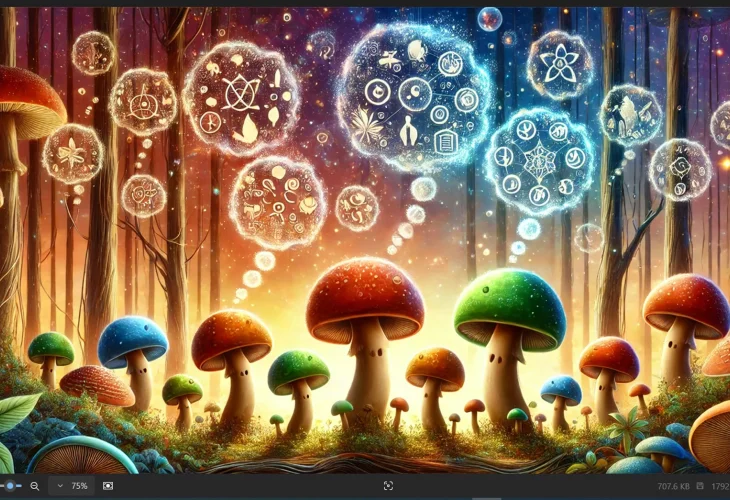
A recent study has sparked widespread curiosity by suggesting that mushrooms may be capable of making decisions, recognizing shapes, and solving problems. These findings raise a fascinating question. Could mushrooms possess a form of intelligence.
Exploring Mushroom Behavior
Researchers from Tohoku University and Nagaoka College set out to explore this possibility by observing how mushrooms grow and spread. What they discovered was remarkable. Even when blocked by plastic barriers that mushrooms cannot biologically sense, the organisms appeared to take future growth possibilities into account.
Yu Fukasawa of Tohoku University explains, “You would be surprised by what mushrooms can do. They have memory, they learn, and they can make decisions. The differences between how they solve problems and how humans do are truly fascinating.”
A Network Beneath the Surface
Mushrooms reproduce by releasing spores that grow into long, threadlike structures underground. While we usually only notice the visible mushroom above ground, beneath the surface lies a vast interconnected network. These threads function in a way similar to a brain, transmitting information across the organism. When this network is cut, communication stops.
The information being transmitted is not abstract or symbolic. It relates to survival and growth. The network shares data about where it is most advantageous to expand next.
Choosing Where to Grow
The study focused on mushrooms that grow on decaying trees. Researchers examined how they decided where to expand by placing them in different environments. Some mushrooms were grown in round enclosures, while others were placed in grid shaped spaces.
The results showed that growth was not random. Mushrooms in grid shaped environments extended their spores toward the corners, areas that offered greater potential energy sources. This happened even when there were no immediate obstacles to guide that choice.
In round enclosures, mushrooms spread evenly in all directions. The growth pattern suggested that the organism was responding to the shape of its surroundings and adjusting its behavior accordingly.
Intelligence Without a Brain
These observations suggest that mushrooms are able to gather information from their environment and modify their growth patterns based on that input. This points to a form of internal communication across the network that allows the organism to optimize its chances of survival.
The research adds to growing evidence that intelligence is not limited to creatures with brains or nervous systems. While intelligence is often associated with animals, especially those with complex neural structures, this study highlights that it can appear in many forms. In mushrooms, intelligence seems to lie in their ability to process environmental information and make decisions that benefit the organism as a whole.
“Our understanding of the world of mushrooms is still very limited,” Fukasawa notes. “We know far more about plants and animals than about fungi. This research sheds light on the hidden intelligence of these organisms and the role their decision making plays in larger ecosystems.”
Wisdom in the Smallest Creations
As scientists continue to explore the world of fungi, we may uncover even more striking examples of intelligence in organisms that appear simple at first glance.
Once again, we see that even within the smallest of Hashem’s creations, there is profound wisdom, planning, and design. Each living being is equipped with exactly what it needs to survive and thrive, revealing depth and intention woven into every layer of creation.

