

World News
Antisemitism Hearing Derails After Commissioner Presses Jews to Condemn Israe
U.S. Religious Liberty Commission session meant to address antisemitism veered into repeated demands that Jewish witnesses denounce Israel, prompting pushback from witnesses and the chair
- Brian Racer
- | Updated
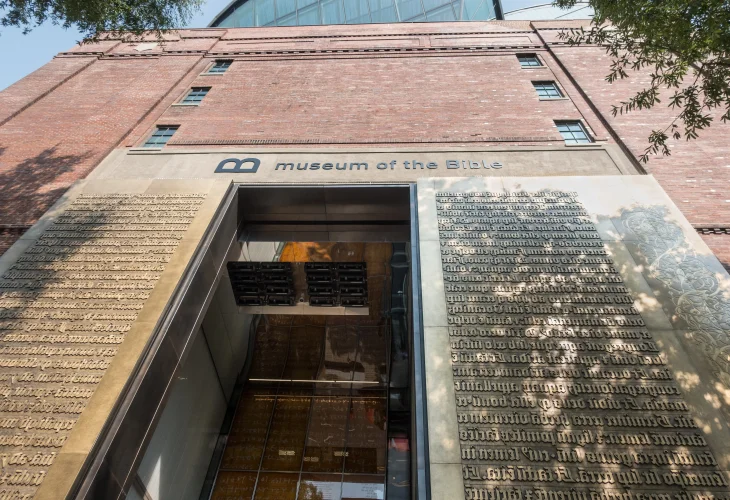 Museum of the Bible (Shutterstock)
The first public antisemitism hearing of the U.S. Religious Liberty Commission in Washington on Monday grew contentious after a commissioner repeatedly pressed Jewish witnesses to condemn Israel, redirecting testimony away from discrimination facing Jews in the United States.
The hearing, held at the Museum of the Bible, was convened to gather testimony from Jewish leaders and campus activists about rising antisemitism in American society. Instead, parts of the session devolved into a debate over Israel, anti-Zionism, and whether opposition to the Jewish state should be considered antisemitic.
The line of questioning was driven largely by commissioner Carrie Prejean Boller, a conservative activist appointed to the commission by President Donald Trump last year. At one point, Boller said she had been counting references to Israel during the discussion and challenged one witness directly.
“Since we’ve mentioned Israel a total of 17 times, are you willing to condemn what Israel has done in Gaza?” she asked Harvard alum and Jewish activist Shabbos Kestenbaum.
Boller also argued that opposition to Zionism should not be considered antisemitic and defended conservative commentators Candace Owens and Tucker Carlson, whom Jewish organizations have repeatedly accused of promoting antisemitic rhetoric. “She’s not an antisemite. She just doesn’t support Zionism,” Boller said of Owens, drawing an audible reaction from the audience.
Kestenbaum later told JNS that he had deliberately avoided mentioning Israel in his testimony in order to focus on antisemitism affecting American students. “Not to get in a foreign policy debate about Israel,” he said, explaining that his goal was to highlight discrimination on U.S. campuses as an American civil rights issue.
“I want to get the point across that what is happening at American universities is happening to American students, and it’s an affront to American values,” he said. “The fact that a commissioner would bring in a foreign conflict, which was not part of my narrative, demonstrates that there was an agenda.”
The exchange prompted several rounds of booing from the audience and appeared to frustrate commission chair Dan Patrick, the Republican lieutenant governor of Texas. Patrick interrupted the discussion and sought to rein in the questioning.
“This is not a commission on defining religions or calling out any theology,” Patrick said. “This is not the commission for that.”
Other witnesses echoed the concern that the hearing had drifted from its purpose. Rabbi Ari Berman, president of Yeshiva University, said it is antisemitic to deny Israel’s right to exist as a Jewish state while accepting Christian and Muslim states elsewhere. When Boller responded by warning against Islamophobic statements, Berman rejected the framing, later saying the exchange was a minor moment in a much broader discussion.
“To build a coalition of angels is what is necessary,” Berman told JNS, arguing that universities must be incentivized to teach American values and moral clarity. “What we’ve seen in universities is that fear has replaced leadership.”
Bruce Pearl, former Auburn University men’s basketball coach and founder of the Jewish Coaches Association, said the tense exchanges were ultimately revealing. “The question was, ‘If I’m anti-Zion, is that antisemitic?’” he said. “The committee was able to explain that these views are antisemitic because denying Jewish people the right to return to our ancestral home strikes at our religious liberty.”
Despite the disruptions, Patrick said he believed the session produced meaningful discussion. “We have no room in this country whatsoever for anyone to give any type of foothold on antisemitism,” he said. “We have to all stand together and say, ‘This will not stand in America.’”

