

Wonders of Creation
Built to Strike: The Mantis Shrimp’s Hidden Defense
The mantis shrimp delivers one of the most powerful punches in the animal kingdom without injury. This article reveals the natural phonon shield behind its extraordinary strength and what it can teach us about engineering.
- Yosef Yabece
- | Updated
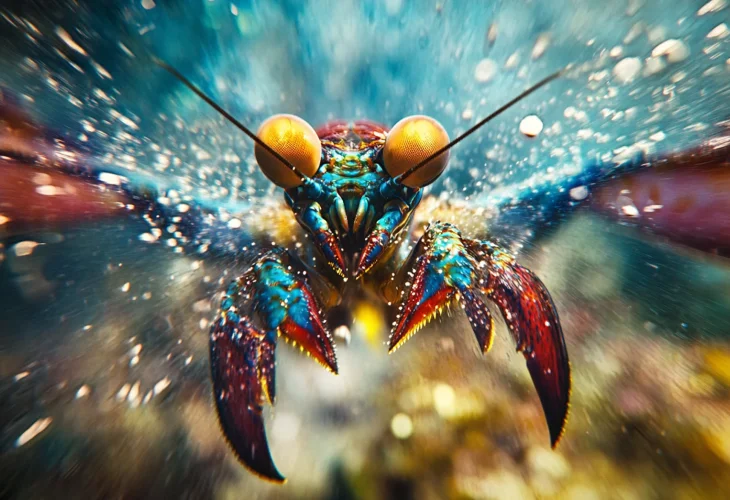 The mantis shrimp is a marvel of nature, combining vibrant colors with explosive strength.
The mantis shrimp may be small, but its size is deceiving. This colorful sea creature delivers one of the most powerful punches in the animal kingdom. With eyes that move independently like a chameleon and claws capable of incredible force, it has earned a reputation that borders on legendary. In fact, if a mantis shrimp were kept in a home aquarium, its strike could easily shatter the glass.
That raises an obvious question. If the mantis shrimp hits with such extreme power, why doesn’t it injure itself?
Imagine swinging your fist with the strength of a tractor. You would almost certainly break your hand. Yet the mantis shrimp strikes again and again without harm. The secret lies in a remarkable natural defense built directly into its claws, known as a phonon shield.
A Built-In Shock Absorber
The phonon shield functions like a microscopic airbag. It absorbs and disperses the enormous energy released during each strike. The mantis shrimp’s claw is coated with a carefully structured layer of proteins and minerals arranged in a way that neutralizes impact energy before it can cause damage.
This allows the shrimp to unleash its punch without paying the price.
According to researcher Mark S. Lavine, writing in a study published in Science, the mantis shrimp can strike prey at astonishing speed and force, either by direct impact or by creating collapsing cavitation bubbles. These bubbles alone can stun or kill prey. Despite this, the shrimp’s claw remains intact. This ability comes from the precise structure of its skeleton, its mechanical properties, and the unique energy-filtering role of the phonon shield.
Advanced techniques such as fast spectroscopy have revealed how this skeletal structure filters energy waves, dramatically reducing the stress placed on the claw during impact.
What Happens During a Strike
Every powerful удар creates energy waves. In humans, similar waves can cause serious injuries, including nerve damage. Energy waves behave much like sound or light waves. They can reflect, intensify, break apart, or weaken as they travel.
The phonon shield intervenes at exactly the right moment. It absorbs and scatters these waves so that their destructive potential is neutralized before reaching the shrimp’s tissues.
To visualize this, think of styrofoam. Fragile items are packed in it because its air-filled structure absorbs shock. It floats on water and compresses under pressure, preventing damage. Now imagine that idea scaled down to a microscopic level.
The mantis shrimp’s claw contains layers filled with tiny air-like pockets, each about 500 micrometers in size. These pockets compress slightly during impact, absorbing energy. Their size, shape, and arrangement are precisely tuned to the specific energy waves produced by the shrimp’s punch.
Precision at the Microscopic Level
Proteins within this layer play an equally important role. They are arranged to interact with the exact frequency of the energy wave created during a strike. As the wave moves through the claw, these proteins disrupt and dismantle it, breaking it apart before it can cause harm.
If we could zoom in far enough, we would see something like a highly specialized factory, custom-built for the mantis shrimp’s lifestyle and environment. With a single punch, the shrimp can crack open shells using hundreds of kilograms of force and then calmly enjoy its meal. If this system were tuned to a different frequency, it would not work nearly as well.
Inspiration for Human Technology
This natural phonon shield has become a source of inspiration in the field of bioengineering. Researchers are exploring how similar principles could be applied to reduce friction and impact during medical procedures, such as inserting implants, or to improve weapon design by reducing recoil.
Scientists note that the complexity of this biological system exceeds anything we can currently design from scratch. We can attempt to imitate it, but its naturally evolved precision continues to inspire awe.
Phonon Shields Beyond the Sea
The mantis shrimp is not the only creature to use phonon-based protection. Certain moths have wing scales that absorb sound waves in the range of 20 to 160 kilohertz. This directly interferes with the hunting method of bats, which rely on sonar to locate prey. When the bat’s sound waves fail to bounce back clearly, the moth effectively disappears from detection.
Phonon-based structures can even influence color.
Color is often produced by pigments, such as indigo plants used to dye fabric. But nature has another method. The brilliant blue of the Morpho butterfly’s wings does not come from pigment at all. Instead, microscopic structures on the wings cancel out all wavelengths of light except blue. What we see is the result of precise physical structure, not added material.
Engineers have already begun copying this method, creating blue surfaces without dyes by arranging materials at the atomic level.
A Quiet Lesson from Nature
From powerful punches to dazzling color, the mantis shrimp and other creatures reveal a deeper truth. Nature does not rely on brute force alone. It relies on precision, structure, and an extraordinary understanding of energy.
The phonon shield is a reminder that some of the most advanced engineering solutions already exist around us, quietly perfected over millions of years.

