

Purim
How Purim Was Lived: Inside the Homes of the Great Torah Leaders
From Megillah readings to Purim night learning, a portrait of the practices that shaped Purim in the homes of great Torah leaders
- Yonatan HaLevi
- | Updated
 (Photos: Flash 90)
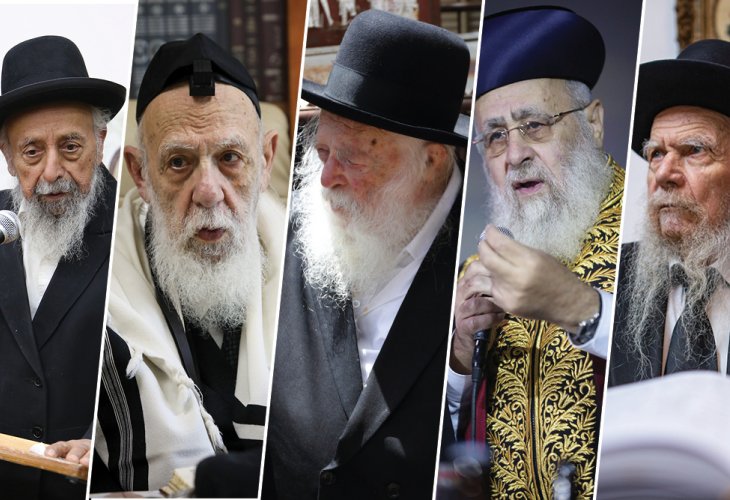
Purim in the homes of the great Torah leaders was shaped by deeply rooted customs, expressed through prayer, learning, and restraint, that continue to guide and inspire, both through their legacy and through those who still lead us today.
Rabbi Chaim Kanievsky zt״l
Purim in the home of Rabbi Chaim Kanievsky zt״l, known as the Sar HaTorah, was marked by simplicity and devotion. Living in Bnei Brak, he observed Purim on the 14th of Adar. He would hear the Megillah at the Lederman Synagogue, and on Purim day, following the Mincha prayer held around midday, thousands would pass by to receive his blessing.
After the long receiving line, Rabbi Kanievsky zt״l would hold the Purim seudah in his home, attended only by close family members and a small circle of associates.
Hacham Shalom Cohen zt״l
Hacham Shalom Cohen zt״l, president of the Council of Torah Sages and head of the Porat Yosef Yeshiva, lived in Jerusalem and observed Purim on the 15th of Adar. He would participate in the Megillah reading in the main hall of the Porat Yosef Yeshiva and would receive visitors on Purim day for several hours in the morning.
Following Mincha, he would hold the Purim seudah at his home, surrounded by family and close תלמידים.
Rabbi Gershon Edelstein zt״l
Rabbi Gershon Edelstein zt״l, rosh yeshiva of Ponovezh, lived in Bnei Brak and observed Purim on the 14th of Adar. On Purim day he would receive visitors at his home until Mincha.
It is worth noting that years earlier, on the 6th of Adar 5759, the Ponovezh Yeshiva entered a period of mourning with the passing of its rosh yeshiva, Rabbi Dovid Povarsky zt״l. Because Purim fell within the thirty days of mourning, Rabbi Edelstein ruled that a learning seder should be held on Purim night in the yeshiva.
From that year onward, a Purim night learning seder became a permanent tradition in Ponovezh. The sight of hundreds of students immersed in Torah study on Purim night was both uplifting and inspiring. Many yeshivot later adopted this custom, in fulfillment of the teaching that one who engages in Torah between the nighttime and daytime Megillah readings is assured a share in the World to Come.
Rabbi Yitzhak Yosef
Rabbi Yitzhak Yosef, the Rishon LeTzion and Chief Rabbi of Israel, lives in Jerusalem and observes Purim on the 15th of Adar. He hears the Megillah at the Chazon Ovadia Yeshiva in the Romema neighborhood and receives visitors there. There is no formal receiving line at his private residence.
The Gerrer Rebbe
The Gerrer Rebbe, who continues to lead his chassidut today, observes Purim in Jerusalem. He participates in the Megillah reading at the large Gerrer beit midrash on Yirmiyahu Street. On Friday night he holds a tish, often combined with a yahrzeit tish in memory of the previous Gerrer Rebbe, the author of Pnei Menachem zt״l.
Rabbi Shimon Baadani zt״l
Rabbi Shimon Baadani zt״l, a member of the Council of Torah Sages, observed Purim on the 14th of Adar. He would hear the Megillah at the Or HaChaim beit midrash on Rabbi Akiva Street in Bnei Brak and then return home to study Torah.
On Purim day he prayed Shacharit at sunrise and received visitors throughout the morning until Mincha. The Purim seudah was held at the home of his son in law, Rabbi Eliyahu Yafet, together with his children and grandchildren.
During the meal, Rabbi Baadani zt״l would read the Ramban’s words on Parashat Bo regarding divine providence and miracles. At the end of the seudah he would bless each of his descendants by name, emphasizing that Purim is an especially auspicious time for blessing.
After nightfall he would pray Ma’ariv and read the Megillah again, in accordance with the view of the Chazon Ish regarding cities adjacent to anciently walled cities.
Rabbi Ovadia Yosef zt״l
When Rabbi Ovadia Yosef zt״l lived in Tel Aviv, he would observe Purim on the 15th of Adar without a blessing, due to Tel Aviv’s proximity to Jaffa, which may have been walled in the days of Yehoshua bin Nun.
During the Purim seudah he would sometimes blow into his hand, producing a trumpet like sound. Family members related that this was one of the only times he allowed himself such lighthearted behavior. After the meal he would briefly rest until the effects of the wine passed, and then return immediately to learning, as he explains in Chazon Ovadia.
When reading the Megillah at home, he would recite the blessings on behalf of his wife and household.
Rabbi Aharon Yehuda Leib Shteinman zt״l
In his later years, Rabbi Shteinman zt״l acquired a particularly beautiful Megillat Esther. He strongly encouraged the Purim night learning seder at the Orchos Torah Yeshiva. After the learning concluded, hundreds of students would pass by to receive a small cup of wine.
He would say, “Baruch Hashem that there are bochurim learning tonight as well. Who knows how much this is valued in Heaven and how many merits it adds to the Jewish people.” He once remarked that if learning on Purim night is considered an aveirah by some, he was willing to take that aveirah upon himself.
When he was too weak to attend one year, he sent a letter blessing the students, emphasizing the unique merit of learning Torah on Purim night and wishing them success both spiritually and materially.
Rabbi Shlomo Zalman Auerbach zt״l
When the question arose regarding which day the residents of Ramot should observe Purim, two opinions emerged. The Minchat Yitzchak zt״l ruled that Ramot was not part of Jerusalem and should observe Purim on the 14th. Rabbi Shlomo Zalman Auerbach zt״l ruled that since Ramot residents paid municipal taxes to Jerusalem, they should observe Purim on the 15th.
Despite this, Rabbi Shlomo Zalman refused to publicize his ruling. When asked why, he replied with characteristic humility that if the residents accepted his authority, they would then be obligated to follow the ruling of the Ra’avad, Rabbi Weiss zt״l, and therefore should celebrate Purim on the 14th.
Rabbi Shlomo Zalman zt״l would also give money on Purim as a remembrance of the half shekel, supporting Torah institutions and scholars in need.
The Enduring Path of Purim Through Their Customs
Purim in the homes of the great Torah leaders was marked not by spectacle, but by simplicity, prayer, Torah, and responsibility toward the Jewish people. Though most of these giants are no longer with us, their way of living Purim continues to teach us how joy, humility, learning, and faith can coexist. Their customs remain a quiet legacy, reminding us that even in times of celebration, true greatness is revealed through devotion, restraint, and service to Heaven.

