

Israel News
Tel Aviv Burial Land Runs Out by 2035 Under Current Policy, Taub Study Finds
Taub Center projects 2.8 million deaths by 2049 and says Israel’s burial model cannot sustain demographic growth
- Brian Racer
- | Updated
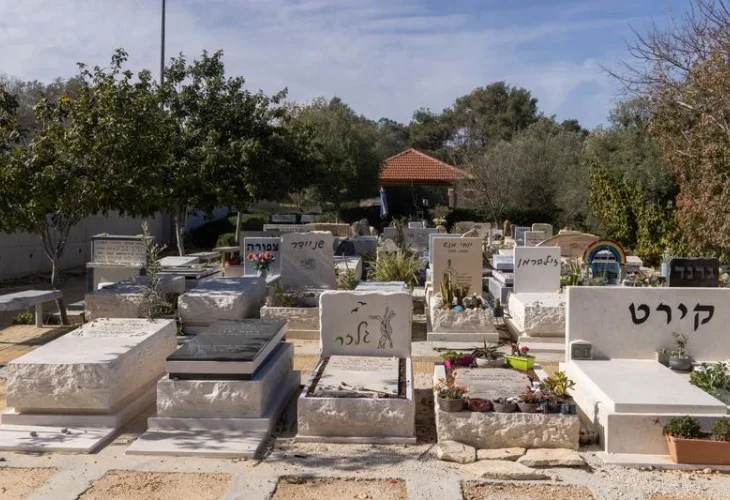 A cemetery at kibbutz Givat Brenner, central Israel. (Yossi Aloni/FLASH90)
Burial land in the Tel Aviv and Central districts is expected to be exhausted by 2035, according to a new study by the Taub Center for Social Policy Studies in Israel. The report, authored by Prof. Alex Weinreb, warns that the 560,000 new graves planned at the Yarkon and Barkat cemeteries will meet demand in Gush Dan only for the next decade.
The warning comes in line with projections of a sharp rise in mortality in the coming decades. The study forecasts 2.8 million deaths between 2024 and 2049, 33% higher than estimates published by the State Comptroller in 2024, raising concerns about the long-term sustainability of Israel’s burial system. Burial in the Land of Israel carries religious and national significance for many Jews worldwide, adding further weight to the debate over how the state allocates land for the deceased.
According to the study, Israel recorded 384,000 deaths between 2000 and 2010. The number is expected to climb to 520,000 between 2020 and 2030, 700,000 in the following decade, and approximately one million between 2040 and 2050. Annual deaths, currently around 45,000 to 50,000, are projected to exceed 100,000 by the mid-2040s and reach 200,000 by the late 2070s.
If burial policy remains unchanged, Israel will need to allocate an additional 3,327 dunams of land by 2050 to accommodate projected deaths, most of it in the country’s densely populated center, where land reserves are limited.
The report argues that Israel’s burial model is unusually generous by international standards. “No other country, and certainly not a wealthy welfare state, grants its citizens such generous benefits, even after death,” the study states. Every resident is entitled to a state-funded grave, typically near their place of residence, and burial plots are considered permanent.
“Every year that policymakers choose not to change the existing practice, they grant another portion of the country to the dead, distancing it from the living and future generations,” the report adds.
For decades, the dominant burial method in Israel has been traditional field burial, allowing approximately 300 to 370 graves per dunam at a cost of about NIS 3,800 per grave. In response to growing land scarcity, the government has encouraged denser methods, including multi-story burial structures and Sanhedrin-style burial niches, which can accommodate up to 1,500 graves per dunam but cost between NIS 18,000 and NIS 20,300 per plot.
Weinreb points to an ancient Jewish practice known as “Land of Israel burial,” or bone collecting, as a more land-efficient alternative. Under this method, the deceased is initially buried in the ground, and after about a year, the bones are transferred to a family ossuary. The approach can reach densities of roughly 3,000 burials per dunam. “Israel faces a choice between adhering to existing burial patterns that are not sustainable, in which the dead take from the living, and adopting burial solutions practiced in antiquity,” the report states.
The study also proposes revisiting the legal requirement to bury individuals near their place of residence. Allowing large-scale burial complexes in peripheral areas such as the Negev, the Ramon Crater, and the Jordan Valley could relieve pressure on central Israel while potentially stimulating economic activity in those regions. “The Negev is expected to become hotter in the coming decades, a development that could push aside many business opportunities, but it certainly will not disturb the dead,” the report notes.
Among more unconventional ideas raised is the construction of artificial burial islands. “Establishing artificial islands to house the dead is a simple option,” the study states.

