

Magazine
The Copper Laver: How Priests Prepared for Temple Service
An exploration of the copper laver in the Tabernacle and the Temple, its role in sanctifying the priests, and the deeper meaning of preparation before sacred service.
- Rabbi Pinchas Doron
- | Updated
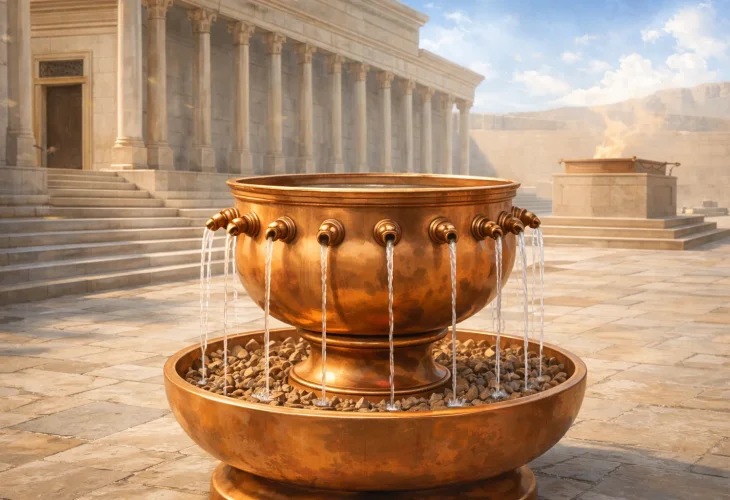
The laver was a large copper vessel in the Temple, kept filled with water at all times. Its primary purpose was to enable the priests to sanctify their hands and feet before performing the Temple service, as well as to serve other Temple needs that required water.
The Purpose of the Laver
Among the requirements of the priests’ service in the Tabernacle, the Torah commands the making of a laver: “You shall make a laver of copper and its base of copper for washing” (Exodus 30:18). The laver was shaped like a large cauldron with spigots through which the water flowed. It stood upon a base, which served as its stand and support, and was open at the top.
When the Tabernacle and its vessels were anointed with the sacred anointing oil, the laver and its base were included, as it is written: “You shall anoint the Tent of Meeting … and the laver and its base” (Exodus 30:26–28).
The laver had the legal status of a service vessel. According to early authorities who hold that the commandment “And let them make Me a sanctuary” (Exodus 25:8) includes the making of the Temple vessels, the laver and its base are part of that mitzvah. According to those who maintain that the vessels are only preparations for the commandments performed with them, meaning they are objects of sanctity rather than mitzvot in their own right, the laver is not a separate mitzvah. Rather, it was commanded solely for the purpose of sanctifying the priests’ hands and feet.
Sanctifying Hands and Feet
The primary function of the laver was to enable the priests to sanctify their hands and feet before service, as the Torah states: “You shall put water there, and Aaron and his sons shall wash their hands and their feet from it, when they come into the Tent of Meeting” (Exodus 30:18–20).
In addition, the laver’s water was used to sanctify other service vessels, as it is written: “They washed from it … and when they approached the altar, they washed” (Exodus 40:31–32).
Regarding the laver in the Temple, it is taught that initially it had only two spouts. Later, Ben Katin, who served as High Priest, fashioned twelve spouts so that the twelve priests involved in the daily offering could sanctify their hands and feet simultaneously. This was done to prevent disputes, with each priest claiming precedence.
The Water of the Laver
The Tannaim disagreed as to which types of water are valid for sanctifying hands and feet. Rabbi Yishmael held that only spring water, meaning living water, is valid. The Sages ruled that even mikveh water is acceptable. Likewise, any water that is valid for completing a mikveh, namely forty se’ah, is sufficient to complete the required measure of water for the laver.
The water of the laver becomes invalid if it remains overnight, since the laver was anointed with sacred oil and thus has the status of a sanctified service vessel. To address this, Ben Katin devised a mukhni, a mechanism by which the laver was lowered into a pit each evening, allowing its water to remain connected to a natural water source and thereby preventing invalidation.
Some explain that the mukhni was a surrounding container that always held water and was itself a non-sacred vessel. Since its water did not become invalid overnight, water would flow from the mukhni into the laver, preserving the laver’s validity.
Closing Thoughts
The laver stands as a reminder that sacred service begins with preparation. Before any act of holiness, the priests were required to pause, cleanse, and sanctify themselves, teaching that attention, readiness, and purity are essential foundations of meaningful service.

