

Purim
Double the Joy: The Spiritual and Practical Meaning of a Jewish Leap Year
Why the Hebrew calendar adds an extra Adar, how it affects Purim and life-cycle events, and the powerful message of sixty days of happiness
- Naama Green
- | Updated
 (Photo: Shutterstock)
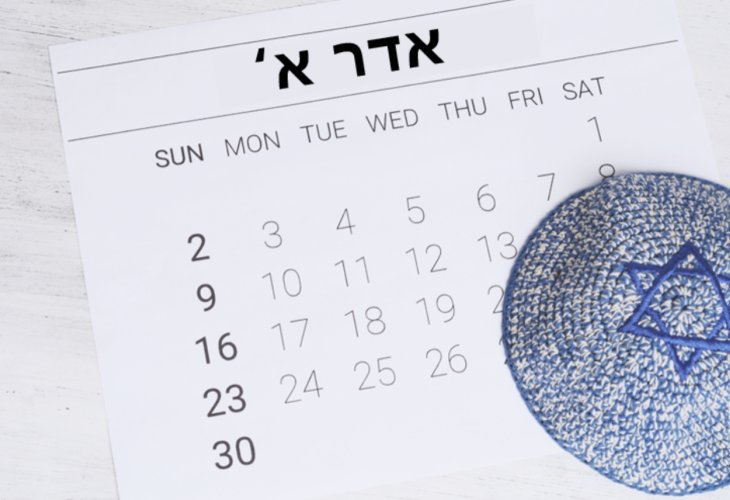
Every few years in the Hebrew calendar, a leap year appears. This is a year that contains 13 months. While regular years have only one month of Adar, a leap year includes two: Adar I and Adar II.
The purpose of adding a leap month is that the Jewish festivals are based both on the lunar cycle and on the seasons of the year. Because of the biblical commandment, “Guard the month of spring,” an additional month must be inserted before Passover so that the holiday of Pesach always falls during the spring season.
How Leap Years Were Determined in the Time of the Sages
During the era of the Sages, the Sanhedrin would decide each year whether to declare that year a leap year. The members of the Sanhedrin considered various factors that could influence this decision. The primary question, of course, was whether Passover would occur in the spring. But other considerations were also taken into account, such as damaged roads or bridges that might endanger pilgrims traveling to Jerusalem for the festival. After the decision was made, special letters were sent throughout the Jewish world announcing the updated calendar.
The Fixed Hebrew Calendar Today
Today, the Hebrew calendar is fixed, and leap years are determined in advance through a regular cycle of seven leap years within a nineteen-year period. In other words, a leap year occurs roughly once every three years. The leap years follow the traditional mnemonic: third, sixth, eighth, eleventh, fourteenth, seventeenth, and nineteenth years of the cycle.
Adar I and Adar II: How the Months Are Observed
In a leap year, an extra month is added between Shevat and Adar. This month is called Adar I, while the regular Adar becomes Adar II. The Sages established that Purim is celebrated in Adar II in order to place it close to Passover. The commemoration of Moshe’s passing, on the seventh of Adar, is also observed in Adar II.
The fourteenth and fifteenth of Adar I are known as “Purim Katan.” During Purim Katan, the mitzvot of Purim such as reading the Megillah, sending food gifts, or giving charity to the poor are not practiced, but fasting and reciting penitential prayers are avoided, and it is customary to add a festive meal.
Why Specifically the Month of Adar?
The decision to duplicate the month of Adar is not random. It stems from two main reasons. First, the leap month ensures that Passover remains in the spring. Second, according to the biblical order of months and the ancient Hebrew calendar, Adar was the final month of the year.
Practical Halachic Effects of a Leap Year
Beyond the simple addition of another month, a leap year also has practical implications. One well-known phenomenon is that a child born before another child may celebrate their bar mitzvah after the younger child. This can happen when both were born in a leap year: one at the end of Adar I and the other at the beginning of Adar II. If thirteen years later the year is not a leap year and contains only one Adar, the younger child may celebrate their bar mitzvah earlier in the month, while the older child celebrates later.
Another interesting case involves twins born on the eve of Rosh Chodesh Adar in a regular year, when one is born before sunset (the 30th of Shevat) and the other shortly after sunset (the 1st of Adar). If thirteen years later the year is a leap year, one twin will celebrate a bar mitzvah on the 30th of Shevat, while the younger twin — born only minutes later, will become obligated in mitzvot a full month afterward, on Rosh Chodesh Adar II.
Questions also arise regarding yahrzeit observance for someone who passed away during Adar of a leap year. These and similar issues are discussed extensively in halachic literature.
The Spiritual Meaning of Sixty Days of Adar
In a leap year, there are sixty days of Adar. The Lubavitcher Rebbe noted that the number sixty symbolizes the concept of “nullified in sixty.” In a blessed year that contains a double Adar — sixty days of joy, all sorrow, pain, despair, and sadness can be nullified through the abundant joy of these sixty days of Adar.

