

Passover
Why Is Chametz Forbidden on Pesach? The Spiritual Meaning of Matzah, Faith, and Freedom
Discover the deeper Jewish perspective behind the ban on chametz, the symbolism of bread and matzah, and how the festival of faith renews spiritual truth and inner growth each year
- Gilad Shmueli
- | Updated
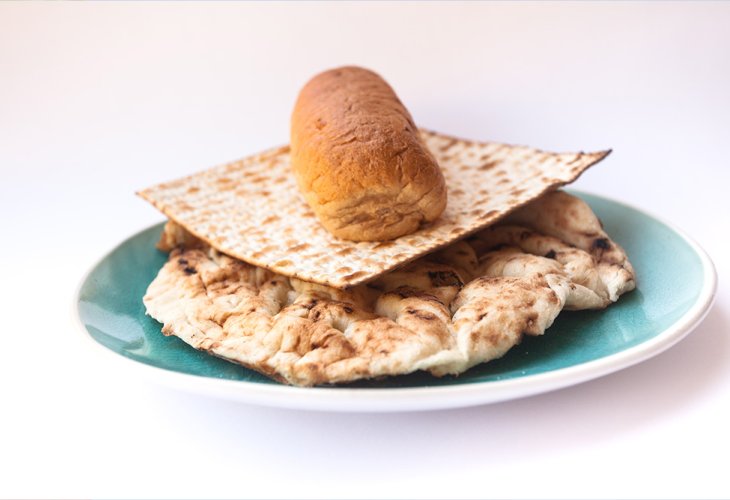 (Photo: shutterstock)
Why all the frenzy around chametz on Passover? What did bread ever do to us that when Passover arrives it suddenly becomes our greatest enemy? At first glance, it can seem completely puzzling. It is a bit like how a Jew wearing tefillin might look to an outsider like someone who just landed from another planet. And if that same observer sees him waving a lulav on Sukkot, he might conclude that the Jewish people are somewhat detached from reality.
The Jewish nation lives on a different, spiritual plane, where seemingly physical actions and objects carry a dimension that reaches beyond this world. The mitzvot are practical actions performed in this physical reality, yet they have spiritual impact in higher realms. The prohibition of chametz on Passover is no different. On the surface, it looks like an intense focus on material details: vacuuming up the bagel crumbs a child left under the couch cushion, searching carefully through every hiding place where snacks may be concealed, or discovering half a bag of chips hidden in a toy box from months ago. Yet writing a Torah scroll also requires physical materials such as parchment made from a kosher animal and ink, and the mitzvah of the Four Species requires agricultural and physical labor.
Within this physical world lie secrets revealed uniquely to the Jewish people through the Torah. These are the pathways through which spiritual actions are accomplished through physical reality. The mitzvot themselves are spiritual forces that allow us to repair what is negative within ourselves and within creation.
The Spiritual Energy of the Festivals
What spiritual action is hidden within the story of matzah and chametz? To understand this, we need a brief introduction to the nature of the festivals and of Passover itself.
The festivals are like recurring stations of spiritual renewal that return each year, each one carrying its own unique spiritual energy. Passover is the festival of faith, when the Jewish people received the foundations of belief in the Creator through the Ten Plagues of Egypt. Through these plagues, God demonstrated His mastery over all aspects of nature: air, land, and sea, humanity, animals, and even the inanimate world. The purpose of the plagues was to instill faith in God within the Jewish people, as was the miracle of the splitting of the Red Sea.
Passover is the birthday of the Jewish nation, the moment we connected to truth, which is faith in the Creator. During Passover, the festival of faith, we are able to recharge ourselves with renewed spiritual strength and elevation.
Bread and Matzah: Illusion Versus Truth
Why, then, is bread specifically forbidden while matzah becomes the central mitzvah? The difference between bread and matzah lies in the process of rising. Both are made from flour and water, but bread undergoes fermentation and rising, creating an inflated appearance that gives the illusion of greater substance due to the air bubbles inside it. Bread therefore symbolizes illusion and false appearance. Matzah, by contrast, represents truth: what you see is exactly what exists.
The world we live in is described by the Zohar and by the sages as a world of illusion. It is built upon concealment in order to allow human beings free choice to discover divine truth within a hidden reality. When the Jewish people were in Egypt, they were immersed in falsehood, in a world of impurity and denial of God. When they left Egypt, they needed a spiritual remedy, like an antibiotic for faith.
Matzah contains the healing power of truth and faith, which is why the Zohar calls it the bread of healing. This spiritual remedy lasts for seven days, corresponding to the seven days of creation and other profound spiritual concepts connected to the number seven.
Why Chametz Is Removed From the Home
The Zohar offers a parable of a sick child who must eat only specific foods and medicine to recover. If sweets and other tempting foods remain in the house, the child will be unable to resist them. Even knowing that such treats exist can make it difficult to eat the healthier food. Therefore everything else must be removed. Once the child recovers, regular foods no longer pose a danger.
Similarly, on Passover we remove all chametz from our homes. After the seven days of eating matzah and refraining from chametz, bread loses its harmful spiritual effect.
How Food Affects the Soul
How can food affect the soul? The Torah commands us to keep kosher, avoiding certain creatures and forbidden foods because they spiritually contaminate a person and create a kind of barrier around the soul, making it harder to feel connection to holiness. Chametz carries a spiritual influence associated with denial and illusion, while matzah carries an influence of faith and truth, specifically during the seven days of Passover.
Passover is therefore the most powerful time for building truth and faith within ourselves. It is the season when the foundations of belief were first planted in the Jewish people during the Exodus from Egypt. Each year, the spiritual light of that moment returns, giving us the opportunity to rebuild ourselves and rise higher in holiness and faith.

