

Magazine
From Abandonment to Belonging: Esther Lavi’s Powerful Journey of Identity, Faith, and Choosing Life
Adopted as a child and searching for her roots, Esther shares a deeply moving story of resilience, conversion, self discovery, and how embracing faith and personal choice transformed pain into purpose
- Michal Arieli
- | Updated
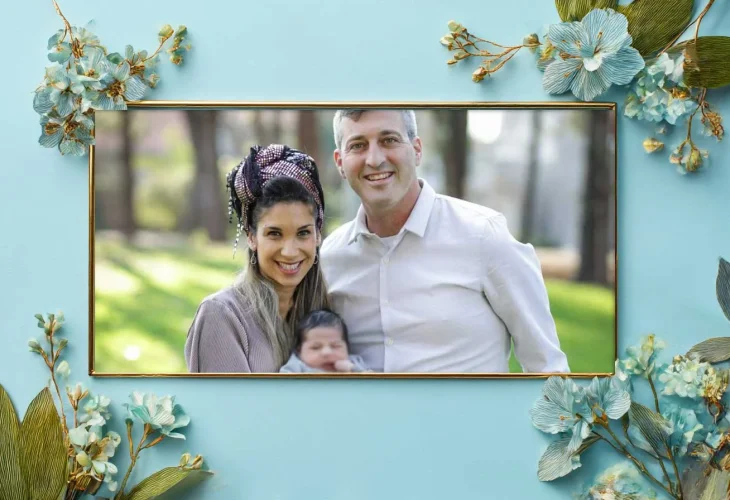 Esther Lavi and her husband, Gilad
“I had an amazing childhood in a religious moshav in the Golan Heights, surrounded by a loving family, devoted parents, an older brother, and many friends,” says Esther Lavi with deep gratitude. “But all my life I had one dream: to reach the age of eighteen. That was my ultimate goal, because I believed that only then could I complete the missing piece of myself. Only then could I truly begin to live.”
When Esther speaks about “age eighteen,” the excitement in her voice is unmistakable. It is the kind of emotion only someone can feel who grew up for years without knowing where she belonged or where she came from. “Today, as a married woman and a mother, I understand how important it is for all of us to feel a sense of belonging. I didn’t have that. I knew I was adopted, and I always dreamed of discovering who I was, where I came from, and who my biological family was.”
“I Am Adopted”
“I was five years old when my mother first told me that I was adopted,” Esther recalls. “She said it simply: ‘I am your mother, but I didn’t give birth to you. I chose you.’ The next day I went to kindergarten full of excitement and told everyone, ‘My mom didn’t give birth to me. She chose me from all the babies in the ward.’ It sounded so perfect and magical to me. But the children quickly made me realize there was another side. When some of them explained that ‘adopted means someone who wasn’t wanted,’ my joy turned instantly into something painful that I felt ashamed of.”
Looking back, was it right to tell you at such a young age?
“Yes. I think it was the right age, because it builds you and prepares you for life. But it wasn’t easy. I had many questions for my mother, especially one that I asked again and again: ‘When will I stop being adopted?’ Once the children understood that being adopted was seen as something negative, they used it to mock and hurt me. Whenever they didn’t want to play with me or wanted to insult me, they threw that word at me: ‘adopted.’”
How did you respond?
“As I became more aware of it, I started building a hard emotional armor. The main thing was not to get hurt, and especially not to show that I was hurt. On the outside I looked incredibly strong, with exaggerated confidence that hid my search for identity and my need to protect myself.
“At home, life was wonderful. My parents were exceptionally devoted people, and I had a beautiful relationship with my older brother, even though he is eight years older than me. Our bond is still excellent today. But throughout those years I knew I had to discover who I was, and I waited eagerly for the day I could finally open my adoption file.”
“Where Do I Belong?”
At age twelve, Esther experienced a dramatic turning point when one of the community rabbis spoke with her and explained that she needed to undergo a conversion process out of halachic stringency. “I couldn’t understand it at all. While my friends were celebrating their bat mitzvahs, I was told I needed to convert,” she remembers. “They told me, ‘You don’t have to,’ which only confused me more. If I decided not to, what would happen to me? Would I have to leave my home? It was a deeply unsettling period. Why did everyone around me have normal lives, and suddenly at age twelve I was told I might not even be Jewish?”
How did your parents help you process this?
“They explained that it was a ‘conversion out of stringency’ and gave me stability and support. But even to them I didn’t reveal how difficult it was for me. Outwardly I acted strong, as if nothing could shake me and I would do whatever was required. I eventually went through the conversion quietly. None of my friends knew, and I decided I would never tell anyone.”
Another painful moment came a year later, when a teacher entered her classroom to teach laws related to adoption. “Apparently he didn’t know there was an adopted student in the class, but for me it was a terrible lesson. Suddenly they were talking openly about halachic issues connected to the most personal parts of my life. I wondered how I was supposed to observe laws of seclusion with my father and brother when our entire family was just parents and two children. And how could it be that according to halacha I would not sit shivah for my adoptive parents? These were overwhelming questions for a thirteen year old who had just converted and was still asking herself, ‘Do I even want to be religious? How does this make sense?’”
“The lesson ended badly. The teacher threw me out of class, and I ended up leaving the school altogether. I was completely shattered, not only because of what happened in front of the class, but because of a deep identity crisis. I had just converted and wanted to belong to this people, so how could it be that if I didn’t keep everything perfectly, I had no place? Where did I belong? And yet, I remember those days as a time when I spoke to God constantly, saying: ‘If You truly exist, show Yourself to me. Let me feel You.’ Out of that pain, I felt His presence more than ever.”
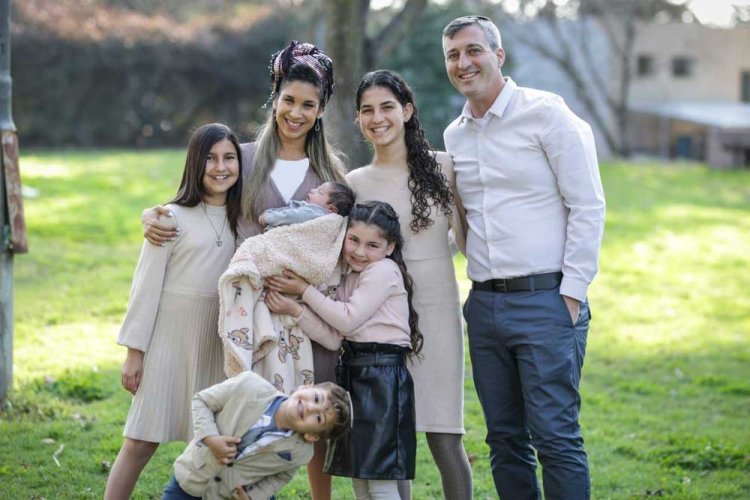 Esther and her family
“Only a Starting Point”
As her eighteenth birthday approached, the tension grew alongside intense anticipation. “It consumed me. There was no ‘sweet sixteen,’ only ‘two more years until eighteen.’ I lived toward that day, knowing it would be the most frightening and most exciting moment of my life.”
On her eighteenth birthday, Esther sat across from a social worker and heard details about her biological family for the first time. “She told me my name was Michal, and I felt on top of the world. I imagined telling everyone that the conversion had been unnecessary. She said my family lived in central Israel, which strengthened my assumption that they were Jewish. She mentioned I had five siblings, and my mind filled with questions. Were they religious? Maybe even ultra Orthodox? If they lived together, why wasn’t I raised with them? And what did they look like? I had never resembled anyone, not my adoptive parents or my brother, so I wondered who I really looked like.”
At one point, the social worker paused to take a phone call. “Only then did I realize she wasn’t even focused on me. When she finished, she said, ‘Listen, Michal,’ and it felt strange hearing my supposed real name for the first time. Then she said the most frustrating words imaginable: ‘Oops, I made a mistake.’ It sounds unbelievable, but she had been reading someone else’s adoption file.
“In that moment I understood something powerful: no matter what she would say next, it wasn’t who I was. That insight stayed with me. She could tell me only about my starting point. Everything that came afterward depended on me. That mistake helped me realize that what she read was not my identity. My actions would define who I truly was.”
She then opened the correct file, marked “confidential,” refusing to let Esther photograph anything. “And then she told me something I never expected, even though there had been hints: that I had been found in the market in Nazareth, on the street, only hours after being born. That was all that was written.”
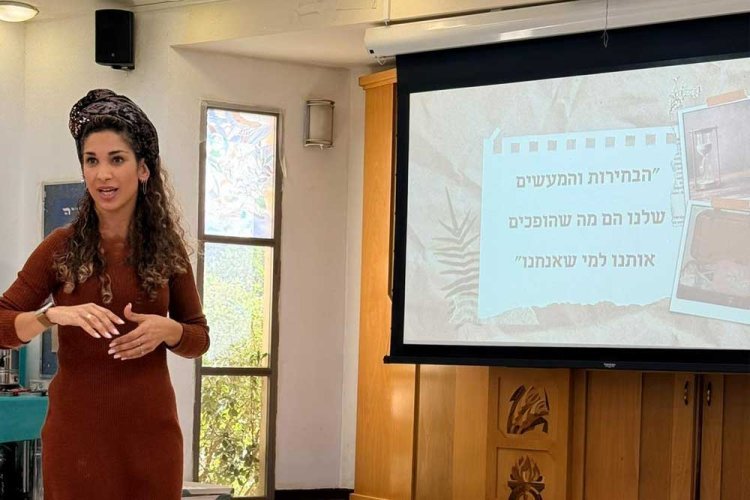 At a lecture
“I was in shock. I asked, ‘Was I really alone? Didn’t they leave a letter or anything? What happens now? Surely they regretted it.’ The response I received pierced me: ‘What do you mean regretted it? They’re amazed you even survived.’
“It felt like a message that not only did they not want me, they never expected me to live. No one can prepare for something like that. But then I forced myself to remember what I had just realized: ‘Esther, this is only your starting point. Because of where you began, you must live your life with even greater strength.’ I left that meeting full of fire, determined to do only good in this world. I would never define myself as an abandoned baby. That is not my story. I walked out filled with positive energy that still carries me today.”
“Choosing Who We Are”
Today, as a married mother of five, Esther says her past continues to resurface at sensitive moments.
“Every major step in my life brought it back. When I got married, I had to prove my Jewish status. When my children were born, doctors asked about genetic illnesses, and I had to answer again and again that I didn’t know because I was adopted.”
Does it get easier over time?
“No. The pain of abandonment still exists on a deep level, no matter how many children I have or how wonderful my husband Gilad is. At first I tried to overcome it, but eventually I realized it isn’t a pain that disappears. I don’t need to fix it, only learn to live with it. Like grief or loss that never fully fades, the fear of abandonment remains. My role is to make sure it doesn’t control me or stop me from doing what I want. Sometimes I still need encouragement from others to remind me: ‘Esther, you are in a different place now, built by your own choices. You are not that abandoned baby left in the market.’”
Do you know anything about your biological family?
“Yes,” she says, surprising me. “I took a DNA test and have a general idea who they are. They don’t want to meet me, and honestly, I don’t think I want to meet them either. From what I understand, they are a Muslim family that is hostile toward Israel.”
She pauses, then adds, “That realization opened my eyes to the depth of Divine providence. Nothing about my story makes logical sense. Even the social worker said there was no explanation for why I wasn’t adopted by an Arab family. It makes me grateful to God for guiding everything so precisely, so I could become part of His people. At the moment I was abandoned, it feels as though He paused everything and said, ‘Wait, I want a different future for this baby.’
“That is how I see my life,” she explains. “Maybe that’s why my life today is so full of joy. I choose to focus only on the positive. I lecture about my story, produce events, and try in every way to convey one message to myself and to others: life is not about where we started, but about how we choose to become the best version of ourselves.”

