

Behind the News
Trump’s Public Rebuke Leaves Herzog Politically Exposed Over Netanyahu Pardon
US president’s criticism forces Israeli head of state to defend rule-of-law authority as Netanyahu’s pardon request remains under revi
- Brian Racer
- | Updated
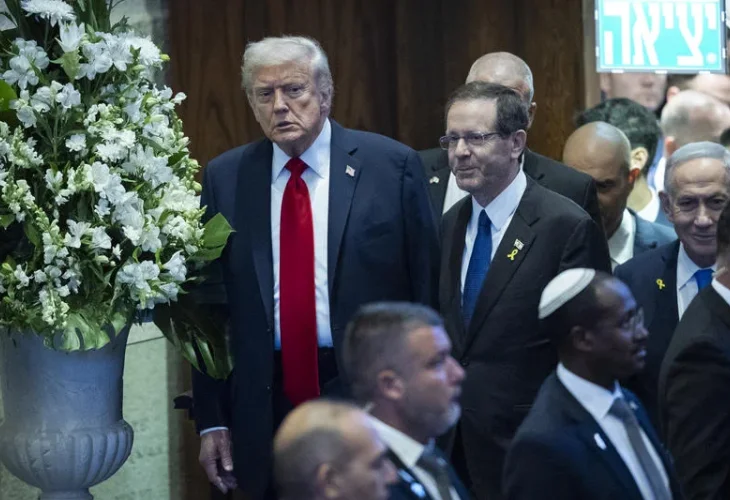 U.S. President Donald Trump, Israeli President Isaac Herzog and Prime Minister Benjamin Netanyahu arrive for a special plenum session in honor of President Trump at the Knesset, Israel’s parliament in Jerusalem, on October 13, 2025. Photo by Yonatan Sin
Days after U.S. President Donald Trump publicly rebuked Israeli President Isaac Herzog for not pardoning Prime Minister Benjamin Netanyahu, the diplomatic fallout continues to reverberate in Jerusalem. What began as a sharp comment at the White House has evolved into a visible strain between the two presidents, placing Herzog in an unusually defensive position.
Trump told reporters that Herzog was “disgraceful” for not granting Netanyahu a pardon and said, “He should be ashamed of himself.” He added that “the people of Israel should really shame him.” The remarks marked a rare and blunt intervention by a U.S. president into an active Israeli legal proceeding.
The pressure centers on Netanyahu’s formal pardon request, submitted in November. The application is currently under review by Israel’s Ministry of Justice, according to established legal procedure. Herzog’s office clarified that no decision has been made and emphasized that the process must be completed before any presidential consideration.
“Only upon completion of that process will President Herzog consider the request in accordance with the law, the best interests of the State of Israel, guided by his conscience, and without any influence from external or internal pressures of any kind,” the president’s office stated. It added pointedly, “Israel is a sovereign state governed by the rule of law.”
Under Israeli practice, presidential pardons are typically granted after conviction. Netanyahu’s corruption trial has been ongoing for more than five years. He faces charges of bribery, fraud and breach of trust, all of which he denies. Legal analysts have noted that a pre-conviction pardon would be highly unusual and legally controversial.
The timing of Trump’s comments, a day after his meeting with Netanyahu at the White House, fueled speculation in Israel that the prime minister may have encouraged the public pressure. Sources close to Herzog have demanded clarification, warning that if Netanyahu had any role in prompting the remarks, “this constitutes crossing a red line.”
Netanyahu’s aides rejected that suggestion. “The prime minister heard about it from the media and did not know about it in advance,” his representatives said.
Both Israeli Ambassador to Washington Yechiel Leiter and U.S. Ambassador to Israel Mike Huckabee also sought to distance Netanyahu from the episode. “The issue of a pardon and/or Netanyahu’s trial did not come up, nor were they discussed in the meeting between the leaders,” Leiter said. Huckabee added, “I’m pretty sure he did not. I think that’s something that originated with President Trump.”
Herzog himself responded cautiously. While returning from a state visit to Australia, he told reporters traveling with him, “To the best of my recollection, I am the president of Israel.” The remark was widely interpreted in Jerusalem as a restrained assertion of institutional independence.
The Israeli presidency is largely ceremonial, but the power to grant pardons is one of its few significant constitutional authorities. Trump has previously urged Herzog to use that power on Netanyahu’s behalf, including during earlier visits and in written correspondence.

