

Passover
From the Burning Bush to Mount Sinai: The Meaning of Freedom
A powerful Torah insight into why the Exodus from Egypt was only the beginning, exploring spiritual freedom, the 49 days of preparation, and the journey toward receiving the Torah
- The Gaon Rabbi Yitzchak Yosef
- | Updated
 (Photo: Shutterstock)
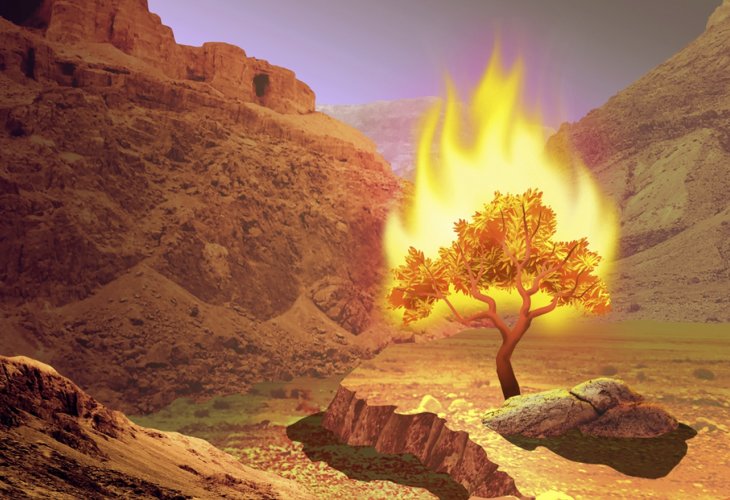
Everything began unexpectedly. The son in law of the priest of Midian went out to shepherd his father in law’s flock. Following the sheep, he arrived without intention at Mount Chorev, the mountain of God, where he experienced his first divine revelation through the burning bush. “Moshe said, ‘Here I am.’”
The vision caught him unprepared. Moshe hid his face because he was afraid to look at God. Only afterward did he remove his shoes and accept the great mission to take Israel out of Egypt. In those elevated moments he also heard from Heaven explanations about exile and redemption. At that very encounter he learned why the exile existed and for what purpose redemption was needed.
The True Purpose of the Exodus
One verse revealed everything: “When you bring the people out of Egypt, you will serve God on this mountain.” Here God hinted to Moshe that the primary goal of the Exodus was the giving of the Torah.
Why was this message given before the process even began? The journey ahead was long. First Moshe needed to go to Pharaoh, then the ten plagues would come, followed by the Exodus, the splitting of the sea, and forty nine days of preparation before the Torah would be given. Why reveal the purpose at the very beginning?
The answer is simpler than the question. Already at that moment, when exile surrounded Israel from every side and they could not even listen to Moshe because of their anguish and hard labor, when physical freedom seemed like the greatest goal imaginable, God declared that there was only one purpose for leaving Egypt: receiving the Torah. Physical freedom without spiritual freedom is not true freedom.
Before overturning the laws of nature, hardening Pharaoh’s heart, bringing the ten plagues, distinguishing between Israel and Egypt, splitting the sea, and shaking the world, God made it clear that all of this was for one purpose: “When you bring the people out, you will serve God.” The Exodus was intended to lead to spiritual liberation.
Pesach and Shavuot: Two Stages of Freedom
In our time the division is clear. The festival of Pesach symbolizes physical freedom, the liberation from Egypt’s chains, while Shavuot represents spiritual freedom, the receiving of the Torah. The days between them serve as preparation, linking the two stages together.
Why did Israel need to wait forty nine days? They longed to receive the Torah and counted each day eagerly. Why did God delay?
The sages provide a parable. A prince once fell ill and left his studies to undergo treatment. When he recovered, the king wanted him to return immediately to learning, but the teacher explained that the boy was not yet ready. “His radiance has not yet returned.” Only after some time, when he regained strength, did the teacher say, “Now he is ready.”
So too with Israel. “God took you, a nation from within a nation.” Spiritually they were in a low state, immersed in forty nine levels of impurity. According to the Arizal, had they remained in Egypt one moment longer, they would have reached the fiftieth level and been unable to receive the Torah. Therefore they needed a process, leaving one level of impurity each day and rising toward holiness, until after forty nine days they were worthy of receiving the Torah.
The Holiness of the Days of Counting
The Ramban writes that the days of the Omer possess a special holiness, similar in some way to the intermediate days of a festival. At first glance this seems puzzling. Does their holiness come merely because they are between two holidays?
The deeper explanation is that the Omer days are not random. They form one continuous journey from the physical freedom of Pesach to the spiritual freedom of Shavuot. Each day is part of the preparation for receiving the Torah. These are days of elevation and reflection on humanity’s purpose in this world, understanding that a person is born to toil in the labor of Torah.
This idea is hinted to in the offerings. On Pesach the Omer offering of barley was brought, a food associated with animals, while on Shavuot the offering of wheat, the Two Loaves, symbolized human nourishment. Physical freedom is something even an animal seeks, but the true goal of the Exodus was spiritual freedom, a freedom only a human soul longs for. “There is no truly free person except one who engages in Torah.”
From Blossoms to Fruit
Pesach is also called the festival of spring. During Pesach trees blossom with flowers, yet the blossoms do not last. By the month of Sivan the flowers fall and fruits begin to appear. This is a powerful hint: the flowers are not the main goal. The real purpose is the fruit, the tangible outcome, which is the receiving of the Torah.
In these days we must prepare ourselves well for Pesach, especially with the desire to attain spiritual freedom. The Chida writes in his book Lev David, quoting his grandfather the Chesed LeAvraham, that a person should prepare himself thirty days before Pesach, improving his deeds and awakening his heart on the night of the festival. On that holy night, through God’s kindness, we are released from the grip of impurity and given a path to attach ourselves to Him and His Torah.
This also explains the teaching that every person must see himself as if he personally left Egypt. Beyond the simple meaning that we would still be enslaved had God not redeemed our ancestors, there is a deeper message. Each year God gradually brings us out of spiritual bondage, lifting us toward holiness until on the night of Pesach we become truly free. This process is a continuation of the original Exodus.
Awakening to Redemption
Chassidim relate in the name of the Yismach Yisrael of Aleksander that at the beginning of the Seder he would declare, “Anyone who does not believe that during the Pesach Seder he can transform from an idol worshiper into a complete righteous person is the wicked son of the Haggadah who excludes himself from the community.”
The Pele Yoetz writes that removing physical chametz alone is not enough. The kabbalists taught that from thirty days before Pesach one should begin walking in the path of goodness and repentance. Each night God elevates sparks of Jewish souls from impurity according to a person’s preparation, until on the night of the festival they stand as free people. This annual spiritual Exodus is the source of our joy.
If a person does not prepare properly or fails to guard himself from chametz, what joy can there be? Everything depends on one’s actions, the purity of the soul, and the level of preparation.
Especially during these thirty days before Pesach, one must awaken to repentance. Our eyes long for redemption. The sages taught, “In Nisan we were redeemed, and in Nisan we will be redeemed again.” As these days approach, the world above waits with anticipation for the moment of salvation.
Every person must awaken and do all that is within his power, pouring out his heart before God day and night for redemption, hoping to find a favorable moment when God hears every prayer and brings comfort to Zion.
May the Holy One grant us true freedom, both spiritual and physical, and may we merit the coming of the righteous redeemer speedily in our days, Amen.

