

Purim
It Starts in Adar: Your Guide to the Half-Shekel Tradition
Why we give the half-shekel today, how much to give, who should give it, and whether it can come from your tzedakah funds.
- BeHalacha UbeAggadah
- | Updated
 (Photo: Shutterstock)
When the Beit HaMikdash stood, giving the half shekel was a Torah obligation. That money funded the daily communal offerings brought on behalf of the entire Jewish people. Today, while the Temple has not yet been rebuilt, we continue this practice as a meaningful custom. We are careful to call it a remembrance of the half shekel, not the actual half shekel itself.
Women give this remembrance as well, just as they did in the time of the Temple.
When to Give
The time to give the remembrance of the half shekel begins with the start of the month of Adar. In a leap year, it begins in Adar II. Ideally, it should be given before the Megillah reading.
Our Sages explained that this timing has deep meaning. Hashem knew in advance that Haman would offer silver in an attempt to destroy the Jewish people, and so He arranged that our giving would come first. Our coins symbolically precede his.
From What Age?
The original obligation applied from age twenty. Over time, the accepted custom became to begin giving from age thirteen. It is also customary to give on behalf of younger children.
Since this money is given as charity and recalls the salvation from Haman’s decree, and since women and children were included in that miracle, the custom developed to give for them as well.
Understanding Haman’s Silver
Haman offered King Ahasuerus ten thousand talents of silver. This number was not random.
At the time of the Exodus, the Jewish people numbered six hundred thousand adult men. The Torah assigns a maximum monetary valuation of fifty shekels for an adult male. Haman sought to match that full valuation.
Six hundred thousand people multiplied by fifty shekels equals thirty million shekels. The Torah teaches that one talent equals three thousand shekels. Ten thousand talents therefore equal thirty million shekels, exactly the same amount.
The Midrash explains that Haman intended to “buy” the Jewish people at their highest possible valuation. Our practice of giving the half shekel in Adar comes to counter that intention.
How Much to Give Today
A half shekel corresponds to nine grams of pure silver, calculated according to the current market price of silver. In recent years, this amount has generally fallen in the range of approximately 25 to 35 shekels per person, depending on silver prices.
Instead of cash, one may give an item of equivalent value.
Giving More or Less
Anyone who wishes to give more than the basic amount may do so as a voluntary gift, adding merit through charity and kindness.
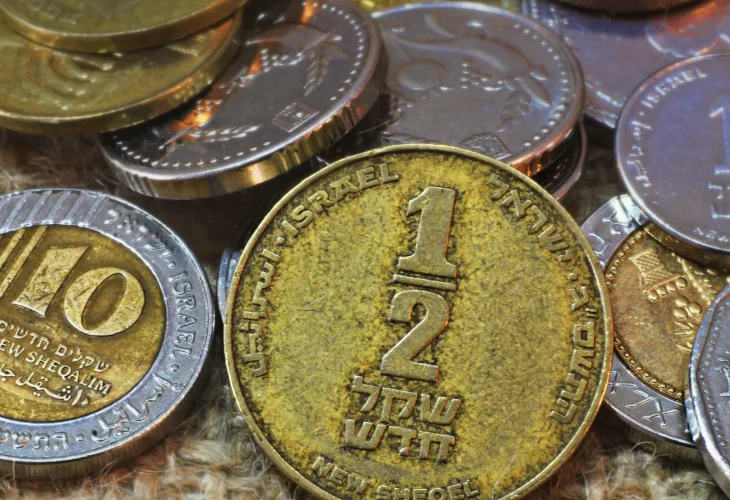
If someone is under financial strain, it is sufficient to give a minimal amount, such as a half shekel coin.
Using Charity Tithes
Setting aside a portion of income for charity throughout the year is a fundamental value. Giving ten percent is the standard measure, while giving twenty percent is considered especially commendable.
The remembrance of the half shekel should ideally not be given from one’s regular charity tithe. However, if a person originally began tithing without making a binding commitment and is now experiencing financial difficulty, there is room to be lenient and use those funds.
Where the Money Should Go
Since the Temple no longer stands, the money should be directed to Torah institutions and scholars. This serves as a spiritual parallel to the communal offerings that once brought atonement.
Our Sages taught that Torah study is even greater than sacrifices. When Rabbi Yehoshua mourned the destruction of the Temple, Rabban Yochanan ben Zakkai comforted him by teaching that acts of kindness and Torah study now serve as our path to atonement.
Those who support Torah learning and inspire others to connect more deeply to it elevate not only individuals, but the entire Jewish people.
The Highest Level of Charity
One of the highest forms of charity is helping Jews who are not yet fully connected to Torah and mitzvot. Supporting education, outreach, and gentle guidance that helps people take even one more step forward carries immense merit.
When someone helps others grow spiritually in a way that is accessible and welcoming, the verse applies: “Those who bring many to righteousness will shine like the stars forever.”
May we merit to soon see the rebuilding of the Beit HaMikdash and to once again fulfill the mitzvah of the half shekel in its complete and original form.

