

Passover
10 Tips That Will Help You Prepare The Seder Plate According To Jewish Law
Everything you need to know: What to put on the Seder plate, how to arrange it, and how did an egg get there?
- Hidabroot
- | Updated
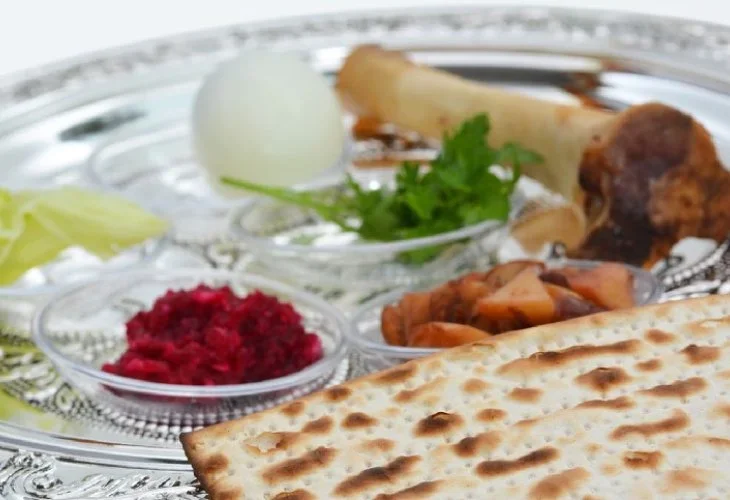 Passover Plate | Passover Seder Plate | Seder Plate
The Seder plate placed on the table and used throughout the Seder was not mentioned in the Mishnah or the Talmud, and its origin lies in the writings of the Rishonim. Before the leader of the Seder, a Passover plate is placed containing Maror, Charoset, Karpas or another vegetable, and two cooked items.
Six items are placed on the Seder plate: according to the custom of the holy Arizal, the items are arranged in the shape of two Segol patterns as follows: the Shank Bone on the right, the Egg on the left, and the Maror beneath them in the center. The Charoset is placed beneath the Shank Bone, the Karpas beneath the Egg, and the Chazeret beneath the Maror.
Pesach: Seder Night and the Haggadah - Rabbi Avrohom Schorr
Seder Plate - Foods and Customs
Before the start of the Seder night, a plate must be prepared containing all the special foods of the Seder night. Each food is intended to remind us of a specific idea, and by arranging them on the plate, we emphasize the special meanings of the Seder night.
The plate contains three Matzos, Maror (lettuce or horseradish), Karpas, and Charoset. When the Holy Temple existed, the meat of the Passover sacrifice was also placed on the table, and since the Temple was destroyed, the Sages ordained to place two cooked items on the plate, one in memory of the Passover sacrifice and the second in memory of the Chagigah sacrifice that was offered on every festival.
The custom is that the cooked item in memory of the Passover sacrifice is a shank bone (a front leg of an animal for Sephardim, and a chicken wing for Ashkenazim), and the cooked item in memory of the Chagigah sacrifice is a boiled egg.
Why specifically an egg in memory of the Chagigah sacrifice? First, an egg is a food served to mourners to hint that "the wheel of the world turns," and we too are comforted that the Holy Temple will soon be rebuilt and we will be able to offer the Passover and Chagigah sacrifices. Another explanation for the egg: the name of the egg in Aramaic is "Be'a," meaning a request, and it hints at our request that God return and redeem us.
In most Jewish communities, it is customary not to eat the shank bone on the Seder night.
Some have the custom to take only lettuce for Maror, and some take both lettuce and horseradish: the lettuce is eaten for "Maror," and the horseradish for "Korech."
Sephardim and some Ashkenazim arrange the plate according to the custom of the holy Arizal: the shank bone on the right, the egg on the left, and the Maror beneath them in the center, the Charoset beneath the shank bone, the Karpas beneath the egg, and the Chazeret—for those who use it—beneath the Maror.
According to the Rama, items that are reached earlier in the Seder should be placed closer to the leader of the Seder. Those who follow the Rama place the Karpas and the salt water in the location closest to the Seder leader, followed by the Matzos, then the Maror and Charoset, and finally the shank bone and the egg.
The Matzos on the plate must be covered with a napkin during Kiddush and during the lifting of the second cup, and revealed during the rest of the time. Those who follow the Arizal also separate each of the three Matzos on the plate with a napkin.
There is no need to place a Seder plate before each participant, or even before married children participating in the Seder at their parents' home. Some have the custom to place three Matzos before each head of a family, but the Seder plate is placed only before the leader of the Seder.
Short and sweet: How to prepare the Seder plate
Questions & Answers
+How Is The Passover Seder Plate Arranged?
+Why Is An Egg Placed On The Seder Plate?
+What Vegetable Is Used For Karpas?
+What Vegetable Is Used For Maror?
+When Do You Drink The Four Cups On Passover?
+Why Is There Karpas On The Seder Plate?
+How Do You Greet Others On Passover?
+What Is The Seventh Day Of Passover Called?
+Do You Put On Tefillin On Isru Chag?

