

Israel News
U.S., Iran Begin Drafting Potential Nuclear Deal in Geneva
Oman reports “good progress” in Geneva as Tehran says talks must center on sanctions and the nuclear file
- Brian Racer
- | Updated
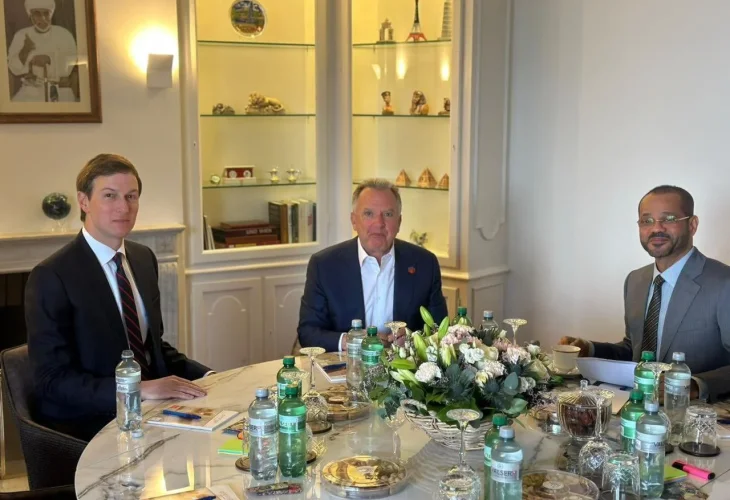 Steve Witkoff and Jared Kushner with Oman's Foreign Minister (Oman Foreign Ministry)
Iran and the United States concluded a second round of indirect nuclear talks in Geneva on Tuesday, with Iranian Foreign Minister Abbas Araghchi saying the sides reached an understanding on key principles but were not yet close to a final agreement.
“Ultimately, we were able to reach broad agreement on a set of guiding principles, based on which we will move forward and begin working on the text of a potential agreement,” Araghchi told Iranian state television after the talks ended.
The negotiations, mediated by Oman, come along a significant US military presence in the Middle East. Tehran has insisted that discussions remain limited to the nuclear issue and sanctions relief, while Washington has previously pushed for ballistic missiles and Iran’s regional proxies to be addressed as well.
Omani Foreign Minister Badr Albusaidi confirmed that progress had been made. “The indirect negotiations concluded today with good progress toward identifying shared objectives. The spirit of our meetings was constructive. Together we made serious efforts to define several guiding principles for a final agreement. Work remains ahead of us, and the parties are left with clear steps toward the next meeting,” he said.
Araghchi cautioned that the progress does not mean a deal is imminent. “It was agreed that both sides would work further on draft texts for a potential agreement, after which the drafts would be exchanged, and a date for a third round would be set,” he said, adding that no date has yet been scheduled.
He also called on Washington to lower its rhetoric. “The United States must immediately cease statements about the possible use of force against Iran,” Araghchi said.
US President Donald Trump signaled before the talks that he believed Tehran was interested in reaching an agreement. “I don’t think they want the consequences of not making a deal,” Trump told reporters aboard Air Force One.
Iran’s Supreme Leader Ayatollah Ali Khamenei responded defiantly during a speech in Tehran. “You will not succeed either,” he said, rejecting Trump’s suggestion that the Islamic Republic could be forced into submission. Khamenei also warned that American naval deployments in the region would not deter Iran. “A warship is certainly a dangerous weapon, but even more dangerous is the weapon capable of sinking it,” he declared.
Araghchi also met with International Atomic Energy Agency Director General Rafael Grossi in Geneva, describing the discussions as technical and focused on cooperation. The meeting marked the first engagement between Tehran and the UN nuclear watchdog chief since Iran suspended cooperation following last June’s 12-day war with Israel.
A senior Iranian official told Reuters that the success of the talks hinges on Washington’s seriousness about lifting sanctions and avoiding what Tehran calls “unrealistic” demands. The official, who declined to be named, said Iran had presented “genuine and constructive proposals.”
Prime Minister Benjamin Netanyahu said last week that any agreement with Iran must address “not only the nuclear issue, but also ballistic missiles and Iran’s regional proxies.” He expressed skepticism about the chances of a deal but noted that Trump believes Tehran could ultimately be compelled into what he described as “a good deal.”
With delegations returning home to consult their governments and draft texts, a third round of talks has yet to be scheduled, leaving the process at what both sides describe as an early but cautiously constructive stage.

