

Magazine
He Waited 19 Years for a Kidney: The Blessing That Saved It
After nearly two decades of waiting, everything seemed to slip away until a father and daughter made one small but powerful commitment.
- Naama Green
- | Updated
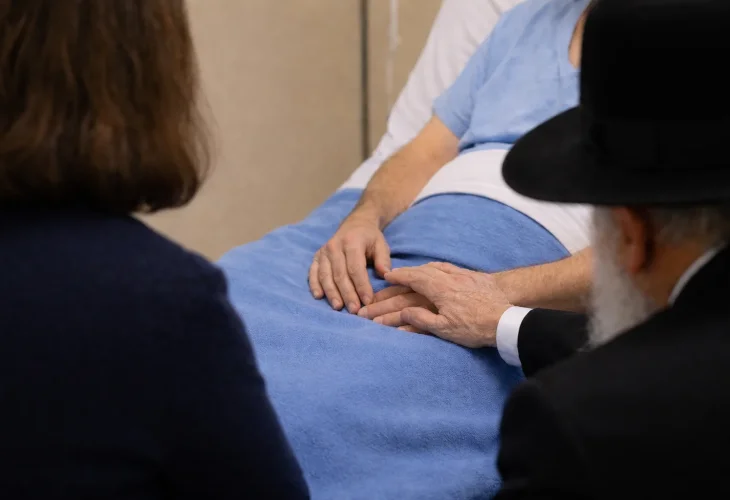
Sometimes the greatest gift is not the surgery itself, but the gratitude that follows it. This moving story reveals the quiet power of one blessing and the faith of a couple who dedicated their lives to sharing it.
Nineteen Years of Waiting
Alex, an older Jewish man, waited nineteen years for a kidney donation. When a suitable match was finally found, the transplant was performed at Ichilov Hospital.
As was their custom with every kidney donor and recipient, Rabbi Avraham Yeshayahu Heber of blessed memory and his wife, Rebbetzin Rachel Heber, came to visit.
“We planned to combine the visit to Alex with a nephew’s wedding that same day in the Tel Aviv area,” Rebbetzin Heber recounts in her regular column in the newspaper Katifa. “We left early, went up to the seventh floor, walked through the long hospital corridors, and arrived at his room.”
Alex was weak but radiant with happiness. “Rabbi Heber!” he called out excitedly when he saw her husband. The Rebbetzin spoke with his daughter, Noga, who was caring for him after the surgery, while Rabbi Heber spoke with Alex. Time passed quickly. Realizing they were running late, they stood up, said goodbye, and made their way down to the car.
The Forgotten Gift
“Only when we were seated in the car and about to drive off did I suddenly remember,” the Rebbetzin writes. “We forgot to give them the magnet with the Asher Yatzar blessing. And we never explained it to them.”
Her husband sighed and glanced at his watch. If they did not leave immediately, they would miss the wedding ceremony.
“We are not the officiating rabbi,” he said. “No one will cancel the chuppah if we are not there,” she added.
They made their decision. The Rebbetzin would go back upstairs. Even if they arrived after the chuppah, so be it. The opportunity for zikkuy harabim, giving others the chance to gain spiritual merit by teaching them a mitzvah, was standing before them, and that mattered more.
She took the blessing magnet and hurried back to Alex’s room.
“Did you forget something?” Noga asked in surprise.
“No,” the Rebbetzin replied gently. “I came to give you a gift.”
“A gift?” they both said, astonished. “We already received the gift of life, a kidney. What other gift could we need?”
“You did not receive the kidney from us,” she answered softly. “You received it from the Creator of the world. He arranged this wondrous gift for you. I came to give you the wrapping that will help protect that gift for the long term, with Hashem’s help. I have here a segulah for long life and good health.”
She sat down and calmly explained the Asher Yatzar blessing, its meaning, its intention, and its spiritual power. Alex and Noga listened politely. Still, she felt that her words were not fully entering their hearts.
She did not push. She and her husband had taken it upon themselves, without making a formal vow, to introduce people to this blessing. What others chose to do afterward was up to them.
She said goodbye and returned to the car. They missed the chuppah but made it to the wedding celebration.
The Phone Call
Wednesday and Thursday passed in their usual rush. On Friday, when the Rebbetzin returned home from work, her husband was waiting for her. He was visibly shaken.
“Alex called,” he said, his voice trembling.
Alex had told him the truth. When the Rebbetzin had explained the blessing, he had not taken it seriously. After she left, he placed the card in the drawer beside his hospital bed and forgot about it.
On Wednesday morning, the professor entered his room with a grave expression.
“You are regressing, Alex,” he said. “There are signs of rejection.”
For any transplant patient, those words are terrifying. For Alex, who had waited nineteen years for a kidney, they were unbearable. The doctor explained that a biopsy would be performed the next day and cautioned him not to expect good news.
A Decision to Say Thank You
After the doctor left, Alex turned to his daughter.
“It is because we did not commit to saying the blessing,” he told her. “The Creator of the world gave us a gift, and we did not say thank you.”
Noga agreed. In that moment, they decided that from then on they would say the Asher Yatzar blessing carefully, slowly, and with intention.
They continued with the hospital routine of blood tests and monitoring. They hoped for good news but did not expect it. What they did do was become meticulous about the blessing and focus on every word.
On Friday morning, a team of doctors entered the room, their faces lit with surprise.
“Alex, we are canceling the biopsy. Your tests are stabilizing. The kidney is functioning as it should. Tell us, what did you do? How did this happen?”
They called it a miracle.
Alex’s numbers continued to improve, and the doctors began discussing discharging him.
“I am calling you,” Alex told Rabbi Heber, “so you will know the power of the Asher Yatzar blessing. It can even save a life.”
The Power of a Simple Blessing
Rabbi Heber fell silent as he finished recounting the call. Tears streamed down his face, and down his wife’s as well.
“The Asher Yatzar blessing,” the Rebbetzin concludes, “who can truly grasp its greatness?”
She asks that the strength drawn from this powerful story serve as an elevation for the soul of her husband, Rabbi Avraham Yeshayahu, son of Rabbi Zvi.

