

Parashat Terumah
The Magical Moment Time Turns Sacred
How Shabbat transforms a hectic week into sacred stillness
- Rachel Wigman
- | Updated
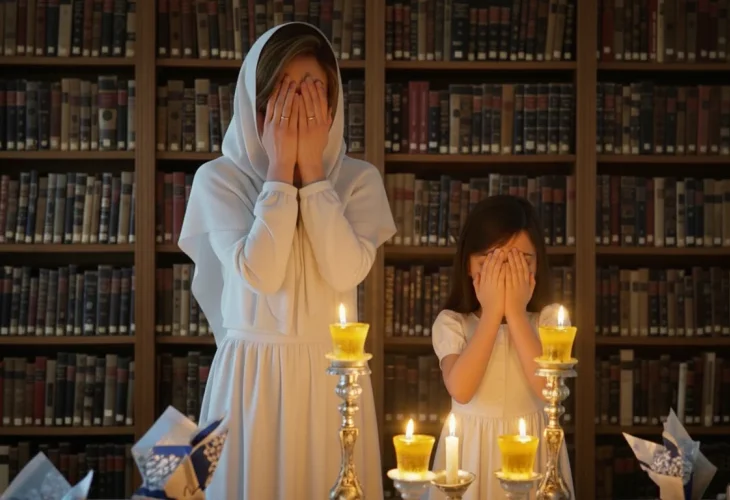
I don’t know about the rest of you, but I had a very busy week last week. Sometimes there are weeks like that—work keeping you until all hours of the day because you have hard deadlines, people visiting from overseas that you’re squeezing in every spare second possible to spend time with them, and, as always, the random little life things that pop up exactly when you have no extra time for them.
One of those things was a paper that I had to write, which was due on Saturday night. I’m in my final year of a master’s program that’s geared towards working professionals, and in theory I can balance my workload with my life-load. However, when life gets hectic, sometimes the schoolwork just waits until the last minute. I had all of the ideas contained in my head, but I absolutely could not find the time to start writing until Thursday night.
The thing is, though, that I had a hard stop on Friday. Whether or not I was finished by then, by the time the sun set on Friday, I had to have my computer put away, my books closed, and my work shelved for the next twenty-five hours. Because when the sun sets and the candles are lit and we usher in Shabbat, everything else ceases to exist.
That moment in which we shift from the mundane to the sacred is almost magical. It’s such a small moment that if you blink, you’ll miss it, because from one second to the next we’ve made that transformation. Personally, I like to take a deep breath before I light the Shabbat candles, to collect myself and focus on the spirituality of the moment, and to be completely and utterly present as I enter Shabbat while all of my worldly concerns fall away.
Now, in case you can’t tell, I absolutely love Shabbat. It grounds my week—and my life—giving me space to clear my mind and my heart and to reset to be able to face the week. There’s been a ton of research recently about how healthy it is to do this sort of cleanse, with a broader movement building in the non-Jewish world of people taking a technology sabbath. I’m lucky enough to have been born with Shabbat as my birthright, and I feel infinitely blessed for it.
One thing that’s always troubled me about the nature of Shabbat is that we derive the laws of Shabbat from the work it took for the Jewish people to build the Tabernacle. In our weekly reading of the Torah, we’re moving now into the second half of the book of Exodus, which is almost exclusively focused on that project. It’s odd that the Torah, in which every word is measured, would spend so much ink on what was, for all intents and purposes, a temporary temple, and it’s odder, still, that we derive the laws of Shabbat from there. What does one have to do with the other?
The simple answer is that the commandment for Shabbat is written in close proximity to the description of the labors involved in building the Tabernacle. I’d like to humbly suggest that there is a deeper connection: sanctity. Shabbat represents the sanctity of time; the Tabernacle, sanctity of place. Time, though, is utterly abstract. How, then, do we sanctify it? How do we transform time into something concrete that can be made holy?
That is where the Tabernacle, with its sanctity of space, comes in. We can understand space easily. It belongs to the physical realm, and in the desert camp of the Jewish people 3,000 years ago, it was the literal center around which their lives revolved. With that firm grounding of the sanctity of physical space, we can understand—and apply—that to the abstract, to then be able to sanctify time.
With that sanctity of time established, Shabbat itself becomes something of a sanctuary. There’s a Midrashic concept of Shabbat being a taste of the world to come, of course, but I don’t think we even have to go that far to understand that Shabbat gives us space to just be, with nothing else pulling at us. There’s a reason why so many people are drawn to technology cleanses, retreats, or, in some way, stepping back from the pressures of daily life to reset. I say this somewhat tongue-in-cheek, but God clearly knew what He was doing when He mandated that we rest on the seventh day.
I did finish drafting my paper before Shabbat began. As I stood in front of the candles and took a deep breath, I felt the craziness of the week, and the stress of the prior twenty-four hours, melt away. And as it ebbed, in flowed that taste of the world to come, that sanctity of time that goes hand in hand with the sanctity of space, giving me those beautiful twenty-five hours to rest, reset, and recharge for the week ahead.

