

Israel News
Israel Permits 10,000 Palestinian Crossings to Har HaBayit Each Friday During Ramadan
Government approves Friday entry from Judea and Samaria under age limits, permit screening and thousands of officers deployed in Jerusalem
- Brian Racer
- | Updated
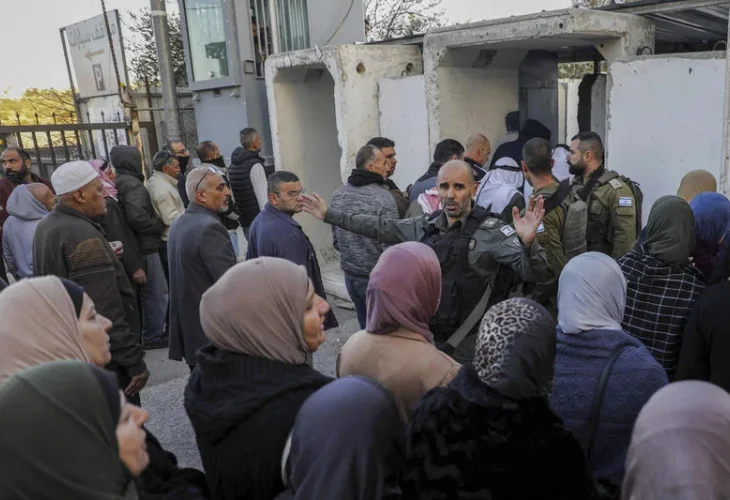 Palestinians Entering on Friday (Flash90)
Israel has approved a security-recommended framework allowing up to 10,000 Palestinian worshipers from Judea and Samaria to enter Har HaBayit (Temple Mount) for Friday prayers during the month of Ramadan. Entry is subject to prior approval and daily permits.
Under the framework, men aged 55 and older, women aged 50 and older, and children up to age 12 accompanied by a first-degree relative may receive permits, subject to advance security screening. Entry is granted through designated crossings at Qalandiya and Rachel, where permit holders are issued a monitored authorization tied to their identification. Authorities are using a magnetic card and digital validation system requiring worshipers to check out upon returning to Judea and Samaria the same day. Individuals who fail to exit as required are immediately flagged, with their details transferred to police for enforcement measures and potential sanctions.
The first Friday of Ramadan served as a test case for the arrangement. According to Israeli authorities, approximately 8,500 Palestinians crossed from Judea and Samaria under the permit system. Police estimated that roughly 45,000 worshipers were present, while figures affiliated with the Islamic Waqf placed total attendance between 70,000 and 80,000. The 10,000 cap applies only to Palestinians traveling from Judea and Samaria, as overall attendance also includes residents of eastern Jerusalem and Arab citizens of Israel.
Jerusalem Police completed operational preparations ahead of Ramadan with more than 3,000 officers deployed across the Old City, Har HaBayit and surrounding areas on Fridays. Police officials said the deployment aims to balance freedom of worship with public order amid heightened alert levels.
“There is no provocation or change to the customary status quo,” a senior police official said. “We enable freedom of worship, and we protect security and public order.” Officials added that while security alerts exist routinely, there is no concrete intelligence indicating a specific threat linked to this Ramadan.
Har HaBayit, known to Muslims as Al-Aqsa, operates under longstanding status quo arrangements in which Muslim prayer is permitted at the site, while Jewish visits are allowed during regulated hours and Jewish prayer is officially prohibited. The compound has been a focal point of tension in previous Ramadan seasons, and unrest there has escalated beyond Jerusalem in past years.
Alongside the permit framework, police confirmed adjustments to Jewish visiting hours during Ramadan. Under the standard arrangement throughout most of the year, Jewish visits are permitted Sunday through Thursday during morning hours and limited afternoon windows, and are suspended on Fridays and Muslim holidays. During Ramadan, afternoon visiting hours are typically canceled, leaving only a morning window.
This year, police moved the morning opening earlier from 7:00 a.m. to 6:30 a.m., and extended the closing time to 11:30 a.m., effectively expanding the morning visiting period while midday visits remain suspended. Police described the adjustment as an operational measure that does not alter the status quo.
National Security Minister Itamar Ben Gvir visited a police command post in Jerusalem during the first Friday prayers and met with officers deployed at the site. “We love you. You have full backing from us,” he told officers. “Whoever wants to pray, ahlan wa sahlan. But whoever comes to disturb order, we will crush him.”
Security forces remain on elevated alert as Ramadan continues, with the permit framework set to remain in effect for upcoming Fridays. Police and defense officials said preparations are ongoing to ensure that religious observances proceed without major incidents while maintaining public order in Jerusalem and Judea and Samaria.

