

Behind the News
Carlson–Huckabee Clash Exposes Growing Rift Over Israel on the American Right
Genetic ancestry claims, loyalty accusations, and conspiracy theories surfaced during Carlson’s clash with Ambassador Mike Huckabee, exposing divisions inside the Republican Party over Israel
- Brian Racer
- | Updated
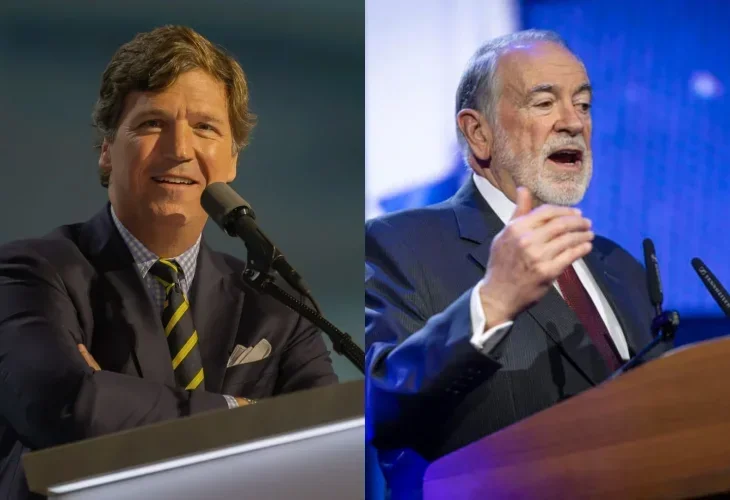 Mike Huckabee (Yonatan Sindel/Flash90), Tucker Carlson (Shutterstock)
In a nearly three-hour interview filmed at Ben Gurion Airport, Tucker Carlson shifted from foreign policy questions to Jewish ancestry, loyalty, and conspiracy claims during his conversation with U.S. Ambassador to Israel Mike Huckabee. The exchange exposed growing tensions inside the American conservative movement over Israel and, for many American Jews, raised new questions about the stability of the pro-Israel coalition that has anchored Republican support for decades.
The most explosive moment came when Carlson asked Huckabee about the Biblical passage in which God grants Abraham’s descendants land “from the Euphrates to the Nile.” Huckabee responded, “It would be fine if they took it all.”
He quickly elaborated: “They don’t want to take it over. They’re not asking to take it over.” When Carlson pressed whether such a takeover would be legitimate, Huckabee said, “I’m not sure that it would be.” He added, “If they end up getting attacked by all these places and they win that war and they take that land, then OK, that’s a whole other discussion.”
The interview escalated further when Carlson questioned the legitimacy of Jewish historical ties to the land. “Why don’t we do genetic testing on everybody in the land and find out who Abram’s descendants are?” he asked. Referring to Israeli Prime Minister Benjamin Netanyahu, Carlson added, “Bibi’s family, we know they lived in Eastern Europe. There’s no evidence they ever lived here.”
The line of questioning echoes the long-standing “Khazar” conspiracy theory, which claims that Ashkenazi Jews are not descended from the ancient Israelites but from a medieval Turkic people who converted to Judaism. The theory has been widely rejected by historians and genetic researchers and is frequently used to undermine Jewish historical ties to Israel. Huckabee later denounced that framing on social media as antisemitic.
Carlson also accused Huckabee of being more loyal to Israel than to the United States, challenging him after the ambassador praised Israel’s practice of dropping warning leaflets before airstrikes in Gaza. The confrontation intensified when Carlson claimed that Israeli President Isaac Herzog had visited Jeffrey Epstein’s private island, an allegation that Herzog categorically rejected. Carlson later apologized on X, stating the claim had been based on a reference to an unspecified “Herzog” in Epstein-related emails.
At another point, Huckabee rebuked Carlson for platforming critics of Israel. Speaking about a former U.S. Special Forces officer who alleged misconduct at Gaza humanitarian sites, Huckabee said, “Tony Aguilar is a liar. You platformed a guy. You had him on your show.” Carlson replied, “I don’t platform anyone.”
The interview did not directly mention Carlson’s previous friendly conversation with Nick Fuentes, an avowed antisemite and white nationalist. Still, that history hovered in the background. Carlson has repeatedly given airtime to voices sharply critical of U.S. support for Israel, even as other Republicans, including Sen. Ted Cruz, have warned about rising antisemitism within conservative circles. Vice President JD Vance, by contrast, has said he does not view right-wing antisemitism as a serious problem.
For many American Jews, especially those who have long relied on strong evangelical backing and a reliably pro-Israel Republican Party, the clash felt like more than political theater. For decades, support for Israel was one of the most dependable pillars of Republican politics. The Carlson–Huckabee confrontation suggests that unity can no longer be assumed and that rhetoric once considered fringe is now entering mainstream conservative debate. As antisemitic language resurfaces in prominent circles, Jewish communities are left questioning how stable those political alliances truly are.

