

Magazine
Weaving Tradition Back to Life: Yosef Gabso and the Revival of Handcrafted Tallitot
In Jerusalem and the Judean Hills, one artisan is restoring an ancient Jewish craft, intertwining spirituality, artistry, and mystical teachings in every handwoven prayer shawl.
- Ari Osher Fritzhand
- | Updated
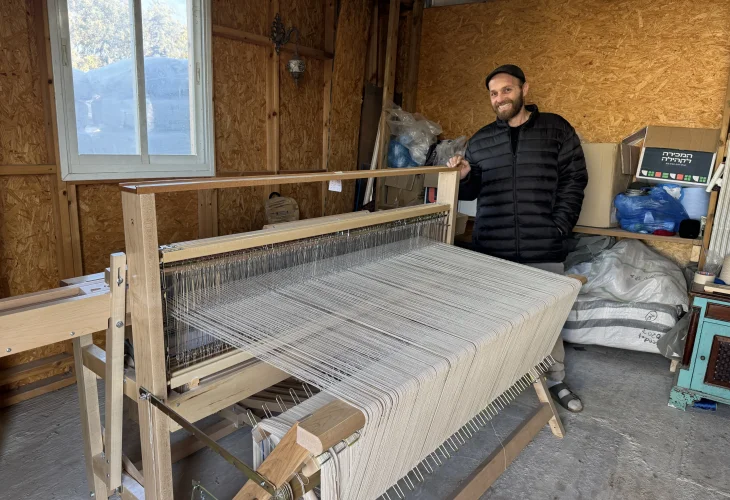
While the world experiences a technological revolution, driven by innovations like artificial intelligence, another, more authentic revolution is quietly taking place in the Judean Hills and Jerusalem’s Old City. There, artisans like Yosef Gabso are reviving ancient Israeli crafts dating back to the First and Second Temple periods.
Gabso, 44, is the founder of Weaving Creation, a studio in the Old City of Jerusalem and in Tekoa, in the Judean Hills, that produces handwoven tallitot (Jewish prayer shawls). He describes his work in an interview with Hidabroot as “woven according to the strictest interpretations of Jewish law, while intertwining mystical teachings through the ten sefirot of Kabbalah.”
His work has inspired dozens of artisans across Israel to learn the ancient techniques of tallit weaving—some under his direct tutelage—sparking what he calls a “revolution” in the art, one he is proud to be part of.
Gabso’s story begins in Bat Yam, a beach town south of Tel Aviv, where he grew up in a traditional family of Tripoli Jews. Working in his family’s restaurants from a young age, he ultimately left religion at 16, moving in with his grandmother. After a short stint in the IDF as a chef, he traveled to Australia with the idea of living and working there. After ten months, he returned briefly to Israel to settle personal matters, at his father’s request, which he honored.
Bouncing between kitchen work and international travel, Gabso found himself in London at 23, hoping to earn some money before returning home. While walking in Golders Green, he passed a store displaying tzitzit in the window. “I bought it. It’s hard to explain—something inside me pushed me to buy it and wear it under my shirt.”
A few days later, on a Friday night, a man approached him in Hebrew, inviting him to a Shabbat dinner. At first, Gabso resisted, but ultimately he joined the meal.
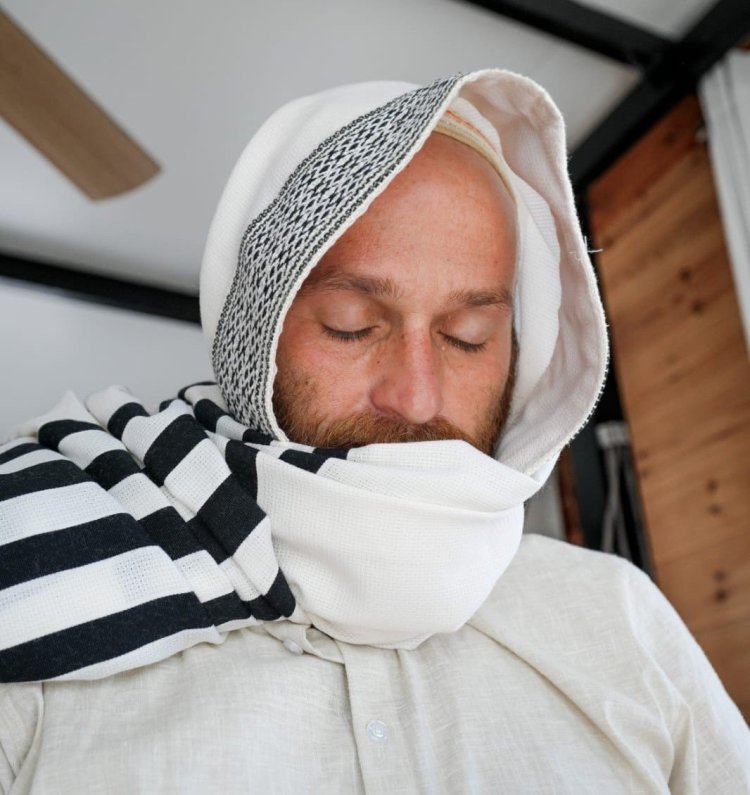 Yosef wrapping himself in a tallit he wove
“Within a few months, I was helping with everything—cooking the Shabbat meals,” he said, laughing. He developed a deep connection, which continues to this day, with the local rabbi, an Israeli living in London who hosts large Shabbat meals for Israelis visiting or living nearby.
A few months later, Gabso returned to Israel, settling in a yeshiva in Jerusalem and immersing himself fully in Jewish texts. Shortly before Passover the following year, he and friends from the yeshiva traveled to Meron in northern Israel, a pilgrimage site where the Talmudic sage Rabbi Shimon Bar Yochai is buried. During the trip, Gabso decided to stay in the area, settling in the mystical city of Tzfat and joining a yeshiva for baalei teshuva.
To support himself while studying, he began working at a café located in a tallit shop in Tzfat’s Artists’ Quarter. Naturally, he started joining the weavers between shifts, eventually apprenticing for several years and learning the ancient art of tallit weaving.
Asked what drew him to weaving, Gabso explained that artistry had always been part of him. “Cooking is an art in itself—always thinking and innovating about the final result and making sure the customer is satisfied.”“When I began to weave, everything inside me changed. I became calm and relaxed,” he said.
More than the craft itself, Gabso spoke of the spiritual significance of weaving, particularly in anticipation of the future Beit HaMikdash (Holy Temple). “That is the center for me—the hope that there will be a ‘Weaving Department’ and that I will be part of the operations there.”
“Very soon we will have many Kohanim [priests] who need their priestly clothing,” he added with a smile.
After marrying, Gabso and his wife moved to Tekoa, a picturesque town in the Judean Hills near her parents, where they live today with their five children. Though far from his work in Tzfat, Gabso was determined to continue his art, specifically aiming to open a studio in Jerusalem’s Old City.
Gabso’s work is not only about craft but about restoring a tradition in the land where it began.
“For Jews in Israel and around the world, coming to the Old City and buying a tallit is the realization of a 2,000-year dream,” he said, describing the “privilege” of bringing this mitzvah back to the heart of the Jewish world.
His studio has been in the Old City since 2009, providing countless Jews with handmade tallitot. His designs range from freestyle patterns to colors representing the Kabbalistic sefirot. “Each sefira has specific colors associated with it. More deeply, many sefirot can be attributed to our forefathers, such as Abraham and chesed, Isaac and gevurah, and Jacob and tiferet,” he explained.
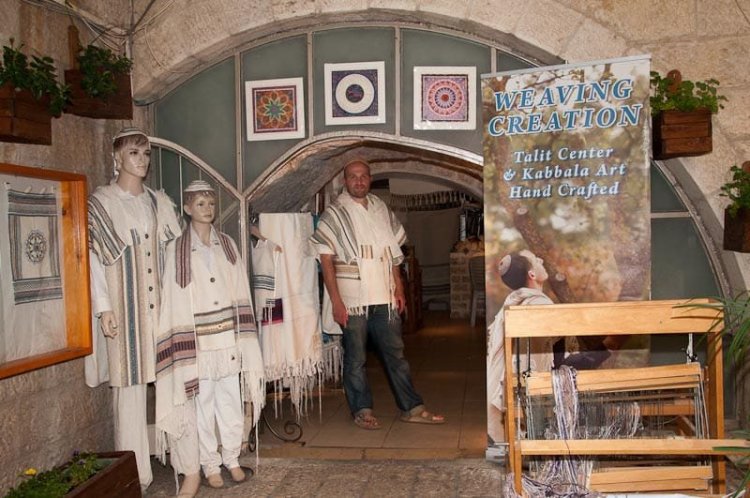 A selection of tallitot on display
For instance, Gabso weaves a “Bina” tallit, representing wisdom, in green. “Each person who purchases a specific tallit for a bar mitzvah or wedding earns a zchut [merit]—for themselves and for us—bridging the sefirot and handmade art.”He takes pride in creating “something authentic.”“I feel like I am on a shlichut [mission] to bring Jews back to the beauty of handwoven tallitot,” he said.
Today, Gabso continues to work from his Jerusalem studio and an additional studio on his wife’s therapeutic horse farm, which features a large custom-made loom. There, he teaches young artisans his ancient techniques, hoping to “allow everyone to own a handwoven tallit.”
In an age dominated by mass production and automation, Gabso’s work is a testament that the most meaningful creations are still made by hand—thread by thread, with intention.

