

Magazine
Eight Hours Under Fire in a Porta Potty: “They Shot at Everything Around Me, Even My Stall”
As gunfire raged around him at the Nova festival massacre, Barak Nixon hid for eight hours in a portable toilet and made a desperate promise to Hashem that he would never forget.
- Hidabroot
- | Updated
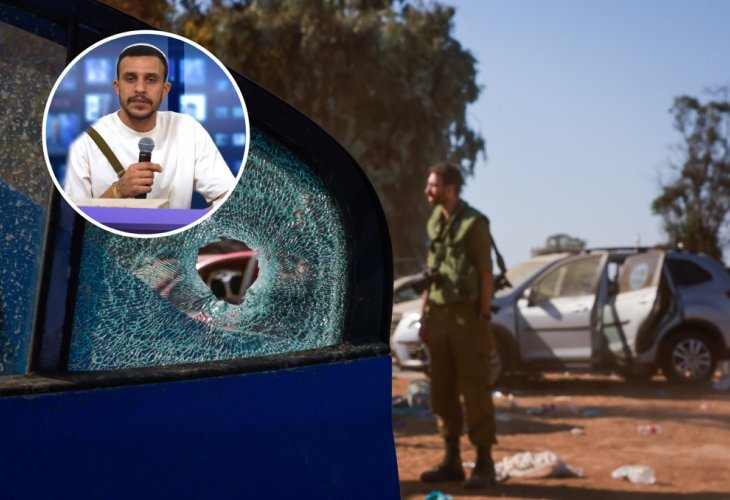
Almost two and a half years have passed since the massacre at the Nova festival in Re’im. The images, the sounds, and the fear remain etched into the hearts of those who survived.
Barak Nixon is one of them.
He had only recently begun strengthening his connection to Judaism when he found himself hiding for eight and a half hours inside a portable toilet, praying for his life and promising Hashem he would fully keep Shabbat if he made it home.
“I Decided I’m Keeping Shabbat”
“I told my parents I want to start keeping Shabbat,” Barak recalls. “I was already putting on tefillin in the morning, wearing tzitzit, and I decided that from now on I’m keeping Shabbat.”
The first Shabbat passed peacefully. The second as well.
The third Shabbat was the Shabbat of the festival in Re’im.
His friends bought tickets. His mother urged him not to go. “You’ve already started keeping Shabbat,” she reminded him.
But he chose to go.
Chaos at 6:30 in the Morning
Barak arrived at the party at 4 a.m.
At 6:30 a.m., everything changed.
“A rocket hit a woman right in front of me,” he says. “There was chaos. People started running.”
He ran toward the exit, where two girls who had come with him were waiting. Together they sprinted toward his car as gunfire erupted around them.
“People were dying before my eyes,” he says.
Just as they reached the car, an RPG struck it.
They turned and ran again. Armed terrorists on pickup trucks were firing at them. Explosions erupted nearby. Molotov cocktails and grenades were thrown. Machine gun fire tore through the air.
“Everything around us was exploding,” he says. “Except us.”
Hiding in a Portable Toilet
They changed direction and ran back toward the party grounds. With a few others, they ducked into a row of portable toilets. Barak and the two girls squeezed into a single stall.
They deliberately did not lock the door, fearing that the red indicator would signal someone was inside.
Outside, the massacre continued.
“We heard the horrors all around us,” he says.
Inside that cramped space, they began to pray.
“Father in Heaven, Please Let There Be No Grief for My Parents”
“We said Shema Yisrael,” Barak recalls. “And then we pleaded.”
“Father in Heaven, forgive me. Please let there be no grief for my parents. I promise You that from now on I will keep every Shabbat. Everything I did before, I will fix. Everything I haven’t done until now, I will do with love. Just bring me home.”
They remained in that stall for eight and a half hours.
For eight and a half hours, terrorists were murdering and committing atrocities around them.
During that time, three bullets struck their stall. One passed directly over Barak. The door never opened, even though it was not locked. Grenades detonated nearby. Gunfire surrounded them.
“Eight hours, and not a single bullet hit us,” he says. “We did nothing but pray.”
A Deadly Deception
Three times, voices outside shouted in Hebrew, “It’s the IDF! It’s the IDF!”
Barak started to rise to open the door.
One of the girls grabbed him and pulled him back. “Be careful,” she warned. “It’s not them.”
Anyone who stepped out was killed.
“They tried that trick three times,” he says.
Inside that stall, one thought filled his mind: if he survived, he would live differently.
“The only thing that mattered to me was how I could fulfill what Hashem wants from me.”
The Moment of Rescue
After eight and a half hours, he heard something different. Real military language. Tactical commands.
“I was a Golani soldier,” he explains. “I know how soldiers speak.”
He shouted from inside the stall, “IDF! IDF!”
A soldier opened the door and pulled them out.
Barak lay on the ground. In the stalls next to him were bodies.
Officers from YAMAM told him and the two girls that they were the last three Jews left alive in that section of the party area.
“They couldn’t believe anyone was still alive there,” he says.
“I Saw the Miracle With My Own Eyes”
Barak does not hesitate when describing what happened.
“I thanked the Creator for getting me out of there,” he says. “I promised Him I would do everything to make Him happy.”
Today, he keeps Shabbat. He puts on tefillin. He gives tzedakah.
“Thanks to Shabbat and the mitzvot, Hashem brought me back to my parents,” he says. “The Creator brought me home. There was a miracle with me. I saw that miracle with my own eyes. I know Hashem was with me there.”
Almost two and a half years later, the memory remains vivid. So does the promise.

