

Passover
The Passover Seder Plate Explained: Meaning, Arrangement, and Customs
Discover the symbolism behind the six foods on the Seder plate, the Arizal and Rema arrangements, and the deeper traditions that shape the Pesach Seder night in Jewish homes around the world
- Hidabroot
- | Updated
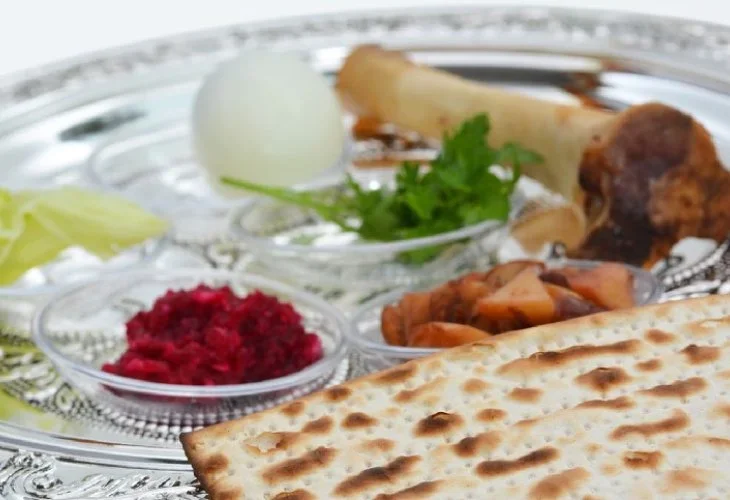 Seder plate | Passover plate | Seder night plate
The Seder plate placed on the table and used throughout the Passover Seder is not mentioned explicitly in the Mishnah or the Talmud. Its source appears in the writings of the early rabbinic authorities. Before the leader of the Seder is placed a Passover plate containing maror, charoset, karpas (or another vegetable), and two cooked foods. Six items are arranged on the Seder plate. According to the custom of the holy Arizal, they are placed in the shape of two triangular groupings: the zeroa (shank bone) on the right, the egg on the left, and the maror beneath them in the center. The charoset is placed under the zeroa, the karpas under the egg, and the chazeret under the maror.
The Seder Plate: Foods and Customs
1. Preparing the Plate
Before the Seder begins, a plate is prepared with all the special foods of the evening. Each food represents a particular idea, and arranging them together highlights the deeper meanings of the Seder night.
2. What the Plate Contains
The plate includes three matzot, maror (lettuce or horseradish), karpas, and charoset. When the Temple stood, the actual Paschal lamb was also present. After the destruction of the Temple, the sages instituted placing two cooked foods on the plate one as a reminder of the Korban Pesach and the other as a reminder of the Festival offering (Korban Chagigah).
3. The Two Cooked Foods
The custom is that the food representing the Paschal offering is a zeroa (a foreleg of an animal among Sephardim, or a chicken neck among Ashkenazim), while the reminder of the Festival offering is a cooked egg.
4. Why an Egg?
The egg symbolizes mourning, as eggs are traditionally served to mourners, reminding us that history turns in cycles and that we hope for the rebuilding of the Temple, when the offerings will be restored. Another explanation is that the Aramaic word for egg, beia, also means “request,” hinting at our prayer that God redeem us once again.
5. Not Eating the Zaroa
In most Jewish communities, it is customary not to eat the zeroa during the Seder night.
6. Types of Maror
Some people use only lettuce for maror, while others use both lettuce and horseradish. The lettuce is eaten for the mitzvah of maror, and the horseradish is used for the korech sandwich.
7. Arrangement According to the Arizal
Many Sephardic communities and some Ashkenazim arrange the plate according to the Arizal’s custom: the zeroa on the right, the egg on the left, the maror beneath them in the center, the charoset under the zeroa, the karpas under the egg, and the chazeret beneath the maror.
8. Arrangement According to the Rema
According to the Rema, the foods that are used earlier in the Seder should be placed closer to the Seder leader. Those who follow this custom place the karpas and salt water nearest, followed by the matzot, then the maror and charoset, and finally the zeroa and egg.
9. Covering the Matzot
The matzot on the plate should be covered with a cloth during Kiddush and when the second cup of wine is raised, and uncovered at other times. Those who follow the Arizal also separate the three matzot with a cloth between each one.
It is not necessary for every participant to have a personal Seder plate, even for married children attending the Seder at their parents’ home. Some families place three matzot before each head of household, but the Seder plate itself is generally set only before the leader of the Seder.

