

Passover
VeHi She’amda Explained: The Song of Faith, Survival, and Jewish Unity at the Seder
Discover the deeper meaning behind one of the most powerful moments of the Passover Haggadah and a timeless message of hope, resilience, and Divine protection throughout Jewish history
- Yosef Yaavetz
- | Updated
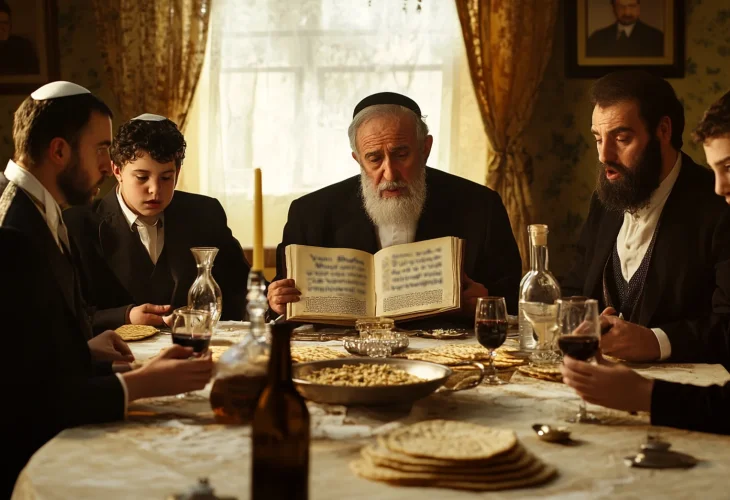
One of the most moving moments of the Seder night is the shared singing of “VeHi She’amda,” when the family sits around the table and sings together. This song is not merely another section of the Haggadah. It is a living symbol of God’s promise to Abraham that his descendants would continue to exist and hold onto their faith throughout all generations, until the final redemption.
In many traditional Haggadah illustrations, one often finds an image that captures this promise: a single Jew standing firm, surrounded by figures representing the enemies of the Jewish people throughout history, including Pharaoh, Nevuchadnezzar, and Greek and Roman soldiers. While those mighty empires disappeared, that Jew remains standing, strong and unbroken. The world constantly changes, civilizations rise and fall, yet the children of Avraham continue to carry the torch of faith from generation to generation.
The Power Behind the Melody
What gives this song its unique power? Why has it comforted generations of Jews who faced persecution whether the Inquisition, cruel rulers, or even the Nazis? Somehow, when they sang “VeHi She’amda,” even in moments that seemed hopeless, they felt that victory was already within reach.
Throughout life, every person encounters difficulties and obstacles. A person of faith believes that these challenges come from God, yet often struggles to understand Divine guidance. It is not always easy to see hardships as “challenges” rather than “punishments.” This is one of the central tests of faith: God’s presence is not always obvious, and at times a person may feel abandoned. “If God were watching over me, why would these things happen?”
Yet through “VeHi She’amda,” a person can recognize how God guides history and watches over Israel. From a purely historical perspective, it is difficult to explain how great empires that ruled for centuries disappeared, while the Jewish people continue to exist.
A Song That Speaks to Every Generation
For generations, on Passover night, Jews gathered around their Seder tables, lifted their eyes upward, and sang with devotion:
“Not only one has risen against us to destroy us, but in every generation they rise against us, and the Holy One, blessed be He, saves us from their hands.”
These words are not merely a historical description of the past, but they reflect a spiritual pattern that reveals God’s guidance in the world both for the Jewish people as a whole and for each individual. Every generation and every person faces their own challenges, whether physical threats or personal struggles. Just as those who sought to destroy Israel eventually vanished, so too will the forces behind our personal trials fade, while those who endure will remain.
This idea is hinted at in the verse: “And I will surely hide My face on that day… and this song shall answer before them as a witness, for it will not be forgotten from the mouths of their descendants” (Devarim 31:17–21).
God tells Moshe that there will be times when Israel feels abandoned, yet as long as they hold onto the “song” their Torah and Jewish identity it will remain testimony to Divine guidance. Through it, they will always be able to recognize God’s presence.
More Than Memory A Source of Strength
“VeHi She’amda” is not only a reflection on the past. It is a source of comfort and hope for the present and the future. In challenging times, when Jewish identity faces pressure from many directions, this song reminds us that we are part of a long chain that began with our ancestors and leads toward complete redemption.
Every time we sing these words at the Seder, we strengthen ourselves. We draw power from our history, from the faith passed down through generations, and from the certainty that just as we endured every trial in the past, we will also face the challenges of today with confidence in God’s promise.

