

Passover
Passing the Torch at the Seder: Raising the Next Link in the Chain
Why is Seder night built around children? Discover the powerful secret that turns your table into a living link in the chain of Jewish faith.
- Dekel Yosfasberg
- | Updated
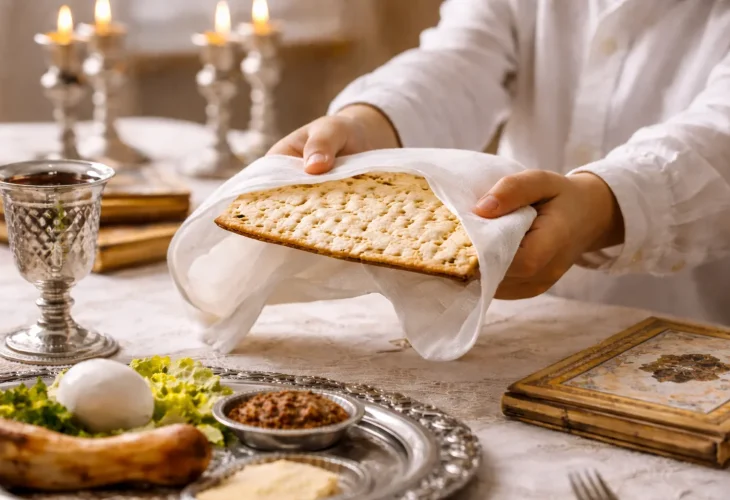
“And you shall tell your child on that day…” (Exodus 13:8).
Why is Seder night centered around children? What is the educational message woven through every step of the evening? And how can we pass that message on in a real and lasting way?
Passover is not just about remembering the Exodus from Egypt. It is about transmitting faith, identity, and responsibility to the next generation.
Passing the Torch of Faith
The positive commandment to recount the Exodus from Egypt applies to every Jew, even if one is alone at the table. But its essence, as explained in Yesod VeShoresh HaAvodah, is to tell it to one’s children and household, to publicize the greatness of Hashem’s miracles and His might.
Our central mission on Seder night is to pass the torch of faith to our children.
Sefer HaChinuch explains that recounting the Exodus is a foundational pillar of Torah and faith. The miracles in Egypt demonstrate that the world was created, that there is a living and eternal God who guides history, and that He can alter nature at will. The Exodus silences denial and strengthens belief.
For over three thousand years, Jewish parents have sat at the Seder table and told their children about leaving Egypt and receiving the Torah at Mount Sinai. The continuity of this night, generation after generation, is itself powerful testimony.
Seder night is the handoff point in the great relay of Jewish history. We received the tradition from our parents, who received it from theirs, all the way back to the Exodus. Now it is our turn to pass it forward.
Without saying a word, we are telling our children: Join us. You are part of something eternal. One day you will carry this forward. You will build a Jewish home, raise believing children, and continue the chain.
That is the root of Pesach and the foundation of Jewish education.
Trust Is the First Message
How do we pass a torch? There must be one who gives and one who receives.
The parent gives. The child receives.
But for the relay to succeed, the child must want to receive and feel capable of carrying it forward.
The first message woven through the entire Seder is trust.
When we invite a child to participate, we are saying: You matter. You are a vital link in the chain of Israel. We believe in you.
Expectation means looking ahead with confidence. When we entrust something precious to someone, it means we believe they are worthy of it. On this night, we give our children the most precious deposit of all: faith.
Just as Hashem believed in us, took us out of Egypt, and entrusted us with His Torah, we must believe in our children, even when their strengths are not yet visible. Trust is the foundation of education and the basis of the parent child bond.
Seder night expresses that trust in practical ways.
The child opens the evening with questions. No one replaces them. Only if there are no children do the adults ask.
In many communities, the Haggadah is read aloud in turns. Even young children are given a meaningful share in fulfilling the mitzvah of telling the Exodus. The message is clear: You are capable. You have a place here.
Later, the child takes the afikoman and hides it. Without its return, the Seder cannot be completed. This is not random. The afikoman represents future redemption. Placing it in the child’s hands symbolizes that the future rests with them.
The Power of Questions
The Torah gives us a profound educational principle:
“And it shall be when your child asks you… you shall say to him…” (Exodus 13:14).
Wait.
Do not rush to lecture. Do not force the message. Wait for the question.
The entire Seder is structured around questions. The Four Questions begin the Haggadah. Matzah is called lechem oni, bread over which we answer questions.
Why are questions so important?
A question reveals curiosity and readiness. When a child asks, they take ownership of their learning. The answer now matters to them.
When there is no question, even wise words may not penetrate. But when a child is hungry to know, they open themselves to receive.
To awaken that curiosity, the Seder includes unusual actions. We recline. We wash hands at unexpected times. We dip vegetables. We break and hide the middle matzah. We eat maror. We spill drops of wine for the plagues. We open the door for Eliyahu. We act out leaving Egypt.
All of this is designed to spark wonder.
When the investigation becomes the child’s own, the story will not pass over them. It will enter their heart.
The Education Begins With Me
There is another essential truth.
The verse continues: “It is because of this that Hashem did for me when I went out of Egypt.”
The mitzvah of recounting the Exodus is not only for the child. It is first for me.
Even if a person conducts the Seder alone, they must tell themselves about the Exodus. The primary goal is self change.
“In every generation, a person must see himself as if he personally left Egypt.”
If we truly engage in that inner work, strengthening our own faith and leaving our own narrow places, our children will sense it. Authentic growth cannot be faked. When we change, education happens naturally.
Real chinuch is not about controlling or pressuring children. It is about living the message ourselves.
On Seder night, we call our children to join the path of our ancestors. We trust them. We wait for their questions. We model personal growth. Through this, we build in them a sense of belonging, commitment, and responsibility to Hashem and to the Jewish people.
May we merit to strengthen our faith and our trust in ourselves and in our children.
Dikla Yosefsberg is a parent coach and counselor in the Shefer approach.

