

Israel News
Israel Takes Historic Water Innovations to Somaliland
First official delegation arrives after recognition as drought-stricken Somaliland seeks agricultural and climate resilience expertise
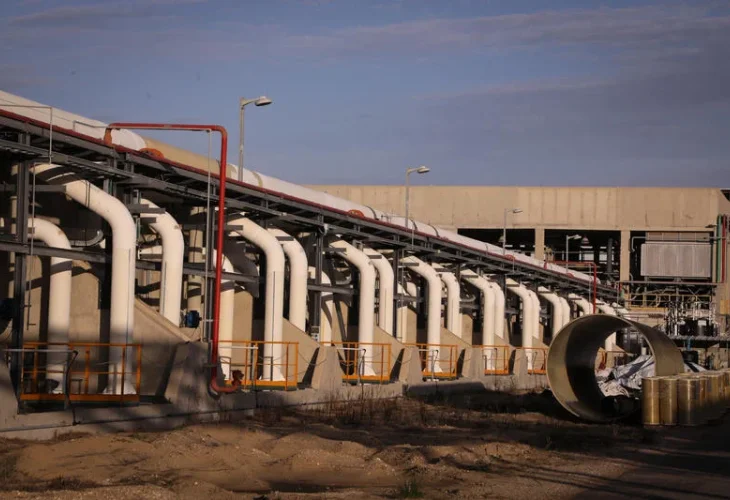 Sorek Desalination Plant (Isaac Harari/Flash90)
Months after becoming the first country to recognize Somaliland as an independent state, Israel, which has built a global reputation for turning water scarcity into innovation, welcomed the first official Somaliland delegation on Monday to study its water and agricultural technologies.
Over decades, Israel developed large-scale desalination, wastewater recycling and irrigation systems that reshaped its own water reality. Today, Israel recycles the vast majority of its wastewater and relies heavily on desalination for drinking supply, making it a global leader in water reuse. That model is now being positioned as the foundation of cooperation with Somaliland.
The visit marks the first official engagement since Israel’s December recognition of Somaliland. With this week’s delegation, cooperation has shifted from political acknowledgment to practical collaboration in water and agriculture.
The delegation, led by Somaliland Water Ministry Director General Aden Abdullah Abdullah and Chief Engineer Omar Ahmed Ibrahim, toured the National Center for Water Education and Innovation at the Shafdan wastewater treatment complex in Rishon LeZion. The facility treats approximately 145 million cubic meters of wastewater annually and serves as a hub for advanced laboratories, training programs and climate-resilience research. It represents the model Israel is now offering to a country struggling with structural water scarcity.
For Somaliland, home to about 6.2 million people in the Horn of Africa, water management affects agriculture, food security and economic stability. Only about 28 percent of rural households have access to improved water sources, and there are no perennial rivers. Agriculture accounts for roughly 15 percent of GDP, but only about 3 percent of land is currently used for farming, and around 90 percent of farmers depend entirely on rainfall. The World Food Programme estimates that 4.4 million people across Somalia, including Somaliland, face severe food insecurity linked to prolonged drought.
The human toll is visible in rural communities. “We are desperate,” said farmer Faisal Omar Salah to Makor Rishon, whose children survive largely on milk from his cattle after months without rain. In the nearby countryside, Mohamed Ismail, who lost more than half of his fruit trees to drought in recent years, summed up the stakes: “If there is no water, there is no life.”
The visit is intended to familiarize Somaliland decision-makers with planning, operation and treatment systems developed in Israel to manage water shortages under climate stress. A first group of 25 Somaliland water-sector professionals is expected to undergo training in Israel, while Israeli experts are anticipated to travel to Somaliland to assist with installing brackish water desalination systems, monitoring technologies and tools to reduce municipal water loss.
Beyond water, broader cooperation is under discussion. Somaliland’s president has said his country is prepared to pursue trade ties, offering sectors such as meat, fish and minerals as a starting point for partnership. For now, however, water is at the center of the relationship.
Questions & Answers
+Why did Somaliland send an official delegation to Israel?
+What is Israel offering Somaliland in this partnership?
+What does this visit mean for Israel-Somaliland relations?

