

World News
China’s State Media Permits ‘Jews Control America’ Narratives to Spread
JPPI report links rise of anti-Jewish conspiracy rhetoric to Beijing’s rivalry with Washington, warning of consequences for Jews worldwide
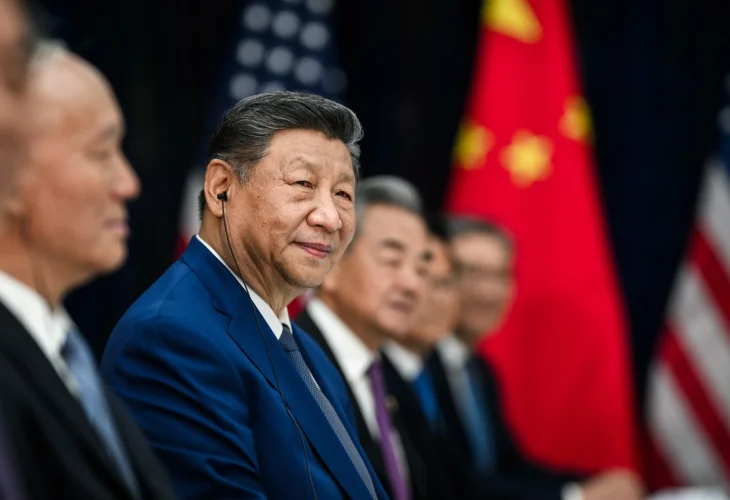 Xi Jinpin (Shutterstock)
A new report by the Jewish People Policy Institute (JPPI) finds that China is allowing classical anti-Jewish conspiracy narratives to circulate as tensions with the United States intensify, framing Jews as a source of American power. The study concludes that recent antisemitic waves were “authorized, if not initiated” within China’s tightly controlled media ecosystem.
The report documents how, following the Gaza conflicts of 2021 and 2023–25, “antisemitic waves washed over China’s social and official media,” moving beyond fringe online spaces into state-aligned outlets, academia, and public discourse. In a country where political speech is tightly controlled, such narratives spread only with government approval.
At the heart of the shift is China’s growing rivalry with the United States. The report says criticism of Washington has increasingly morphed into rhetoric aimed at Jews, driven by the belief that Jews hold significant sway over American politics and finance. One senior Chinese official is quoted in the study as saying, “We use the Jews as a stick to beat the Americans,” suggesting that anti-Jewish narratives are being used as part of the broader power struggle.
The report cites statements from government-affiliated figures claiming that “the foundation for political survival in the U.S. is parasitically attached to Israel’s powerful Jewish forces.” Such language echoes old conspiracy claims that cast Jews as secretly controlling global power. Similar themes have surfaced in comparisons between Israel and Nazi Germany and in accusations that Jews as a whole are responsible for Israeli policy.
A major concern in the report is the growing tendency in Chinese discourse to blur the lines between Israel, Jews, and Judaism. While criticism of Israeli policy is not inherently antisemitic, the report argues that in many cases distinctions have blurred, with Israel’s actions presented as evidence of alleged Jewish global influence. This pattern intensified after October 7 and Israel’s subsequent military campaign in Gaza.
The study links these developments to Beijing’s closer alignment with Iran and other Muslim-majority states as part of its broader geopolitical positioning. As China seeks greater influence across the “Global South,” distancing itself from Israel has become a relatively low-cost strategic move. Anti-Israel rhetoric, and at times antisemitic language, has accompanied that shift.
The report warns of longer-term consequences. Chinese universities are described as “influential incubators,” where anti-Israel positions sometimes cross into explicit antisemitism, shaping the perspectives of future policymakers. Given China’s size of one-fifth of humanity and its growing influence over global media and digital platforms, the normalization of such narratives could resonate far beyond its borders.
“China joins a global movement,” the report states, describing antisemitism as a worldwide phenomenon that spreads quickly through digital media and political rhetoric. When a major world power allows conspiracy narratives about Jewish influence to circulate, JPPI warns, it can reinforce similar themes already gaining traction elsewhere.
At the same time, the institute stops short of calling for a break in relations between Jerusalem and Beijing. Instead, it urges Israel to maintain diplomatic ties while drawing clear lines against antisemitic rhetoric, noting that “the diplomatic consequences are practical and immediate.” The report calls for closer monitoring of Chinese media and universities, and for coordination with Jewish communities and allied governments to push back against antisemitic narratives.
For decades, China was widely seen as a civilization largely untouched by a deep-rooted tradition of antisemitism, and at times even admiring of Jewish history and achievement. The JPPI study suggests that this image is now changing, not because of a longstanding domestic tradition of Jew-hatred, but because Jews and Israel have become useful tools in its global power politics.
The report’s warning is simple. If China finds value in antisemitic narratives, those ideas may not remain confined within its borders. As global tensions rise, that could shape both Israel’s diplomacy and the climate facing Jewish communities worldwide.
Questions & Answers
+How many Jews live in China today?
+Has China historically been antisemitic?
+Does China tightly control its media and online speech?

